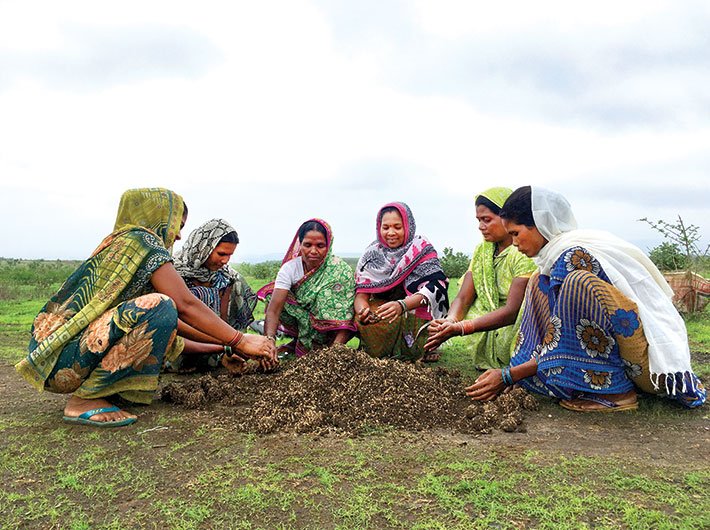
The true measure of India's millet revolution will be whether women and tribal communities who have cultivated these grains for generations experience meaningful improvements in their incomes, livelihoods and economic agency
The story of millets is nothing short of extraordinary. Once seen as the food of the poor and downtrodden, they are now seen as the food of the health conscious and the elite. Today, these nutri-cereals occupy prominent shelves in premium supermarkets, feature on the menus of gourmet restaurants, and are enthusiastically endorsed by nutritionists, fitness experts, and celebrities alike. Their rise from a neglected staple to a celebrated superfood is one of the most striking shifts in India's food landscape.
Yet, beneath this success story lie some uncomfortable questions. Has the growing popularity of millets translated into better livelihoods for those who have cultivated them for generations? Have the farmers, particularly women and tribal communities who form the backbone of millet cultivation, been able to share in the economic gains of this newfound 'superfood' status? Or has the value created by the millet boom largely accrued elsewhere along the value chain?
Millets require far less water than India's staple crops, wheat and rice. They are climate-resilient, drought-tolerant and well suited to rain-fed agriculture. In an era of climate uncertainty, they are increasingly viewed as a safer crop. Combined with their nutritional advantages, this has brought millets to the centre of both public policy and consumer interest. Initiatives such as the Sub-Mission on Nutri-Cereals under the National Food Security Mission, together with India's leadership during the International Year of Millets 2023, have further boosted their production, promotion and consumption.
However, increasing production alone is not sufficient. The larger challenge is ensuring that the economic gains from the expanding millet market reach the cultivators themselves, particularly those in rain-fed and tribal regions.
The Millet Farmers: Are They Sharing The Gains?
Historically, millet cultivation has been concentrated among small and marginal farmers, particularly those living in India's rain-fed and tribal regions. These communities have preserved millet cultivation for generations, long before it became fashionable among urban consumers. Data from the Periodic Labour Force Survey (PLFS) also reveal another overlooked reality: women constitute 54.6% of the agricultural labour engaged in millet cultivation, compared with 45.4% for men. India's millet revolution is therefore being sustained by a workforce in which women play an even larger role than men.
According to the NSS 77th Round Situation Assessment Survey of Agricultural Households, the social composition of millet farmers varies sharply across states. In Odisha, more than 82% of millet farmers belong to Scheduled Tribe communities, compared with around 12% in Karnataka. This highlights that improvements in millet markets have direct implications for tribal livelihoods in states where millet cultivation remains concentrated among vulnerable communities.
The Gender Divide
This greater participation of women in the labour force of millet cultivation, however, has not translated into their increased incomes. While the average income of a male millet farmer is about ₹8,377, that of his female counterpart is only ₹5,459, i.e., women earn about 35% less than men. Despite accounting for the majority of the workforce, women continue to receive substantially lower earnings than men. The millet economy therefore mirrors a broader pattern within Indian agriculture where women's labour is indispensable but remains undervalued.
The State Story
Women's participation in millet cultivation also varies considerably across states. Odisha, Telangana, Maharashtra, Madhya Pradesh, Karnataka and Tamil Nadu record relatively high female participation, while Punjab, Haryana, Uttar Pradesh and Rajasthan report much lower levels. These regional differences suggest that a one-size-fits-all policy approach is unlikely to succeed. For instance, although both Odisha and Karnataka have actively promoted millet cultivation through state missions, farmers' access to markets differs significantly. Such differences ultimately determine whether growing consumer demand translates into better farm incomes.
Why Does This Gap Exist?
The answer lies in deep-rooted structural inequalities within agriculture. Women's labour is often treated as unpaid family labour rather than recognised as productive work. Land titles are rarely in their names, limiting their access to institutional credit and government schemes. Men usually handle the sale of produce and interact with markets, while women remain excluded from both price negotiations and household decision-making. Although women contribute significantly to millet cultivation, much of their labour remains economically invisible.
What about Tribal Communities?
Millet cultivation in India is concentrated in rain-fed and tribal regions where livelihoods are already vulnerable to climate shocks. Rising demand for these climate-resilient grains therefore presents an important opportunity to improve incomes in these areas. Yet the experience of Odisha illustrates that higher demand alone is not enough. Despite strong policy support for millets, nearly 92% of millet farmers continue to sell through local markets. By contrast, farmers in Karnataka have access to a wider range of marketing channels, including Agricultural Produce Market Committee (APMCs), government procurement agencies and private processors. Unless farmers are connected to better markets, much of the value created by the millet boom is likely to bypass them.
Profitability figures reinforce this concern. Despite the growing popularity of millets, returns from cultivation remain modest. Data from the Commission for Agricultural Costs and Prices show that returns over comprehensive cultivation costs for Ragi were negative in both Odisha and Karnataka during 2022–23, suggesting that rising consumer demand has not automatically translated into higher returns for cultivators.
The Missing Link in the Millet Value Chain
Today's urban consumers increasingly buy millets as branded, neatly packaged products displayed prominently on supermarket shelves. Yet limited market access weakens farmers' bargaining power. Even as millet products move into premium retail outlets and organised food chains, many cultivators remain dependent on local buyers, making it difficult for them to capture the value added further along the supply chain. Brands capture a premium. Processors capture a premium. Retailers capture a premium. But do farmers?
Way Forward
India's millet revolution has demonstrated that agriculture can simultaneously advance nutritional security and climate resilience. The next challenge is to ensure that it also promotes equity. This requires strengthening procurement, expanding marketing channels, improving farmers' awareness of support mechanisms and ensuring greater participation of women and tribal cultivators in higher-value segments of the millet value chain.
The true measure of India's millet revolution will not be the growing number of millet products on supermarket shelves. It will be whether the women and tribal communities who have cultivated these grains for generations experience meaningful improvements in their incomes, livelihoods and economic agency. Only then will the millet revolution be as inclusive as it is climate-resilient.
Dr. Akash Kumar Baikar is Assistant Professor of Economics at Manav Rachna International Institute of Research and Studies, Faridabad, Haryana.
Dr. Vaishnavi Sharma is an economist and Visiting Faculty at Welingkar Institute of Management Development and Research (WeSchool), Mumbai.