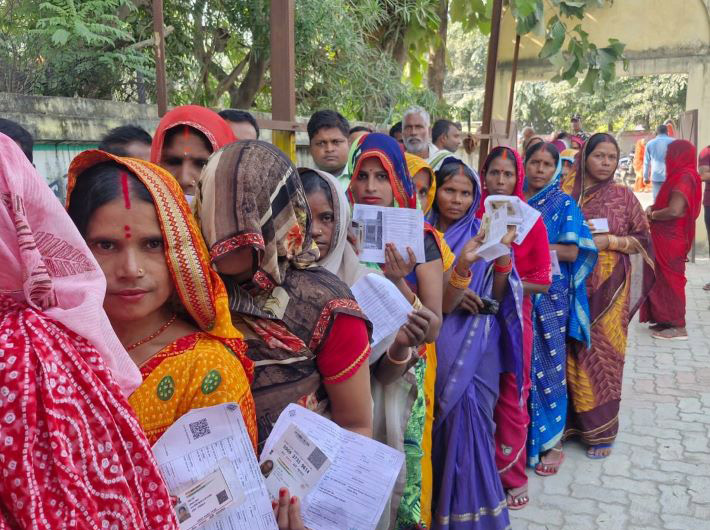
The Supreme Court’s remark reveals the enormous scale of productive activity that remains invisible in standard economic metrics
The Supreme Court recently described homemakers as “nation builders” and fixed a notional monthly income of Rs 30,000 for them in motor accident compensation cases. The judgment was not about wages. It was about compensation. Yet it inadvertently raised a larger economic question: If a homemaker's labour has enough value to merit compensation, why does it disappear almost entirely from India's labour statistics?
The answer reveals a striking paradox. According to the unit level estimates from the Periodic Labour Force Survey (PLFS) 2025, India has 162.6 million working-age (15-59 years) women whose principal activity is attending to domestic duties. That number is almost identical to the country's entire female labour force, which stands at 167.8 million for the same age bracket.
Their recognition is long overdue
The conventional labour market framework divides people into those who participate in economic activity and those who do not. According to PLFS estimates, India has around 385.8 million women aged between 15 and 59 years. Of these, 167.8 million are in the labour force. Another 218 million are classified as being outside it.
The striking finding is that nearly 162.6 million of these women report domestic duties as their principal activity. In other words, almost 75% of working-age women outside the labour force are not idle. They are engaged in household production, caregiving, cooking, cleaning, child-rearing, elderly care and the daily management of family welfare.
This distinction matters because labour statistics often shape policy priorities. When women are classified as “not in the labour force”, the implicit assumption is frequently one of economic inactivity. Yet the reality is different. These women perform tasks that sustain households, reproduce labour power and reduce the need for market expenditure on care services. Their work may not pass through markets, but it remains essential to economic functioning.
Economists have long recognised this problem. The System of National Accounts deliberately excludes most unpaid household services because they are produced and consumed within the same household. This convention improves comparability across countries. However, it also creates a statistical blind spot. Activities that would be counted as productive if purchased in the market disappear from economic measurement when performed within the household.
The consequences extend beyond statistics
India’s female labour force participation rate remains among the most debated development indicators. Policy discussions typically focus on barriers to paid employment. These include safety concerns, social norms, inadequate childcare, skill mismatches and labour market conditions. All of these factors matter. But an equally important constraint is the sheer volume of unpaid care work that women perform.
Time-use surveys consistently show that Indian women spend substantially more time on unpaid domestic and caregiving activities than men. This creates what economists describe as a “time poverty” trap. Hours devoted to household responsibilities reduce the time available for education, skill acquisition, paid employment or entrepreneurship. Labour force participation, therefore, cannot be understood independently of care responsibilities.
The Supreme Court’s observation provides an opportunity to rethink this relationship. Consider a simple illustration: If the court’s notional income of Rs 30,000 per month were applied to the estimated 162.6 million working-age female homemakers, the implied annual value would exceed Rs 58 lakh crore. This figure should not be interpreted as a contribution to GDP. The court’s valuation was designed for compensation purposes, not national accounting. Yet the exercise serves a useful purpose. It reveals the enormous scale of productive activity that remains invisible in standard economic metrics.
The policy road ahead
Recognition alone, however, is insufficient. The policy challenge is not necessarily to monetise household work through wages. Such proposals raise difficult fiscal and conceptual questions. Instead, the objective should be to reduce the penalties associated with performing unpaid care work. This requires investment in public childcare, eldercare services and care infrastructure. It requires better access to labour-saving technologies, reliable water supply and clean energy. It requires designing social protection systems that acknowledge interrupted work histories caused by caregiving responsibilities. Most importantly, it requires moving beyond a limited understanding of work that values only market transactions.
India’s demographic dividend debate often centres on the productive potential of its workforce. Yet a substantial share of that workforce remains statistically invisible. The economy benefits from their labour every day, even if labour force surveys do not classify them as workers. The Supreme Court has recognised homemakers as nation builders. The data suggest that they are something more. They constitute one of the largest workforces in the country. The question is whether public policy is prepared to recognise that reality as well.
Tarun Kumar is a Public Policy researcher associated with the School of Public Policy and Governance, TISS Hyderabad, whose work focuses on labour market inequalities, gender, unpaid care work, and social protection policies in India.