According to the “lesser of two evils” principle, whenever we have to choose among two evils, we should go for the lesser one. Flawed election systems provide voters such a limited choice that they are forced to vote for the “lesser evil.” This is the situation we are facing these days while choosing our representatives. Noam Chomsky, the most famous advocate of “the lesser evil”, argues that the most immediate moral imperative is to prevent the worst possible electoral outcome from occurring [https://chomsky.info/an-eight-point-brief-for-lev-lesser-evil-voting/].
Many times, voters find no right or clean candidate to vote for. In that case, while exercising their right to vote, they have to cast their votes either for NOTA (None of the Above) or the least undeserving/least unacceptable candidate (the all too familiar “lesser evil”). Voters feel helpless as most of the political parties field candidates with criminal background and options to elect honest candidates are closed. Best they can do is to vote for the lesser evil.
The Election Commission of India (ECI) has already clarified that even though votes cast as NOTA are counted, they are considered invalid votes. They are not taken into account for calculating the total valid votes and so they will not change the outcome [more here]. If NOTA votes polled are higher than the leading candidate, the latter still prevails. On other hand, if people don’t vote, chances of a greater evil coming to power increases and their aspirations won’t be reflected in governance. In this way, this provision does not have a substantial impact on cleaning up the electoral process.
Knowing the fact that NOTA does not hold any electoral value, many voters end up casting their vote in favour of the least undeserving candidate, lest their vote should go to waste. Similarly, if the voter believes that the most preferred candidate cannot win, the voter may be tempted to vote for the most favoured viable candidate, as a necessary evil or the lesser of the evils. However, in both conditions, their vote is blended in with millions of others. There is no way to register their dissatisfaction with the choices the political parties have given them. There is no way to separate those who voted for the lesser of the evils, from those who voted because they actually liked the candidate. If voters, who are regularly unhappy with the viable candidates, vote for the lesser evil, election after election, their votes will be taken for granted by the political parties.
There is a need to allow voters full expressivity, and the ECI should provide an appropriate mechanism in the electronic voting machine (EVM) for the effective exercise of such a right. The supreme court, while directing the ECI to introduce a “None of the Above” button in EVMs, also stated, “Democracy is all about choice. This choice can be better expressed by giving the voters an opportunity to verbalize themselves, unreservedly, and by imposing least restrictions on their ability to make such a choice.” [see here]
The right to express and form opinions is an essential feature of a democracy, and liberty to express opinions without any obstacle plays a significant role in the development of the society. Our judiciary has always placed a broad interpretation on the value and content of Article 19(1)(a), making it subjective only to the restrictions permissible under Article 19(2). Article 19 of the Universal Declaration of Human Rights states that everyone has the right to freedom of opinion and expression; this right includes freedom to hold opinions without interference and to seek, receive and impart information and ideas through any media and regardless of frontiers [more here].Voting is inherently an act of self-expression. Free and fair elections guarantee the growth of a healthy democracy in the state. The voters’ participation in the election is none other than their participation in democracy itself. Change doesn’t come from the top; it always comes from the masses of people expressing their opinion through their vote over time.
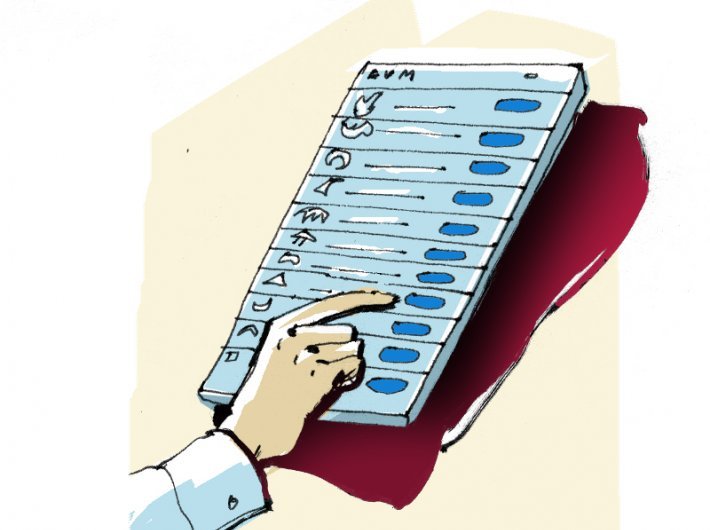
The ECI should provide an extra red button in the balloting unit of EVM, along with the blue button, against the names of all the contesting candidates. The voter can record his/her vote for the candidate as the “least undeserving candidate”, by pressing the red button, next to the candidate’s name.
Alternatively, the ECI could provide a separate panel, printed with “LEAST UNDESERVING CANDIDATE”, on the ballot paper below NOTA. This ballot paper shall be affixed on the ballot unit of the EVM. The voter could then record his/her vote for the candidate, as the “least undeserving candidate”, by pressing the button next to the "LEAST UNDESERVING CANDIDATE" option; within seven seconds of pressing the button next to the candidate he/she considers as the least undeserving.
“LEAST UNDESERVING CANDIDATE” votes should be counted and indicated in the final result chart. The value of the vote given to “LEAST UNDESERVING CANDIDATE” should be the same, like that of the value of the general vote. Total votes received by the candidate will be the sum of general votes and “LEAST UNDESERVING CANDIDATE” votes.
The “LEAST UNDESERVING CANDIDATE” option will ensure maximum participation of the public in the election. People not satisfied with the candidates will have a reason to go to the election booth and register their dissatisfaction. And looking at the figures of “LEAST UNDESERVING CANDIDATE”, political parties and candidates will be able to understand where they stand in the eyes of the public.
Our vote is generally interpreted by the candidates we select as an endorsement of all their views. Our vote contributes to the false sense of the candidate that he/she has won a “mandate from the people”. The “Least Undeserving Candidate” ballot option will send out a signal to the political parties and candidates what voters exactly think about them.
Dr. Bajad is an independent researcher on good governance and public policy based in Mumbai.