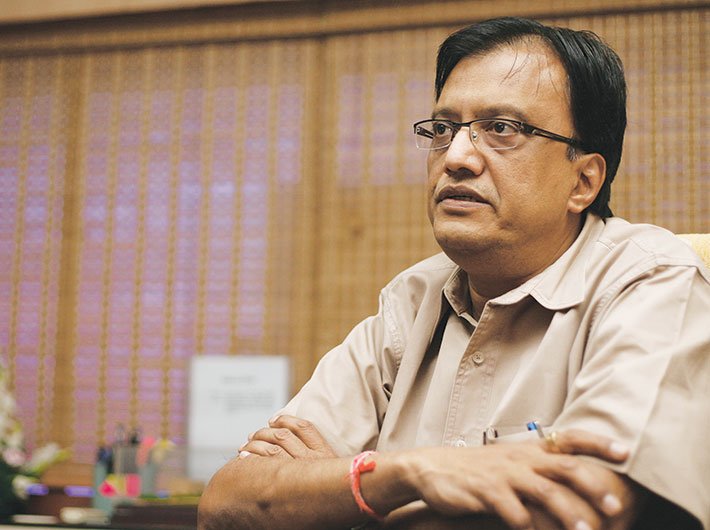
An eminent academician and administrator, Dr SS Mantha has been at the forefront of bringing in radical changes at the All India Council for Technical Education (AICTE). In an interaction with Pragya Gupta, he tells how India can improve its gross enrolment ratio and the crucial role technology plays in helping the AICTE tackle corruption and lack of transparency. Excerpts:
What was the rationale behind the AICTE’s decision to allow new engineering colleges even though a lot of existing institutions were unable to fill the allocated seats?
In India, the gross enrolment ratio (GER) in higher education is 18 percent. There are approximately 50 million students appearing for Class 10 and 12 examinations. Yet, only half of them end up going to college. Now the important question is, if the supply side increases what will happen to these students? Let’s say tomorrow 75 million students take the examination and 35 million pass, keeping a 50 percent pass rate. Now, do we have colleges to accommodate these 10 million more college-ready students? That is the problem. We will need more universities and colleges in near future.
So there are only two choices: either we invest now for tomorrow or face the consequences later. Therefore, we have to invest in expanding college infrastructure. What we should also simultaneously do is utilise the existing infrastructure efficiently. Colleges should look at starting a second shift, or maybe even a third shift. Resources should be optimised.
With faculty deficit how can we keep adding more institutions?
Faculty deficit would always be there. Technology can only be introduced to augment resources. There should be a methodology by which we can add a certain number of teachers every year, by the rule. Not just add numbers but train them in using technology, be it in pedagogy or a subject. We need to identify passionate people in every university and college and give them incentives. Today industry pays much more than what teachers get, despite the sixth pay commission. Therefore, good students will always flow into private sector where opportunities are better.
There should be a cell in every college to identify potential students who can become good teachers. Like we have an entrepreneurship cell in institutions, we should have a teacher mentoring cell, which should be responsible for identifying 10-20 potential teachers among students. They should be provided with the best of training and made to interact with good teachers all over the world. Get them free admissions to anywhere they want to do PhD from. Don’t put money restrictions on them. We need to put a robust system in place, which looks into the future.
Along with GER, the increasing dropout rate is also a key concern. How can we address this issue?
Yes, dropout is one of the big areas of concern. I would like to see from the new government a good financial model where states, centre and the corporate sector together create a corpus. Such a corpus could even be funded by the World Bank or by any other institution around the world. This corpus should go to children who want to build their skills.
Indian engineering colleges don’t innovate much. What is the AICTE doing on this front?
There is hardly anything happening in the country for innovations, new designs, and new products. At AICTE, we have taken an important initiative where we have put in '25 crore seed money to develop the idea. What we are doing under this initiative is reverse engineering. For instance, we will identify about five imported products. Taking a systems approach, we will divide them into sub-components of mechanical, electrical and allied, computer and allied and give each component to these institutions and they will develop the drawing, design and concepts of that component. Then we will have a nodal centre, which will bring back all the sub-systems together. While doing this each sub-component will be associated with industry for fabrication and testing. For example, mechanical engineering systems can be associated with L&T. We will create very clear timelines. We are working with the defence research & development organisation (DRDO) and some council of scientific & industrial research (CSIR) labs. We are also talking to electrical and mechanical engineering (EME) schools.
How are you using technology to improve the functioning of AICTE?
The AICTE embarked on the e-governance platform five years ago. Now we have an end-to-end web application for giving AICTE approval to technical and management colleges. This covers the entire process of receiving and processing applications to the final approval. This has greatly improved transparency and accountability. Our portal provides complete information about 11,500 institutions. The system also generates business intelligence reports, which provide comprehensive statistics on technical education. The system, developed using Oracle-Siebel CRM, is extremely robust and scalable, providing for several features that aid the student and teacher communities.
We have taken a lot of initiatives recently. One of them is the direct benefit transfer (DBT) scheme for post-graduate students. We have 1,00,000 post-graduate students. They get scholarship of around '8,000 per month for two years during their course. For the last one-and-a-half years this scholarship is going directly into their bank accounts due to the DBT application.
We are also mandatorily capturing students’ projects. We call it application project factory. Students do projects at under-graduate and post-graduate levels and some of them are very good. Now we are creating a repository of these projects. Students at the BE, PG and PhD levels have to enter the abstract of their project into the system. Based on keywords these projects could be accessed by anyone with a login and password.
Is there an industry linkage as well?
To accelerate utilisation of this system, we have tied up with the Confederation of Indian Industry (CII) for adding the industry database, making it more interactive. The repository will be opened for industry and research labs to use and they can contact the faculty involved in the project. We expect that this will have long-term use for people. Besides, we have also taken IBM, Microsoft, SaaS, Oracle, and Autodesk on board to make free tools available to students. We are promoting open source in a big way. We have 50 open source applications available on the AICTE website. We have also mapped the commercial equivalent of that. The automation project has been developed by L&T.
Are you happy with the changes that ICT is bringing about in AICTE?
The shift from a transactional system to a robust process-driven approach has brought in transparency and our online database had touched eight terabytes. We did transactions worth about '600 crore through the online payment gateway in a year. While we collect about '200 crore, we give away about '400 crore under various schemes to our institutions. Five years ago the transactions used to be about '40 crore in a year. Not a single cash transaction happens now.
The AICTE has also set up an online job portal to address the issue of employability. How different is it from conventional job portals?
We have got a database of our 10 million students and 6,00,000 faculty members who have been given unique identification numbers. All our students and faculty can access various services online. This is not a conventional job portal. It is meant for our students who have to upload their data using their unique identification number (not Aadhaar). Due to our partnership and linkages, the portal gives the applicant access to entire CII’s database. Conversely, industry can also access students’ database and recruit according to their requirements.
You helped set up the IT department in Maharashtra. How challenging was the project?
We started the process in 1992 with Suresh Kumar, who was then IT secretary. Being from pure academics background I had limited exposure to entire government functions and transactions. The project helped me understand the various government processes. The experience came in handy when we decided to unleash technology-driven changes at the AICTE.