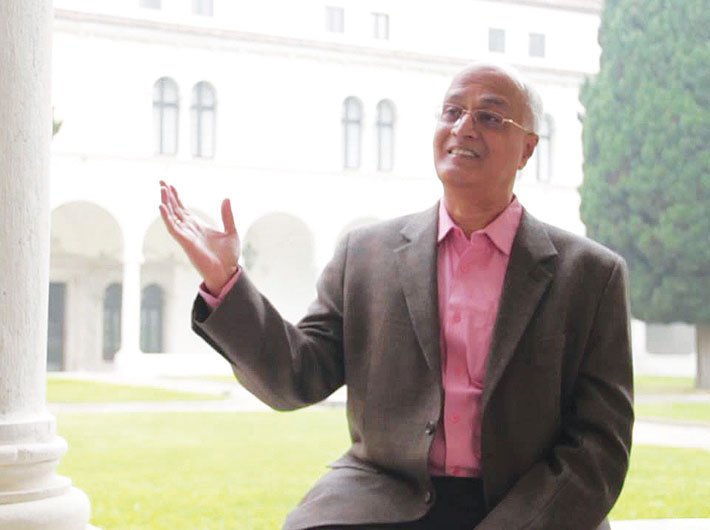
Peter Ronald deSouza is a professor at the Centre for the Study of Developing Societies (CSDS), Delhi, and held the Dr S Radhakrishnan Chair of Rajya Sabha till April 2017. He works on issues of democratic politics and comparative politics of South Asia.
A former director of the Indian Institute of Advanced Study (IIAS), Shimla, where he served two terms from 2007 till 2013, he was also co-director of the Lokniti Programme at CSDS till 2007. As a political theorist his abiding interest is in threats to freedom of expression in democratic polities. He spoke to Governance Now on what happiness is.
Is happiness a worthwhile goal for governments to chase? Don’t you think it’s too lofty?
The pursuit of happiness has a moral goal. It’s a good goal to present as an aspiration, something that motivates and inspires. All constitutions of all societies require such lofty goals, they guide policies, they guide institutions. The “pursuit of happiness” comes from the United States constitution. The pursuit of happiness as a lofty principle and placing it in a constitution is a good idea. It would be nice if governments have policies that produce outcomes which lead to happiness. But those policies must be assessed. There are two levels of assessment: one, at the level of capability to deliver; and second, in terms of nature of what is delivered. Third level is the issue as to how we decide what constitutes happiness.
This is a very complex question. There are studies that suggest that in states like Bihar and others, where healthcare is pretty poor, you ask people: are they happy? In states like Kerala, where healthcare is much better, there are higher levels of suicide. So what is happiness is a very complex question. Therefore, there can be agreement on what is happiness, so to convert that into policies becomes problematic. Therefore, happiness cannot be measured.
Maslow’s hierarchy of needs speaks of higher goals such as happiness and creativity and spiritual fulfillment being aspired to only when basic needs are met. Isn’t it the government’s responsibility to provide for basic needs and leave it to people to follow their higher goals?
The government should work on things that lead to the pursuit of happiness, so that people can follow their higher goals. The governments should focus on human development. Under education, you have primary schools, higher education facilities, mid-day meal, education of the girl child etc. Under healthcare, you have government hospitals, private hospitals where the government should rather focus. In India, the biggest factor is nothing but health. Similarly, if there is paucity of employment, then how can you expect people to be happy? So the government’s concern ideally should be to provide the basics, which pave a path to happiness. Because freedom is about allowing people different perceptions of happiness. One should not measure it.
India ranks rather low on the happiness index. What do you make of such rankings? Is happiness measurable for a government?
The idea of gross national happiness comes from Bhutan. It was the first country to abandon the idea of gross domestic product and say that the goal of society should be gross national happiness. Therefore, some countries got attracted to it; like France said it’s a good idea. But whether it can be converted to a set of measurable indicators is a problem.
So the first question is: Can it be converted into a set of measurable indicators, because you have a set of indicators that lead to assessment of something which further leads to an index. An index is always an outcome of certain measurable indicators, whereas the idea of happiness is disputed. For instance, a human development index is an outcome of indicators that are measurable, which includes the three clusters of indicators: livelihood, healthcare and education. Here, the government can provide you a suitable index about human development. What might be happiness for one person may be a nightmare for the other. So when we as people cannot decide what happiness is, how can the government? How can they measure happiness? They should rather work on things that would lead to happiness for the people of the society. Happiness cannot be measured.
Are gross national happiness and gross happiness index mere fads?
Terms like gross happiness index and many others are picked on as slogans rather than any analytical exercise. The idea of creating an index is merely political. We need more social science thinking by the government. Indexes are also to shame the government, and that is good for the country. It mirrors the outcomes of the policies and efforts undertaken by the government. I would rather say that every state should prepare an index and use it to create a competition among them based on measurable indicators. This will encourage the governments to work towards the betterment of their respective states. An index is an aggregate of suitable indicators and each indicator would have a ranking.
Bhutan’s experiment with happiness as a goal is almost anti-consumerist. What would you say about that? Isn’t it too restrictive?
For a government to be anti-consumerist is wrong, but consumerism produces psychological degradation, though it satisfies want, which is created through advertising. There is a difference between need and want. People shouldn’t be consumerist, as these are seductions of corporative drive to create consumerism. Want is created through market process, through strategies of advertising. A want is not a need. Consumerism poses a lot of pressure on ecology, in terms of consumption and in terms of disposal. Consumerism also doesn’t allow you a free choice, it is market driven. Therefore, freedom is a complex question. The Gandhian argument is important here: there’s enough for everyone’s need, but not enough for everyone’s greed.
Madhya Pradesh has a department of happiness. Andhra Pradesh CM Chandrababu Naidu has a portfolio under him for ‘happiness index’. What do you make of this trend?
It is completely bogus. Having a department like the department of happiness will not lead to anything. Instead of having a department of happiness, we should rather have a department of human development so that the indicators of what leads to human development are clear, that is, livelihood, healthcare and education. So that there is more livelihood and security, more employment generation and job security. It can be easily explained as it would lead to happiness in the lives of the people. If the government doesn’t provide the necessary ingredients to live happily like employment and healthcare, how can it expect the people to be happy? And then what purpose would a department like the department of happiness serve in the life of the people? We have to think from the public point of the view. So things like having a department of happiness is completely bogus, nothing else.
[email protected]
(The interview appears in the May 31, 2017 issue)