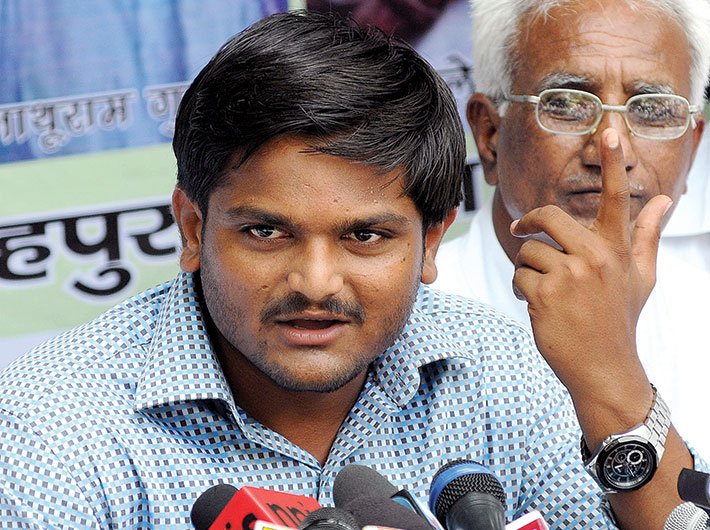
Hardik Patel, the newsmaker of the month, would be a most indistinguishable face in a college canteen in Ahmedabad. No wonder, in his pithy, unvarnished, un-nuanced one-liners, he is echoing what a large number of youngsters feel, when they finish their graduation (he completed his BCom last year), and look at career options.
At the end of a long day when he brought his quota battle to Delhi, he was feeling sleepy, his associates said he had barely slept for an hour or two for the past three-four nights, but with a smile, Patel agreed to reply to a few questions. Edited excerpts from the interview with Ashish Mehta:
Nobody would have imagined the scale of response your agitation has got. How did this happen?
What we have demanded is something very necessary for the [Patel] community. The community responded to it, leading to the success.
What has been the response from other communities?
Most sections of society have cooperated in our agitation though some communities may not have done so.
With your Delhi visit and making a common cause with Jats, Gurjars and others, are you planning to extend your agitation to the national platform?
No, we don’t have any national plans for our agitation. First we have to build it up at taluka and district levels. You cannot scale it up overnight.
There is some ambiguity about your aims. Some perceive that in making this unlikely demand of reservation for the Patel community, you are agitating against the whole quota policy itself. Will you please clarify if you want reservation for the Patel community or you want the quota policy cancelled?
[Emphatically] We want reservation.
Another clarification: do you favour reservations on caste basis or the economic basis?
Give reservation to the Patel community.
What do you think about the reservation policy?
See, the reservation policy cannot be withdrawn in India: there’s big politics behind it. When it started it was supposed to be reviewed after ten years. [That did not happen.] If it is withdrawn, its beneficiaries will come out in streets. So, what we say is that all the remaining communities should come out to demand quotas for them. Then the government will have to think about ending the quota policy. There are 16 communities, with about 28 percent population – I don’t have precise data. When all of them will raise their demand, the government will have to end the quota. If the quota is not done away with, the nation will go back by 60 years.
What about empowering the marginalised communities?
We are not against the beneficiaries of the reservation policy. We are not opposed to an SC/ST candidate becoming a district collector [under the reservation policy]. What we are against is his son becoming a magistrate under the quota.
We never realised the castes of our classmates till we were in the 4th or 5th standard. When some of them got scholarships, we asked our parents why we didn’t get the same, and we were told that, ‘son, they are from this or that community, so the government gives them scholarships’. That is when we became aware of the caste. We don’t mind if they get admission [to government colleges] with only 60 percent marks, but we very much mind when we can’t get admission even with 85 percent marks.
What do you expect next from the state government? Should it set up a committee to study your demand?
That would be meaningless; we want reservation. How the government finds the way – whether it goes to the court or committee – is not our concern.
One reason why the agitation has surprised the nation is that Gujarat’s ruling party, BJP, rose in the 1980s with the Patel support, and Patels have been an important part of it ever since. The community’s demand could have been conveyed and resolved within the party/government. How come the BJP failed to take note of the Patels’ perceived deprivation?
Even the Patels had not taken note of, what to say of the party?
No such demand was made during 12 years when Narendra Modi was the chief minister. Why did it come up now – when, ironically, the chief minister is a Patel?
It has nothing to do with who is the chief minister. This would have happened today even if Modi were chief minister.
Why did the demand and the agitation come up so suddenly?
Mangal Pandey also fought for India’s freedom, but it was after Mahatma Gandhi came to lead it that the freedom struggle got impetus.
Whom do you blame for the violent overreaction – police or their political masters?
Both are involved. There is big politics behind this. Nine people died. Police entered localities in the middle of night and beat up people. More than 9,500 people have been arrested. Many victims of police atrocities are not even activists associated with us.
There are speculations about your political ambitions.
I am not interested in politics – only in this cause.
What about the Congress, the only opposition party in Gujarat: has it approached you or expressed support?
There is no contact with the Congress, and there is no question of their support.
[email protected]
(The interview appears in the September 16-30, 2015 issue)