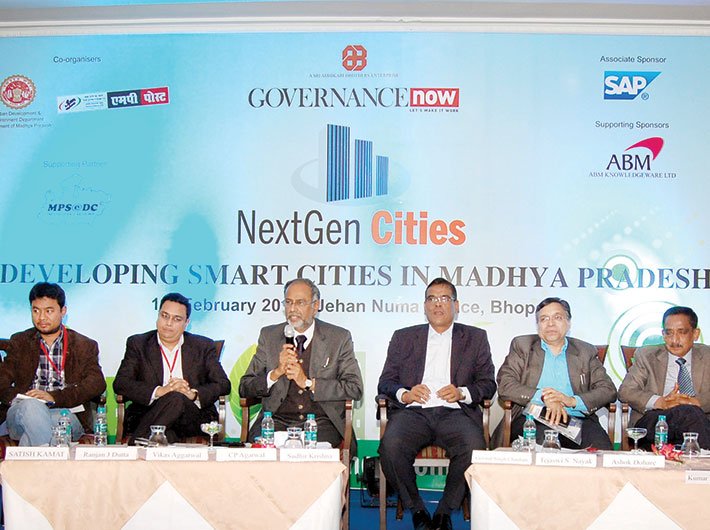
Various technological and social aspects that help in developing smart cities came up for a discussion at the NextGen Cities conference, held in Bhopal. Kailash Vijayvargiya, minister for urban administration, housing and environment, Madhya Pradesh, said a smart city should be developed in a democratic way. “The essential requirement of a smart city is that the four pillars of democracy need to be smart, from top to bottom, and techno-friendly,” he added. Local leadership should be promoted and connectivity must be enhanced for building a smart city.
Sanjay Kumar Shukla, commissioner, directorate of urban administration and development, laid stress on automatic building plan in his opening address. Discussing about the challenges in automatic building plan like weak infrastructure, illegal colonies, and lack of resources and technology in urban local bodies, he suggested that a municipal cadre should be developed to help the urban local bodies overcome these challenges.
Dr. Sudhir Krishna, former secretary, union ministry of urban development, said, “We should not rely completely on the government in taking the initiative. The lead has to be taken by us for building smart cities.” The perspective of a smart city should be a money-spinning area with smart planning, drainage planning, sewage management, smart buildings, smart energy management, ICT planning, smart governance, etc. Heritage perseverance is also a major factor that needs attention while building smart cities.
Richard Slater, team leader and urban governance expert, Madhya Pradesh urban infrastructure investment programme, highlighted the drivers of a smart city. He said that competitiveness, technology innovations, need for seamless mobility and efficiency gains drive towards the smart city building. A smart city commission should be there to attract attention of various groups and the connectivity should be optimised.
Urban development for smart cities
During the panel discussion, Pawan Jain, additional director general of police (planning), MP police, highlighted the importance of internal security as an essential requirement of a smart city. He stressed that technology and human resource training should be provided so that security is maintained with the coming up of smart cities.
Subroto Das, industry director, public services, SAP, said that the intervention of ICT into smart city is a must. With the help of ICT we need to provide better citizen services. Good governance, user empowerment and community engagement are also components of a smart city. He also said that city surveillance has to go hand in hand with city administration for efficient functioning of the smart city. All forces ensuring security to the public should be integrated in one platform with the ICT for smooth functioning.
Talking about planning for developing integrated smart cities, Gulshan Bamra, commissioner, town and country planning, Madhya Pradesh, said that from zonal to town levels, the layout should mark the greenfield, brownfield and whitefield areas.
NSN Murthy, associate director & smart cities leader, PWC, stated that the concept of smart city needs to be very clear. “If we look at Mumbai and Delhi as smart cities, then other cities should be built on that map,” he said. Smart city should promote livelihood. Marking the importance of a smart urbanisation policy he said that its impact on business and regulatory aspects needs to be checked. Incubation centres are needed for skilled labour, market, finance, etc.
Municipal governance and ICT
Satish Kamat, deputy city manager, Lavasa Corporation, said there is need to convert villages into smart cities. Integration between the resources and sources has to be maintained. Integration, efficiency and viability will lead to productivity. Also, safety and security with sustainable energy and climate should be taken into consideration while building a smart city, noted Ranjan J Dutta, project manager, Urban Mass Transit Company Ltd.
Reflecting upon the relation of urbanisation and development, CP Aggarwal, secretary, PWD, Madhya Pradesh, said that the urban local bodies should be given technical support and funds for public development.
Ashok Dohare, additional director general of police (cyber crime), MP police, said that the need of the hour is to build hospitals with best human services and not building more and more hospitals. Security along with privacy needs to be checked. Security impinges our privacy but being secure and living a private life is the utmost requirement. Cyber security as a tool needs to be properly handled in next-gen cities.
Kumar Purshottam, CEO, Bhopal development authority said that better municipal governance is required. Capacity building for better municipal governance needs to be promoted. Building up of knowledge, skill and attitude is very much required among the basic ground level workers.
Tejaswi S Nayak, municipal commissioner, Bhopal, said that improvement of finances is required for smart cities. Thorough analysis of information and utilising it efficiently can prove helpful in building smart city.
A city that reaps the maximum out of the minimum is a smart city. “Proper planning, integrated monitoring and management has to be there, then only efficient smart cities can be built. Citizen participation is essential for next-gen cities,” said Vivek Aggarwal, MD, MPRDC and secretary to CM, Madhya Pradesh.
Govind Singh Chauhan, executive director, ABM Knowledgeware, said that the rules and regulations need to be revisited, cost of services need to be understood for smart cities. The trust deficit between the public and the government needs to be filled with trust.
The event was part of a series of NextGen Cities conclaves, organised by Governance Now across the country.