
Poet-Diplomat Abhay K. expands ‘Meghaduta’ beyond borders
GN Bureau | June 2, 2022

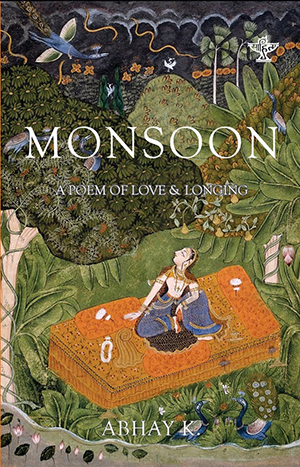 Monsoon: A Poem of Love & Longing
By Abhay K.
Sahitya Akademi, 54 pages, Rs 110
Monsoon, the biggest annual event in India, has arrived. To be precise, the southwest monsoon has entered Kerala a couple of days ahead of the schedule. You may believe the southern state is the starting point of its journey; but it is not. It originates in Madagascar, the Indian Ocean island.
Abhay K., an Indian Foreign Service officer, was posted in Brazil when he came to know this unusual fact, and as luck would have it, he was then posted as India’s Ambassador to Madagascar. Since then, in another coincidence, he produced a translation – an excellent one – of Mahakavi Kalidasa’s ‘Meghaduta’, the Cloud Messenger (as also one of ‘Ritusamhara’).
It would have been surprising if one thing did not lead to another, and now Abhay K. has come out with an original, book-length poem which follows the path of the southwest monsoon, right from Madagascar to the Himalayas. The poet urges the Cloud to carry his message to his beloved who is in Srinagar, who in turn is expected to assign the messenger a reply on its return journey to the island.
In describing the journey, the poet evokes the beauty of Madagascar as well as several other islands along the way in the Indian Ocean, including finally Sri Lanka. After entering India, its path is bifurcated –one from Andaman and Nicobar to Kolkata, then Bhutan, Nepal, Tibet, and finally Delhi; the other taking the west coast, but both meeting in the capital to move northwards then.
Following Kalidasa’s template, the journey is a pretext to description of nature. Abhay adds new themes to it, for example, the Cloud will also get a glimpse of architectural marvels inspired by monsoon – lakes and palaces [Badal Mahal built in your honour/at Kumbhalgarh will be ecstatic host to you,…] – and revel in festivals based on the theme of rains [women will sway on tree-swings singing folk songs/ and celebrate Teej to mark goddess Parvati’s union/ with Lord Shiva after a hundred years of penance,…].
Nature as well as culture, in other words.
As the modern-day poet describes the itinerary to the Cloud, here is what he has to say about the capital:
ecstatic peacocks at Jawaharlal Nehru University
will spread their plumes and dance, amorous couples
will kiss, cuddle and make love under your rains
at the Parthasarathy rocks in the Aravali hills
The Cloud will also get a chance to look at similar and other scenes in Lodhi Gardens, Nehru Park, Khan Market, Rose Garden of Delhi University and elsewhere, while
homes will be filled with the tantalizing aroma
of bhajiya, samosa, jalebi and masala chai,…
In other words, here is a 40-page poem you can read while waiting for rains and know what to expect. It will make “forgotten Raga Gaund” play again in Delhi’s old havelis, “evoking deep longings …”
Also read:
Reading ‘Meghaduta’ in the times of climate change
Reading Kalidasa in the time of climate change
In 2012, Anita Dash wasn`t dreaming of building a dairy brand. She wasn`t studying business models or planning market expansion. Like countless mothers across India, her focus was on something much simpler: giving her children a better future. At the time, her most valuable
India`s crude oil consumption is estimated to be around 88.5% imported from abroad. This one single figure is also responsible for why ethanol has become both an economic strategy and fuel policy at the same time. In an economy like India, which depends so heavily on foreign oil, any increase in internat
India`s retail inflation shows a reassuring picture at first glance. According to the latest data, Consumer Price Index (CPI) inflation edged up to 4.38% in June 2026 from 3.93% in May 2026, but continued to remain within the Reserve Bank of India`s (RBI) target band of 4% (+/- 2%). However, beneath this
When a company founder opens their personal chequebook to buy shares in their own business, stock markets usually applaud. To the average retail investor, it feels like the ultimate vote of confidence, a sign that the people running the show have real skin in the game and believe brighter days are ahead.
As we mark 80th anniversary of independence, ‘Asianism and the Fall of Empire’ (HarperCollins India) by historian Mithi Mukherjee offers a new perspective on Ind
The Chromatic World Order: The Fiction That Rules Our World By Sajid Mohamed Aakar Books











