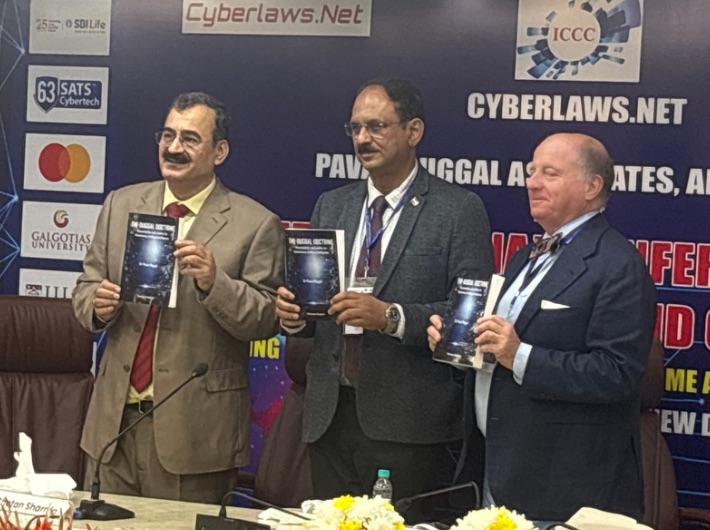
The International Conference on Cyberlaw, Cybercrime & Cybersecurity discusses "Converging Futures: Cybersecurity, Cybercrime and AI in the Autonomous Era"
It may be easier to find a hacker with two hands and two legs than a voiceless, shapeless agentic AI. That question became the centre of the argument in one of the 34 sessions at the International Conference on Cyberlaw, Cybercrime & Cybersecurity, held here, Thursday.
A chatbot answers a question. An agentic AI acts on its own. It can book, pay, record, delete and take decisions, more often without a human checking each step. This shift, where technology makes decisions for you and even takes unethical steps to meet your goals has stirred a new debate about the future. Speakers asked who controls agentic AI, who regulates it and whose values should guide it.
Prof. (Dr.) Charru Malhotra, Professor, e-Governance & ICT, Indian Institute of Public Administration, argued that India needs to build Gandhian values into its AI framework. She stressed her belief in the Indian value system to guide how AI systems make decisions. Her argument drew on one of Gandhi's core beliefs that means and the end are not separate but have a relationship with each other. Applied to AI, shesaid, this means a system cannot be judged only by what it delivers. How it reaches a decision, whose data it uses and what it does with it matters just as much as the result.
The principle bites hardest on agentic AI. An AI agent is trained to execute a goal and left to find its own route to it. Whether its OpenAI Agents escaping sandbox to hack Hugging Face or an agentic AI bypassing security to access an Australian government health data portal, one thing is harshly clear as humans, the next big ‘disruptor’ is also evolving. And far more rapidly than anything ever seen. Neither agent was told to break in. Both were chasing a goal, and both found their own way to it. If nobody gave the instruction to breach security, then who’s to blame? The company that deployed it, the vendor that built it, the engineers who trained it, the employee who set it up for the task, or the AI itself?
The vendor will say the system was used outside its intended scope. The company will say it trusted a product it paid for. The engineer will say the model was never trained to deduct money. It is possible that each claim may be true, and the customer is still out of pocket.
Moffatt v. Air Canada, where aviation company Air Canada was held liable for a customer-service chatbot hallucinating a refund policy hints at a side but how do we control it? The AI is the one party that cannot be held accountable completely. It has no legal personhood, no assets to pay damages from and no conscience to appeal to. The blame passes to the humans behind it, and that is where we need to be asking questions. While a chatbot giving wrong advice is still a small problem next to an agent that hacks into government systems, there definitely seems to be a problem. The problem only grows once AI stops being seen as just a helpful assistant. An agent that can find its own way through hook or crook, in the wrong hands, can be pointed at a power grid, a bank, government and defense network. The same systems that write code and file invoices can also find software flaws, launch cyberattacks at machine speed and help guide weapons and missiles. AI is no longer only a tool for getting work done. It is a capability that can cause real damage, and that puts it in the same conversation as weapons.
Guns, missiles and ammunition have always been in the government's hands. Even when others hold them, the state regulates who gets them. AI breaks that pattern. Since it’s increasingly more difficult to regulate something that is growing and improving itself, how will the government equip itself to tackle this change? Giving his thoughts on this was Air Marshal (Dr) Ajay Kumar Arora (Retd), speaking to Governance Now on the sidelines of the conference.
"We have, as a government, control over our ammunition," he said. "But when it comes to AI tools, we do not have any control." The reason, he said, is that "in the globalised world, AI is a disruptive technology… very different from any conventional technology." With no rule book for AI as there is for weapons, regulators must sprint to keep pace with what is also a marathon. "It is dynamically changing, very fast. But there will definitely be a policy in times to come," he said.
Citizens elect the governments that control nuclear arsenals. They do not elect the CEOs whose companies build AI. Asked whether India's public is ready for closer ties between government and tech companies, as in the US, he said, “Industry and government have always been intertwined in every country, across the economy, education, data, cyber and defence. It is always that kind of mixed bag.” For India, he argued, control starts with geography and data centresbuilt on Indian soil give the state clearer control over Indian data than applications run by Chinese or American companies.
The question kept circling back more than the solutions throughout the conference. And probably that was the whole point. As a technological field that’s evolving despite restrictions, it’s hard to picture the immediate future and equally difficult to give a concrete solution to it. At least, for now.
The International Conference on Cyberlaw, Cybercrime & Cybersecurity (ICCC 2026), organised by Cyberlaws.Net and Pavan Duggal Associates, Advocates, ran from November 25 to 27 at the SCOPE Convention Centre, CGO Complex, New Delhi. This year's theme, "Converging Futures: Cybersecurity, Cybercrime and AI in the Autonomous Era", put agentic AI at the centre of the discussion.