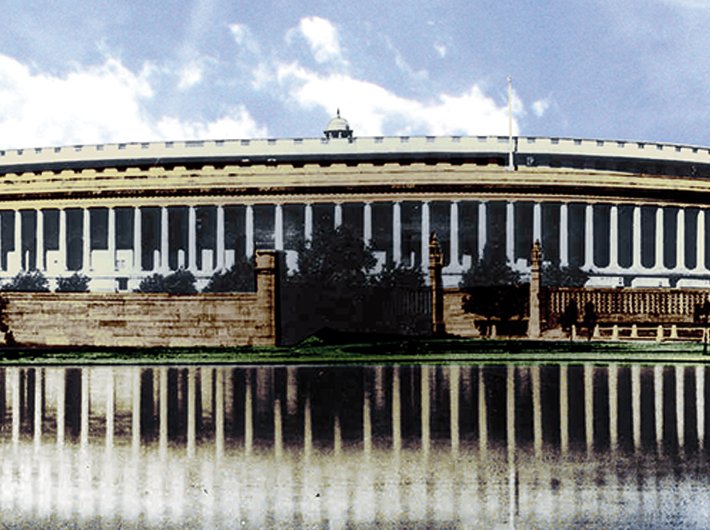
There are 12 members nominated to the Rajya Sabha, while two Anglo-Indians are nominated to the Lok Sabha
The members nominated to the Rajya Sabha have time and again failed to be effective parliamentarians – and cricketer Sachin Tendulkar is no exception.
Tendulkar, a Bharat Ratna, last week made his first and only attempt to initiate a debate, but he could not speak due to ruckus by the opposition. The cricketer is about to complete his six year term and his performance has been below par.
As many as 12 people are nominated to the Rajya Sabha, while two Anglo-Indians are nominated to the Lok Sabha.
The maximum number of members of Rajya Sabha can be 250. Article 80 of the Constitution of India provides that 12 members are to be nominated by the president of India and not more than 238 representatives from the States to be elected by the elected members of the State Legislative Assemblies in accordance with the system of proportional representation by means of the single transferable vote, said the election commission.
By adopting the principle of nomination in Rajya Sabha, the Constitution has ensured that the nation must also receive services of the most distinguished persons of the country who have earned distinction in their field of activity, many of whom may not like to face the rough and tumble of the election. By nominating them to Rajya Sabha, the State not only recognises their merit and confers honour on them, but also enables them to enrich the debates by their expertise and knowledge that they have in different areas.
Speaking about the nominated members, Jawaharlal Nehru said in the House of the People on May 13, 1953: “…The president has nominated some members of the Council of States who, if I may say so, are among the most distinguished, taking everybody in Parliament altogether – it is true, distinguished in arts, science, etc. – and our Constitution in its wisdom gave that. They do not represent political parties or anything, but they represent really the high watermark of literature or art or culture or whatever it may be.”
What about their powers?
Nominated members enjoy all powers, privileges and immunities available to an elected member of parliament. They take part in the proceedings of the House as any other member. They, however, are not entitled to vote in the election of the President of India. But in the election of the vice-president of India, they have a right to vote. So far, none from them has been inducted into the Council of Ministers.
The first batch of 12 nominated members represented a galaxy of talented persons. They were: scholar and educationist Dr. Zakir Husain, renowned historians Dr. Kalidas Nag and Dr. Radha Kumud Mookerji, national poet Maithilisharan Gupta, well-known Gandhian author Kakasaheb Kalelkar, eminent scientist Professor Satyendranath Bose, social worker N.R. Malkani, renowned exponent of classical dance forms Shrimati Rukmini Devi Arundale, Gandhian scholar and teacher, Dr. J.M.
Kumarappa, legal luminary Dr. Alladi Krishnaswami, famous stage actor and cine star Prithviraj Kapoor and eminent medical scientist Major-General S.S. Sokhey.
The trouble is that the nominated members are not known to be active parliamentarians, with few asking questions and participating in debates.
In March this year, Naresh Agarwal of the Samajwadi Party asked if the nominated members like Tendulkar and filmstar Rekha should not resign due to their continued absence from the House.
"If they are not coming, does it mean they are not interested and if they are not interested, shouldn't they resign," Agarwal asked.
Deputy chairman PJ Kurien said Agarwal could use his good office to convince the nominated members to be present in the House for a few days, reported New Indian Express.
Agarwal said if the Chair so suggests, he will write to the members on the issue.