Chaturvedi Badrinath’s work can prove therapeutic reading in today’s troubled times
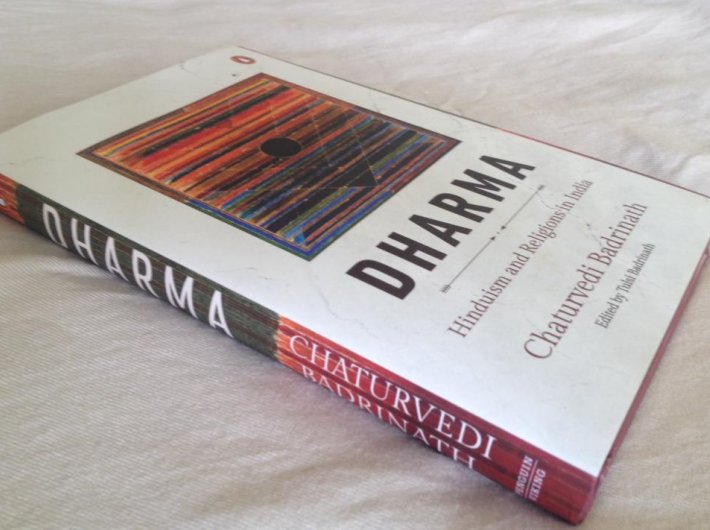
Dharma: Hinduism and Religions in India
By Chaturvedi Badrinath
Edited by Tulsi Badrinath
Penguin, 194+ xiii pages, Rs 499
How to live: That is the most fundamental question of human existence. The Indian civilisation’s answer, in short, is: Dharma. The long answer can fill the longest epic, by expanding the same term. What is Dharma, then?
It is one of the most multivalent words imaginable in any language, writes Buddhist scholar Glenn Wallis. It comes from the Sanskrit root ‘dhr’, which means “to hold, support, sustain”. In Buddhist literature, he adds in the introduction to his translation of Dhammapada, it can mean: “phenomena, i.e., elements or things, from atom to a mountain or a cosmos; mental objects, or roughly, thoughts, any type of quality, personal or physical, abstract or concrete; morality, righteousness; law, foundation, custom, standard; teaching; truth.”
Buddhism, Mahatma Gandhi would maintain, was only expanding and deepening the resources available in Hinduism (even if, as Chaturvedi Badrinath argues, it was not called Hinduism then).
With words, multivalence can be double-edged. If the semantic shades are so wide in range, it can render the term open to unintended usages. When the outsiders looked for a common label for people here, they invented the term ‘Hindus’, and when they sought a local equivalent of ‘religion’, ‘Dharma’ was employed to play the role.
“The question ‘What is your religion’ put in English to a person labelled Hindu, is unanswerable, strictly speaking,” writes Badrinath, in a posthumous collection of essays, ‘Dharma: Hinduism and Religions in India’ [edited by Tulsi Badrinath, published by Penguin]. Also, “There has thus been the double error of identity. First in gathering the diverse faiths, beliefs and practices into a fictitious ‘Hinduism’, then in taking that to be a ‘religion’. This error still persists.”
What the opening essays of this highly thought-provoking collection aims to do is to correct both the errors – explain ‘dharma’ in its original connotations, and counter the notion that “Hinduism was mostly antagonistic to two other religions that arose in India, Buddhism and Jainism”.
Badrinath (1933-2010) had a rare career combining philosophy and governance: on one hand, he was a member of the Indian Administrative Service (1957-89), serving Tamil Nadu, and on the other, he wrote about Dharma and other perennial questions and delivered talks on Indian philosophy abroad. For his ‘The Mahabharata: An Inquiry in the Human Condition’ (Orient BlackSwan, 2006), he won a Sahitya Akademi award – a day before his death in 2010.
The seven essays in the collection, as his daughter Tulsi Badrinath – an accomplished writer herself – notes in the introduction, are taken largely from his lectures. They range from broad and introductory (‘Jainism’, ‘Buddhism’) to the specific (‘Towards the Hinduism-Christianity Dialogue’) and the timely (‘Secular and Religious Fundamentalism’).
All essays are variations on the theme of Dharma, the “core of Chaturvedi Badrinath’s intellectual work” and informed by his lifelong study of the Mahabharata, the one text that is a sustained meditation on ‘Dharma’. For him, Dharma is the Idea of India, the core concept that binds Indian society. Given the broad range of its interpretations, there is space for more than one perception of truth. Reading the Mahabharata alongside the Jain philosophy of Anekantavad, he concludes, like Gandhi did, that “One principle that must be upheld at all times is the right of every human being to life and to live in the manner he or she wishes to, provided it does not lead to anarchy: Ahimsa paramo dharma: not-violence is the greatest dharma.”
It is logical, then, that “A person counts as a person. The very idea of some human beings in any given society living as a minority is deeply offensive to human dignity, and thoroughly a-dharmic.”
Today, as a variety of barriers are going up again between one human being and another, the world can learn from India the lessons in peaceful co-existence. In that context, Badrinath’s work should be essential reading in today’s troubled times.