
Government approves E-vehicle policy

Aims to promote India as a manufacturing destination for EVs

GN Bureau | March 15, 2024

#manufacturing   #policy   #electronic vehicles   #energy   #Environment   #business   #economy  
(GN Photo)
(GN Photo)

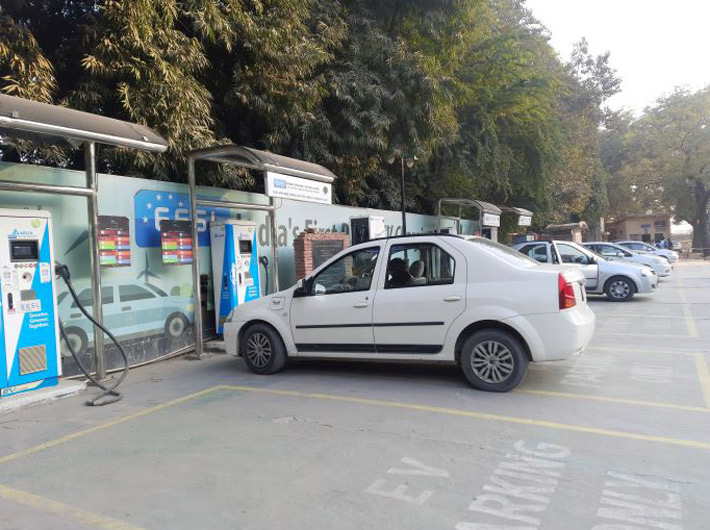
The union government has approved a scheme to promote India as a manufacturing destination so that e-vehicles (EV) with the latest technology can be manufactured in the country. The policy is designed to attract investments in the e-vehicle space by reputed global EV manufacturers.

This will provide Indian consumers with access to latest technology, boost the Make in India initiative, strengthen the EV ecosystem by promoting healthy competition among EV players leading to high volume of production, economies of scale, lower cost of production, reduce imports of crude Oil, lower trade deficit, reduce air pollution, particularly in cities, and will have a positive impact on health and environment, an official release said on Friday.

The policy entails the following:


•    Minimum Investment required: Rs 4150 Cr (∼USD 500 Mn)

•    No limit on maximum Investment
    
•    Timeline for manufacturing: 3 years for setting up manufacturing facilities in India, and to start commercial production of e- vehicles, and reach 50% domestic value addition (DVA) within 5 years at the maximum.
    
•    Domestic value addition (DVA) during manufacturing: A localization level of 25% by the 3rd year and 50% by the 5th year will have to be achieved
    
•    The customs duty of 15% (as applicable to CKD units) would be applicable on vehicle of minimum CIF value of USD 35,000 and above for a total period of 5 years subject to the manufacturer setting up manufacturing facilities in India within a 3-year period.
    
•    The duty foregone on the total number of EV allowed for import would be limited to the investment made or ₹6484 Cr (equal to incentive under PLI scheme) whichever is lower. A maximum of 40,000 EVs at the rate of not more than 8,000 per year would be permissible if the investment is of USD 800 Mn or more. The carryover of unutilized annual import limits would be permitted.
    
•    The Investment commitment made by the company will have to be backed up by a bank guarantee in lieu of the custom duty forgone
    
•    The Bank guarantee will be invoked in case of non-achievement of DVA and minimum investment criteria defined under the scheme guidelines
 

Comments


Other News

Master sculptor recalls the making of the Shankaracharya statue

The Golden Chisel: The Story Behind the Making of Ram Lalla  By Seethalakshmi S. and Rahul Nandan Rupa Publications, 168 pages, Rs 395  

Mumbai’s missing affordable homes

Mumbai’s real estate market keeps growing, yet homeownership remains out of reach for much of its population. Three experts – urban researcher Hussain Indorewala, urban planner Vidyadhar Phatak and developer Kamlesh Thakur of NAREDCO Maharashtra, agree that simply constructing more apartments

Rubio denies US foreknowledge of Starlink restrictions in Ukraine

US secretary of state Marco Rubio has said he was unfamiliar with the Wall Street Journal report suggesting Elon Musk had decided to throttle Starlink services in Ukraine, but rejected claims that Washington had ordered the restrictions to pressure Kyiv.   “There was no

Can AI change India’s breast cancer story?

Breast cancer has become a public-health challenge in India. The greatest opportunity is to find cancers earlier. Artificial intelligence (AI) is opening a new era in breast cancer detection. AI systems can analyse mammograms and other breast-imaging studies, identify subtle abnormalities and assist radi

Farm stability in the time of climate change

Indian agriculture is experiencing significant climate volatility, while the world economy seems to be in a highly volatile situation. Economic indices from various countries show that they need to recalibrate their strategies to withstand economic headwinds. In such a challenging situation, a country li

El Niño threatens India’s Rabi crops

India’s southwest monsoon ended with a 13% rainfall deficit in 2026, its weakest performance in a decade, raising concerns over agricultural production, water security and the upcoming rabi season. With El Niño expected to persist into early 2027, experts warn that declining soil moisture, dep


Upcoming Conferences


-->

Archives

Current Issue

Opinion

Facebook Twitter Google Plus Linkedin Subscribe Newsletter

Twitter





