
Freeing up markets, augmenting supply of food and leveraging the use of IT necessary for ensuring food security
GN Bureau | February 26, 2016
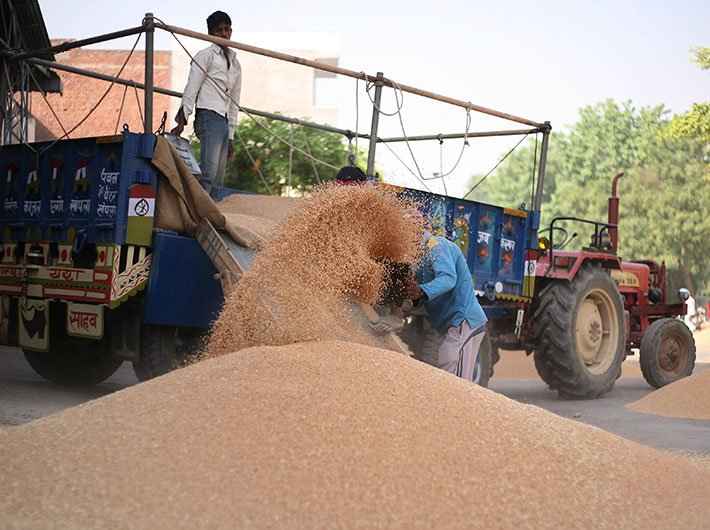

“Though India’s GDP growth has been impressive and the agricultural production has also increased over the past few decades, hunger and starvation still persist among the poorer section of the population,” the economic survey 2015-16 report says. There has been moderation of inflation including food inflation during the last two years, but more needs to be achieved by freeing up markets, augmenting supply of food and leveraging the use of IT, the report says.
According to the data of the 66th round of the National Sample Survey (2009-10), the average dietary energy intake per person per day was 2147 Kcal for rural India and 2123 Kcal for urban India. As per the report of nutritional intake in India, 2011-12 (NSSO, 68th round), among the bottom 5 percent of rural population ranked by monthly per capita expenditure (MPCE), 57 percent of households had calorie intake below 2160 Kcal/consumer unit/day.
The average protein intake per capita per day rises steadily with MPCE level in rural India from 43 gm for the bottom 5 percent of population ranked by MPCE to 91 gm for the top 5 per cent, and in urban India from 44 gm for the bottom 5 per cent to about 87 gm for the top 5 per cent.
The 2015-16 report states that India has the second highest number of undernourished people (194.6 million persons) (FAO, State of Food Insecurity in the World, 2015) which warrants immediate attention. Moreover, with 27 per cent of the population below the poverty line, the rise in prices of food impacts the poor adversely, with a greater proportion of their household incomes being spent on food. Therefore, along with provision of food subsidy, stability in agricultural commodity prices is essential for making poorer sections food secure, the report says.
There is a strong correlation between stability in agricultural production and food security. The volatility in agricultural production impacts food supplies and can result in spikes in food prices, which adversely affect the lowest income of the population.
The Golden Chisel: The Story Behind the Making of Ram Lalla By Seethalakshmi S. and Rahul Nandan Rupa Publications, 168 pages, Rs 395
Mumbai’s real estate market keeps growing, yet homeownership remains out of reach for much of its population. Three experts – urban researcher Hussain Indorewala, urban planner Vidyadhar Phatak and developer Kamlesh Thakur of NAREDCO Maharashtra, agree that simply constructing more apartments
US secretary of state Marco Rubio has said he was unfamiliar with the Wall Street Journal report suggesting Elon Musk had decided to throttle Starlink services in Ukraine, but rejected claims that Washington had ordered the restrictions to pressure Kyiv. “There was no
Breast cancer has become a public-health challenge in India. The greatest opportunity is to find cancers earlier. Artificial intelligence (AI) is opening a new era in breast cancer detection. AI systems can analyse mammograms and other breast-imaging studies, identify subtle abnormalities and assist radi
Indian agriculture is experiencing significant climate volatility, while the world economy seems to be in a highly volatile situation. Economic indices from various countries show that they need to recalibrate their strategies to withstand economic headwinds. In such a challenging situation, a country li
India’s southwest monsoon ended with a 13% rainfall deficit in 2026, its weakest performance in a decade, raising concerns over agricultural production, water security and the upcoming rabi season. With El Niño expected to persist into early 2027, experts warn that declining soil moisture, dep










