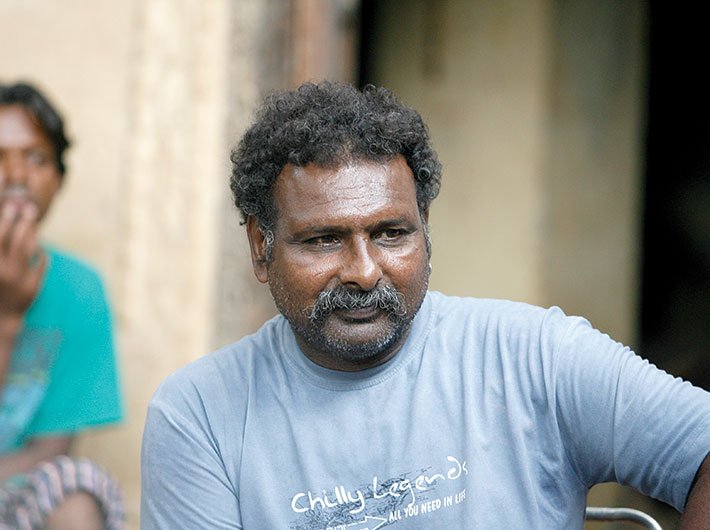
Puran Bhatt’s world-renowned puppetry stares at the same fate as that of his locality, Kathputli Colony – bleak
In the mid-1950s, a group of travelling artistes, mostly puppeteers from Rajasthan, would frequently tour the northern and eastern states, sometimes going as far as Nepal. The money was good, and they got respect. The only problem was finding accommodation. So, sometimes they would camp by the railway tracks but eventually would be driven away by the authorities.
Now nearly 60, Puran Bhatt, a globally renowned, award-winning puppeteer and the brain behind the Aakaar puppet theatre group, does not know his exact age. What he does recall is growing up by the tracks. He also knows his family was among the first few to settle down on that empty land parcel near Shadipur area of west Delhi. Sandwiched between railway tracks and two mills, the location was uninhabited and convenient for travel. But making a home there proved difficult, as the area was thickly forested and the ground was uneven.
Little Puran and his family toiled hard to make the place habitable. They worked on the land, carried heaps of sand and soil on their heads to level the ground.
At first, only a few families – the brave ones – settled in the area. With time, more puppeteers started arriving from Rajasthan, until it became a colony of puppeteers. As seasons went by, and the artistes entrenched their position in the area, all kinds of artistes began arriving and settling down here – puppeteers, magicians, snake charmers, jugglers, acrobats and more – giving the place its unique, distinct identity.
Welcome, then, to Kathputli Colony – a habitat that might just vanish in the months to come, razed by bulldozers and multi-storey buildings raised to erase it from memory.
Bhatt, whose life seems to mirror that of Kathputli Colony’s, is unlike most others in the locality. He is articulate and his speech is not a pastiche but dotted with clearly pronounced English words. Had it not been for puppetry, Bhatt says jokingly, his looks certainly would not have earned him praise.
But some things are passed down without the subject even realising it. It was puppetry in Bhatt’s case. He grew up watching and learning from his grandfather, who was a big influence on him, and assisted his father till he was 13 years old. In 1982, a young Puran joined Sriram Puppet Centre and learnt contemporary puppetry. The 1980s was an era of renaissance for traditional artistes, and Bhatt was much sought after – across the country and outside it.
Bhatt says he has travelled to at least 25 countries, performing in shows and winning accolades. In 2003, he became the first Rajasthani traditional puppeteer to be given the Sangeet Natak Akademi award. Besides puppetry, he is also adept at wood carving and playing instruments.
These days, however, he can be found loitering in Kathputli Colony. With the advent of new media and modern entertainment, the demand for traditional entertainment has dipped drastically.
Like Bhatt, time has been unkind to the other residents of this nondescript colony of artistes as well. These people may have made Kathputli Colony their home for over five decades now, but they might soon be evicted like any other squatters.
Missed chance
Talking about the colony he so obviously loves, Bhatt says his parents and grandparents did not foresee a lot of things when they decided to settle here so many decades ago. He says the present-day problems could have been avoided had his father and grandfather been literate enough to anticipate the complications arising in future. “We could have got legal ownership of the land if we had bought the land from the Delhi development authority (DDA). Back then, we could have easily afforded it, as land prices were not so steep,” he says.
Citing the example of a nearby colony, Bhatt says, “The residents of Baljit Nagar also settled down illegally on DDA land. But they were smart enough to realise the benefit of paying taxes and started doing so – the reason they cannot be evicted.” Though technically those residents of Baljit Nagar do not own the land, they have established an ownership by virtue of paying taxes, he adds wistfully.
Kathputli Colony, though, is not new to controversy. It was under the threat of demolition during the Emergency years but the residents saved it by organising around their art. Since the 1980s, the DDA had been pushing for rehabilitation of its residents. In 2009, DDA awarded its first slum redevelopment project, under which it allocated Raheja Developers about
13 acres for '6.11 crore, with the developer obliged to rehabilitate Kathputli Colony.
Residents resisted the move for multiple reasons, including non-expandable quarters to accommodate large families and unfeasible conditions to ply their trade. The situation has been tense ever since mass protests erupted in February this year.
In August, 12 men from the colony were arrested. Residents alleged that on the pretext of rounding up suspects in a brawl that had occurred earlier outside the colony, the police arrived in riot gear and armed with teargas shells. “They broke doors and dragged men out of their homes. When the women tried to reason with them, they misbehaved,” says Dilip Bhatt, pradhan of the Rajasthani samaj.
The endgame?
For the residents, meanwhile, life has to go on despite the uncertainty of not having a roof over their heads in near future.
“The government gave me an award but soon I will not have a place to keep it,” Puran Bhatt rues.
Ever since the agitation against DDA and the builders began, Bhatt has been too scared to attend shows. He even goes to the extent of verifying the address before confirming attendance. Ironically, Bhatt was invited to perform at a real estate awards ceremony in September, where he came face to face with his nemesis: Navin Raheja. “I was preparing before my performance when Mr Raheja came calling in the green room,” he says. “He acknowledged our situation and even agreed to hold a dialogue with the residents of Kathputli Colony. He seemed amicable but I told him that the residents need to have a dialogue with DDA for swift resolution of the conflict.”
Both sides, he says, will have to reach a compromise.
Plying a dying art
Ironically, Bhatt says, Indian art has more takers abroad. He got this feeling afresh during his most recent foreign trip – to New York, where he attended the premiere of ‘Tomorrow We Disappear’, a documentary on the final days of Kathputli Colony. The feature-length documentary, which spans three years in the lives of Bhatt, Rehman the magician, and Maya the acrobat, follows the trio as they go about their daily lives under the looming threat of eviction.
In their statement, the directors of the documentary, Jimmy Goldblum and Adam Weber, write, “In capturing Kathputli’s final days, our hope is that our audience gets to see the colony like Puran, and the many artistes like him, see it: as a world with no distinction between life and art, where India’s past, present, and future blur together, a home that somehow – impossibly, incomprehensibly – still brims with possibility.”
When Kathputli’s artistes move into transit camps later this year, many will surrender their art, modernise, try to send their children to school instead of making them learn the tricks of their own trade, or put them in the workforce, the director duo writes. “The process is under way, and although we want to do everything in our power to ensure it happens fairly, justly, and transparently, it is not our goal to stop it. The relocation is not a Manichaean issue, and it’s near impossible to argue that the street arts are a viable livelihood for the majority of Kathputli’s 2,800 families.
“Kathputli is dying, and we see ‘Tomorrow We Disappear’ as its funeral; not a Western-style funeral that laments the tragedy of loss, but an Indian funeral, which honours the uniqueness and vibrancy of its life.”
As we discuss the documentary, Bhatt says his five sons are still associated with the family tradition of puppetry but the days are numbered – the children will not be forced to carry forward the family profession, though “I have told them to never forget the tradition, art and language”.
While the demand for puppetry has declined steadily, Bhatt refuses to acknowledge it as a ‘dying art’. “Art,” he stresses, “never dies. It is the artiste who dies due to lack of support. When artistes like us find work, the home comes automatically. Had enough people sufficiently appreciated our talent, we would not have been facing this predicament.” Ruing the overwhelming dominance of western culture, he says, “People today will be eager to listen to jazz music. But magicians and street artistes would not find any takers.”
Beneath the clear blue autumn sky, amid the faint sound of trumpet and drums as performers set out to entertain a wedding party, Puran Bhatt forlornly awaits tomorrow as we leave the colony.
The story appeared in November 16-30, 2014 issue