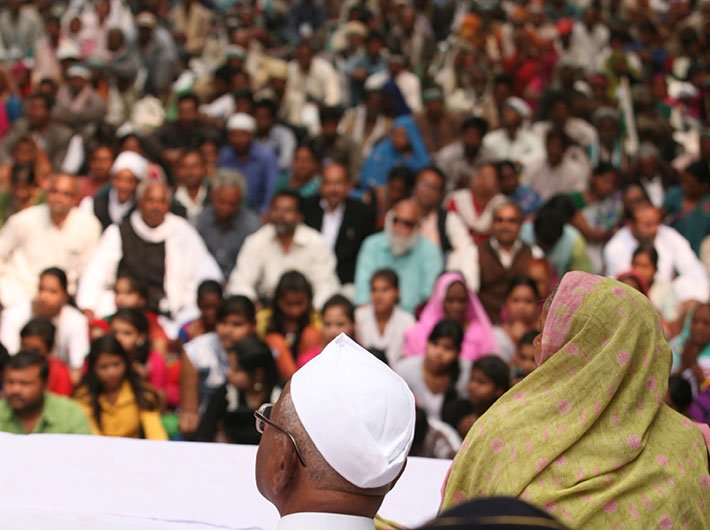
Why the Manmohan Singh government exempted Anna Hazare the harsh treatment but made an example out of Baba Ramdev
What’s the difference between a fasting patriarch and a faster Babaji? Between a satyagrahi and a pranayamic capitalist? Between a ‘mera neta chor hai’ topi and a tastefully understated dupatta? For that matter, what’s the difference between an oppressively silent prime minister and an expressively dancing leader of the opposition? Ever since the night of the long sticks in Delhi’s Ramlila ground, when Baba Ramdev’s cohorts felt the heavy hand of the state upon their slumbering bodies, I’ve been playing 20 questions with myself.
Unlike the tireless Ram Jethmalani, I don’t have to pose the questions myself. The brouhaha over the Lokpal bill is throwing up so many every week. It’s put a question mark on all the players and is damaging reputations as rapidly as the season of scams. Shanti Bhushan, a valuable member of Team Anna whose legal activism gave the project a certain edge, is under a cloud following the accusation of accepting a favour from government. Anna Hazare himself lost traction by joining the lawmaking process when he should have remained its critic. And could there be an easier way to alienate people than to suggest that Magsaysay awardees and Nobel laureates know better?
Finally, Ramdevlila cost the movement so much credibility that the government could think of throwing the activists out of the lawmaking process. Which was not entirely a bad idea. It is the job of activists to demand change. It is the job of government to legislate it. The two functions are best kept separate.
But the government is looking inept, too. Delhi is humming with jokes about ‘Maun-mohan Singh’, the inscrutable Jedi master of ‘lath yoga’. The public, which once saw him as Mr Clean, now suspects he has something to hide because his government resists bringing the prime minister under the purview of the Lokpal. And UPA II is looking a bit cheap, going after the Baba in the ancient manner by turning the investigative agencies and the taxman upon him like vengeful weapons.
Meanwhile, the BJP is trying to justify a dance number at Rajghat by Sushma Swaraj, leader of the opposition in the Lok Sabha. Can’t really fault her, because the night of the long sticks has given her party its first emotive issue in years. And the government should be dancing, too. Baba Ramdev has flamboyantly thrown away the trump cards of the movement for the Lokpal bill – an ability to bring together disparate groups representing huge populations, and a commitment to stay clear of party politics.
Anna Hazare had turned away Uma Bharati and other politicians when they tried to gatecrash his fast. Baba Ramdev put Sadhvi Ritambhara right on stage. The government could never face down a pressure group which only represented the people, not political interests. But after Ramdevlila, it is easy for the home minister to dismiss the movement as a right-wing conspiracy. Ironically, the movement has turned out to be as fissiparous as the early Left. It’s not a great qualification for survival.
So, to get back to my game of 20 questions, what’s the difference between the two camps? One, the Baba had the foresight to keep camouflage gear handy. Anna Hazare did not foresee that the government would unleash a smear campaign on his colleagues. And two, Anna is generally acceptable. The Baba is not. The former recalls the Mahatma and does mass politics uncomplicated by party affiliations. The latter is a canny businessman and wannabe politician who will stand with the colours of any organisation, so long as it’s saffron. And now, he wants to raise an army. The salient difference between the two camps consists of credibility and acceptability to different constituencies, and the government has taken note of it. Anna was respectfully allowed to break his fast with a bottle of Nimbooz – ironically a Pepsico brand, slogan ‘ekdum asli Indian’. Babaji’s people, on the other hand, got some shuddh desi lathi in the dead of night.
In India, it’s normal for anyone who asks for anything at all to get stick. True, Ramdev went the extra mile, well beyond Anna Hazare’s limit. Beyond belief, actually. And elsewhere, he had made himself ridiculous already. By supporting khap panchayats, for instance, out of a conviction that same-gotra marriages would sap our strength. By recommending pranayam as armour against terrorist attacks like 26/11. Jet-setting Babajis have to go a little over the top. Their constituency expects it.
But essentially, the feted Anna and the chastised Baba were asking for the same thing. The former sought systemic change with the support of prominent figures of civil society. The latter turned the focus on black money, the only saffron issue which has resonated at all in recent years. And the government discriminated between them instead of administering stick even-handedly. It made an exception for Anna and made an example of the Baba.
We hardly noticed. We were incensed at the use of state violence to break up a peaceful demonstration, especially the use of tear gas in a closed space where the elderly, women and children were present. But we did not notice that an exception had been made. We are so used to the idea that it seems normal.
This is the Indian flavour of exceptionalism. Or should we call it exemptionalism? When you draft a law, you lay down the exemptions. When you announce a policy, you enumerate exemptions. Exemptions are built into the very backbone of the system. And they fuel the engine of corruption which the Lokpal is supposed to fight.
Exemptions rest on the discretionary powers of government officials and politicians. Consider the budget, a well-meaning activity intended to maximise economic growth and the delivery of development. But before the budget every year, the finance ministry is ruthlessly lobbied by corporates and pressure groups to cough up exemptions. These are euphemistically announced as ‘stimuluses’ and ‘incentives’, but are often just favours. Since the ministry has the discretionary power to decide who will be stimulated and who will be deflated, the budget – and policymaking in general – is not entirely an innocent exercise. For the party in power, it’s a covert revenue stream.
Discretionary powers are politically useful, too. In the hands of the taxman, it is more powerful than a lathi. Consider the ongoing governmental attack on Ramdev, with leaks to the media about his Rs 1,100 crore business empire. At its heart are a yoga non-profit outfit– which would have legally got significant tax exemptions – and a constellation of companies selling everything from ayurvedic medicines to health biscuits. Was information on these cash cows unavailable to the government earlier, during the meteoric rise of the Baba over the last decade? Not at all. Every detail must have been filed with the tax authorities, the registrar of companies and a magistrate. If there were discrepancies, why were these not probed earlier? Because it’s discretionary, you see.
The Income Tax Act, a tome almost as fat as Gray’s Anatomy, is littered all over with the word ‘reasonable’. Essentially, it requires the declared expenses of companies, on which tax is deducted, to be credible. But it neglects to define the term. Which is reasonable, because it’s impossible. But is it reasonable to compute tax on the basis of undefined reasonableness?
Consider a few of the assets and expenses that companies routinely report – real estate, furniture, stationery, refrigerators, heaters, coffee machines, cars and trucks, computers of various kinds, communications equipment, publicity materials, industrial plants, distribution networks, hotel accommodation and meals, consultancy fees, transport costs and sometimes, private jets, paintings by famous artists and potentially valuable ideas.
Is it humanly possible for a tax official to tell if the reported value of such disparate things is ‘reasonable’? Of course not, and thus is the door to discretion opened. Today, an officer may pass expenses as reasonable. But later, when the government wants to put the screws on you, another could say, sorry, I think that F N Souza on your boardroom wall is overpriced by a crore. In fact, I think the difference went to Haji Baba Mastan’s money laundry in Dubai. And, a cat’s paw in a political game, he would stick you with a case which is guaranteed to drag on for years. You can save yourself needless anxiety by being ‘reasonable’, of course. Terms strictly cash.
The role of the tax system in supporting the culture of corruption and political vendetta is so large that fighting it will provide a whole chapter in the history of the Lokpal movement. Now, the plot is so muddied by the intrusion of party politics in a people’s movement that it’s difficult to even frame a foreword but this history will be written, and soon. Public impatience with a broken system is so high that the success of the movement is inevitable. In its history, Anna Hazare’s movement will provide the meat of the plot. And Baba Ramdev will supply the funnies.
This piece first appeared in the June 16-30 issue of the Governance Now magazine (Vol. 02, Issue 10).