
Stories you must read over the weekend

We replug a list of five stories that you must read over the weekend

GN Bureau | November 18, 2016

#paperless   #WHO   #Demonetisation   #Black Money   #GM mustard   #coal ministry  
We replug a list of five stories that you must read over the weekend

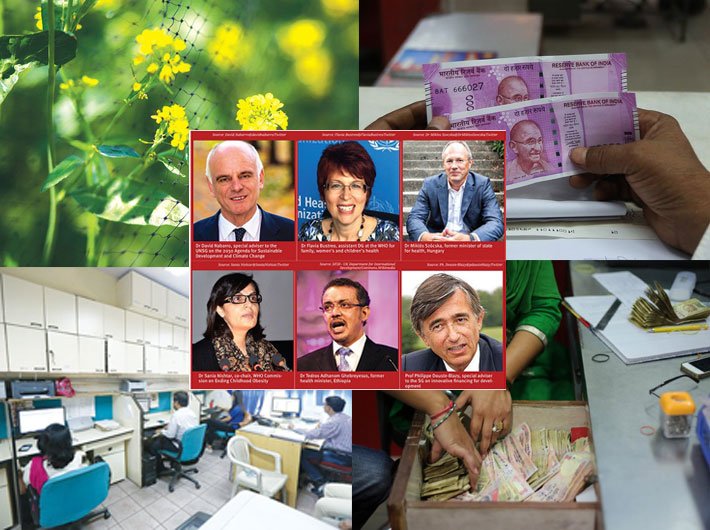
 “Our farmers have been modifying their crops for centuries through the method of conventional breeding. But here we have not modified but *genetically engineered* the mustard parental lines and hybrid in a manner which gives a 20-30% higher yield compared to non-GM mustard. So, it’s better to call it ‘GE mustard’ rather than ‘GM mustard’,” explains Pental, a former vice chancellor of DU and internationally renowned scientist. To understand the significance of Pental’s work, it would help to look at some historical background. When prime minister Rajiv Gandhi set up a National Technology Mission in May 1986, one of the tasks assigned to it was to figure out a way to attain high output with low input in agriculture. Such a multiplier effect was not possible without some out-of-box idea which could come only from technology. Thus began the era of a technological revolution. 

 
It’s a war; it’s a mahayajnya. You have to decide on whose side you are.” -- M Venkaiah Naidu, in parliament on November 17   In its well-intentioned but misconceived war on black money, the government has obviously bitten off more than it can chew.   A wide spectrum of people and political leaders (including PM Narendra Modi’s bitter foe Nitish Kumar) had expressed support to the move. At that point, only economists like Ashok V Desai were criticising the government for what they thought was a foolhardy move. Social media was full of god-natured jokes about housewives and old notes.
 
It’s 2.30 in the afternoon and there is a mad rush in the corridors of Shastri Bhawan which houses the headquarters of several ministries. Holding a bunch of files in their hands or balancing the stack against the waist, peons run across various departments. To save some time, they carry at least five to eight files in one go, before they start for another round. A worker hurriedly pushing a trolley laden with files and papers is seen at frequent intervals in the gallery.
 
The man standing in front of me shifted his weight from his left leg to the right leg. A minute later he gazed forlornly at the serpentine queue outside the ATM, adjusted his spectacles and shifted back his weight on to his left leg.We had been standing in the ATM queue for just under an hour at an upscale neighbourhood of Noida thanks to the decision to demonetise. The seemingly endless number of people ahead of me and the ever lengthening queue behind me was disheartening. Some hopefuls, who arrived thinking they would take out cash, shrugged their shoulders and walked away. The queue was just too long for them.
 
The process for selecting the chief of the world’s biggest multilateral health organisation is underway. The next director-general (DG) of the World Health Organisation (WHO) will be elected at the world health assembly (WHA) in May as the current DG Margaret Chan steps down in June after ten years. Much has changed in the global health landscape during the past decade as new threats have emerged and old ones have quietened down.  


Comments


Other News

“Cancer is just a mind game”

Dr. Ananda Shankar Jayant, a Padma Shri awardee, inspired audiences for decades through her mastery of Bharatanatyam and Kuchipudi. But it was her journey through cancer that taught some of life`s most powerful lessons in courage and resilience.

Why Swami Vivekananda is the pathfinder for our times

Swami Vivekananda for Our Times  Edited and compiled by Rajiv Sikri, with Introduction by S. Gurumurthy Rupa Publications, 552 pages, Rs 695  

Five ways to realise the potential of India’s handicraft and handloom sector

India`s economic ambitions are increasingly defined by the industries of the future. Semiconductors, electronics, artificial intelligence and advanced manufacturing dominate policy conversations. Yet one of India`s largest employment-intensive sectors continues to occupy a surprisingly marginal place in ec

Beyond toilets: Why open defecation persists in rural India

Despite the awareness campaigns on sanitation across India, open defecation (OD) is practised openly and widely in both rural and urban areas. Research shows that rural respondents are well aware of the negative impacts of OD, yet this awareness does not lead to toilet construction or use. In rural North I

What unpaid nation builders want from policymakers

The Supreme Court recently described homemakers as “nation builders” and fixed a notional monthly income of Rs 30,000 for them in motor accident compensation cases. The judgment was not about wages. It was about compensation. Yet it inadvertently raised a larger economic question: If a homemake

What the US–Iran peace deal means for India

After months of rising tensions, the United States and Iran have reached a memorandum of understanding called the "Islamabad Agreement." This agreement allows for the immediate reopening of the Strait of Hormuz without tolls and provides Iran with relief from sanctions, depending on its complianc


Archives

Current Issue

Opinion

Facebook Twitter Google Plus Linkedin Subscribe Newsletter

Twitter







