
Telangana battle won, all eyes on AP assembly now

Though Congress has announced that Andhra Pradesh assembly’s approval by two-thirds majority is not binding on Telangana issue, big question still remains whether the party has enough numbers to get the resolution pass the assembly hurdle

GN Bureau | July 31, 2013
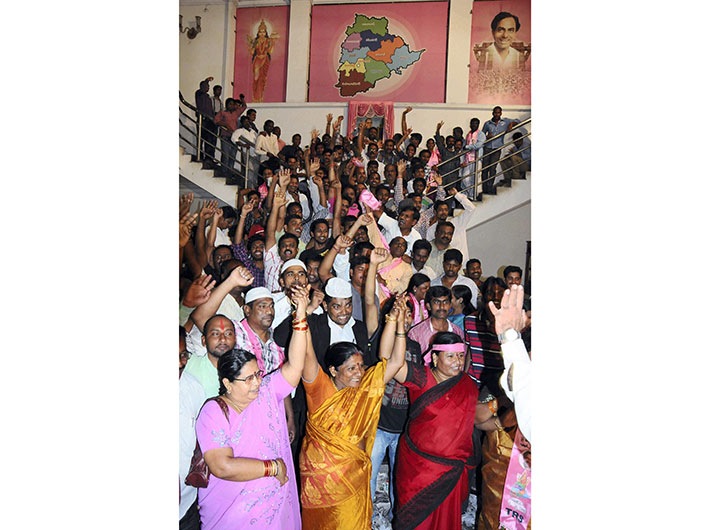

TRS workers in Hyderabad celebrate Congress working committee`s decision to bifurcate Andhra Pradesh and create a separate Telangana state on Tuesday.

After teasing with the Telangana issue for nine years, the Congress may have warmed the hearts across the region, with the party’s working committee on Tuesday giving the nod to bifurcate the state, but nothing will be considered as over until the process for creation of a separate state is over.

For now, more than the union cabinet, all eyes will be on the Andhra Pradesh state assembly when it sits down to pass a resolution to this effect as part of a constitutional procedure.

But does the Congress have enough numbers to get the resolution pass the assembly hurdle is the big question now.

As per constitutional procedure, it’s a lengthy process. The union home ministry will first have to prepare a note on the state’s bifurcation and creation of a new state.

The note will then be endorsed by the union law ministry, which in turn forwards it to the union cabinet, which will refer the issue to the Andhra Pradesh state legislative assembly. As per constitutional obligation, the assembly will have to ratify the resolution by a two-thirds majority.

This is precisely where the Congress could be left on a sticky wicket, given the slender majority it enjoys on the floor of the House. The Congress, with floor strength of 146, will not be in a position to bulldoze through with any bill or resolution.

The party’s Telangana decision is already facing opposition within its own ranks. Two Congress MLAs from the Seemandhra region have announced their resignations since the time the CWC gave its Telangana verdict on Tuesday evening, and there are reports that at least 15 Congress MPs from coastal Andhra Pradesh and Rayalaseema have intimated the party high command that they would abstain from voting in favour of Telangana in parliament.

The number of Seemandhra legislators quitting in protest is likely to swell in the coming days. By the time the resolution is referred to the state assembly, chances are high that more MLAs would dent the party.

The Congress, though, has announced that the assembly’s approval by two-thirds majority is not binding on the Telangana resolution. It announced its plans to introduce the Telangana bill in parliament regardless of its fate in the Andhra Pradesh assembly.

The Lok Sabha and Rajya Sabha will have to pass a constitution amendment bill for the creation of the new state under Article 3 of the Constitution.

The Congress may have the last laugh, as it seemed to have mobilised support for the bill in parliament. The party may win the battle on the bill before it is referred to the president. But a storm is certain to brew, especially in case the resolution fails to pass the assembly test.

This can become a precedent and give fillip to other statehood demands across the country. The campaign against smaller states, coming from within the UPA, can become stronger with leaders like Omar Abdullah getting more vocal.

Besides, the Congress will be accused of adopting double standards, especially regarding Uttar Pradesh. The previous government under chief minister Mayawati had already got the state assembly to pass a resolution to break UP into four smaller states. Thus, the Congress party’s decision to opt for a parliament approval for Telangana while stonewalling the UP assembly’s resolution is certain to spark a new debate.

Perhaps this is the reason why the party high command got trusted lieutenant Digvijaya Singh treat the Telangana tangle as a unique issue. Speaking from the same podium used for the Telangana announcement, Singh sought to see the vexed issue as completely different from other statehood demands.

Comments


Other News

In Arunachal, a river we call mother

In Arunachal Pradesh, the Siang is not just a river. For many of us, especially the Adi people, it is part of our family. Our grandparents fished in it. Children learned to swim in it. Our farms drink from it. When someone says a huge dam will be built on it, we do not hear the word "project".

A new retelling of the Mahabharata delves into key moments

In a time when every decision carries consequences and questions of ambition, power, loyalty, identity and moral choice continue to shape our lives, Dr. Arun Krishnan’s new book, ‘Mahakshana’ (Penguin India) offers a strikingly relevant retelling of the Mahabharata.  

Cabinet approves viability gap funding to develop grid-scale energy storage systems

The Union Cabinet, chaired by PM Narendra Modi, has approved the Viability Gap Funding (VGF) Scheme for Development of Grid-Scale Energy Storage Systems, with a total financial support of Rs.14,500 crore for the period FY 2026-27 to FY 2030-31. The scheme aims to support the development o

Cabinet creates a pathway to absorb Agniveers in Defence Forces

An objective assessment in terms of organisational requirements and operational efficiency has brought out the outstanding performance of Agniveers in terms of skills, motivation levels, physical fitness and technological prowess. As envisaged earlier, based on merit, 25% of Agniveers will be offered reg

Modi inaugurates, lays foundation stone of Pune Metro projects

Prime minister Narendra Modi inaugurated and laid the foundation stone for Pune Metro projects worth around ₹21,800 crore on Tuesday through video conferencing. Addressing the gathering on the occasion, the PM extended warm Diwali greetings to the people of Pune and Maharashtra and remarked that f

Wired for good: Building sustainable cities with AI

The First Industrial Revolution in the 18th-19th centuries ushered in a paradigm shift in how cities were imagined. Fueled by railways, factories and grids, and obsessed with speed and scale, it was an ode to efficiency, which spurred unprecedented economic growth. Now, as the Fourth Industrial Revolutio


Upcoming Conferences


-->

Archives

Current Issue

Opinion

Facebook Twitter Google Plus Linkedin Subscribe Newsletter

Twitter





