
The Kashi-Kyoto (dis)connect, rise of Chandrashekhar Azad, and why parties should return to the masses

Here is a list of five stories that you must read over the weekend

GN Bureau | June 2, 2017

#Bhim Army   #Kyoto   #Kashi   #AAP   #weekend stories   #Chandrashekhar Azad   #Maoists  


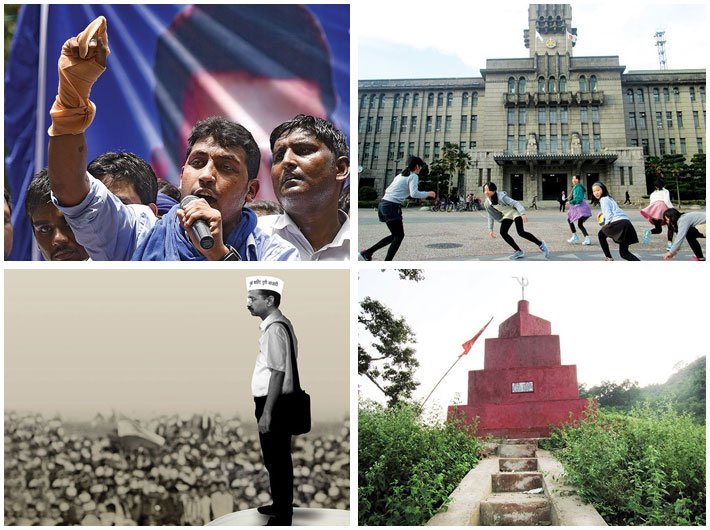
In 2014, Varanasi and Kyoto came in a ‘partner city’ relationship, a non-financial affiliation under which private firms (and not governments) from both cities finalise a set of themes and take them forward. Kyoto mayor Daisaku Kadokawa and the then Indian ambassador to Japan, Deepa Gopalan Wadhwa, signed the pact in the presence of Narendra Modi and Japanese premier Shinzo Abe. The agreement proposed cooperation between the cities in areas of art, culture, academics and city modernisation. 
Three years have passed since then. The agreement of cooperation and redevelopment of Varanasi on Kyoto lines, however, seems to be dying.
 
 
Varanasi is still celebrating its status of one of the oldest cities, its great history and political and religious significance. But it is yet to see achhe din. Thousands of kilometres away, in Kyoto, Japan, nothing is like Kashi. Back in Kashi, nothing is like Kyoto. The Kyoto-Kashi pact has been reduced to a sarcastic idiom for use by locals. Even so, this ancient city has the potential to become a good, livable city – without diluting its identity and without being compared to Kyoto.
 
 
Of the total 1,730 people killed in insurgency hit areas of Bihar, Madhya Pradesh, Chhattisgarh, Andhra Pradesh, Telangana, Odisha, Maharashtra, Uttar Pradesh and West Bengal from 2011 to April 2017, as many as 642 were security forces personnel. The worst month was April when 25 security personnel were killed by Maoists in Chhattisgarh. In spite of the rise in the fatalities among CRPF personnel, the ongoing exercise to arm the forces with modern equipment and training is tardy.
 
 
Despite its missteps and irrespective of its failure, what the Aam Aadmi Party experiment shows is that there is enough space for alternative politics based on the principles and probity in public life. Indians are yearning for principled politics. Any political formation that taps this yearning is in all probability likely to be suitably rewarded. Once on the downside, AAP fell back on traditional strategies of mobilisation: publicity mongering, allegations of corruption in high places, advertising and blame game. The more the AAP relied on the traditional methods, the more it distanced itself from its middle class support base that had brought it to power and went against the very grain of its creation.
 
 
BJP leaders might be dismissive of the Bhim Army, but it does signify a new, aggressive phase in dalit politics in western Uttar Pradesh that is also spreading to Haryana, Delhi and Rajasthan. Saharanpur, close to the Haryana and Uttarakhand borders, with a mixed population dominated by Muslims and dalits, is known for wood-carving, cottage industries, basmati, and mangoes. In Chutmalpur, some 30 km from Saharanpur and close to Deoband,everyone knows Chandrashekhar Azad of the BhimArmy, which they say he founded in July 2015 to fight caste oppression. 


Comments


Other News

Caring for cancer patients: the expanded network of facilities

Health is a State subject, and the primary responsibility for providing healthcare services, including cancer care, rests with the respective state governments. However, the Department of Health and Family Welfare provides technical and financial support to States and Union Territories across the country

Capabilities, aspirations of India’s youth limitless: Modi

The capabilities and aspirations of India’s youth are limitless, prime minister Narendra Modi said in his remarks to the media at the start of monsoon session of the parliament on Monday.  "In the past month, the country has achieved many milestones, filling citiz

India gets the first hydrogen train

Prime minister Narendra Modi on Friday laid the foundation stone and dedicated to the nation various development projects worth around ₹14,700 crore in Jind, Haryana.   The PM positioned the city as a shining reflection of the good governance model. Emphasizing that the entire Haryana

Climate change is stealing sleep

Climate change has at least doubled the temperature-related sleep loss across 1,338 major cities worldwide over the past five decades, highlighting an emerging but often overlooked public health consequence of rising global temperatures. A new study by Climate Central estimates that between 2020 and

Cabinet approves Mobile Phone Manufacturing Scheme

The union cabinet chaired by PM Narendra Modi has approved the Mobile Phone Manufacturing Scheme (MPMS) with a budgetary outlay of Rs 62,500 crore. It aims to further scale up the production, deepen domestic value addition, strengthen supply chain resilience, enhance global competitiveness. It

Building infrastructure is only half the job

Recent stories of stolen railway wires, disappearing communication towers and missing public infrastructure are often treated as bizarre law-and-order failures of India. Yet they raise a more fundamental question. Why does the State often discover the disappearance of a public asset only after it has alrea

Upcoming Conferences


Archives

Current Issue

Opinion

Facebook Twitter Google Plus Linkedin Subscribe Newsletter

Twitter







