
World needs to move fast to achieve modern renewable energy goals
GN Bureau | May 20, 2015

While the world becomes more connected through all kinds of communication modes, around 1.1 billion people across the globe still live without electricity, reveals a World Bank report.
The report, ‘Progress Towards Sustainable Energy: Global Tracking Framework 2015’ reveals that around 2.9 billion people (which is more than the population of India and China combined) have no access to clean and modern cooking fuel.
READ: Key findings of the report
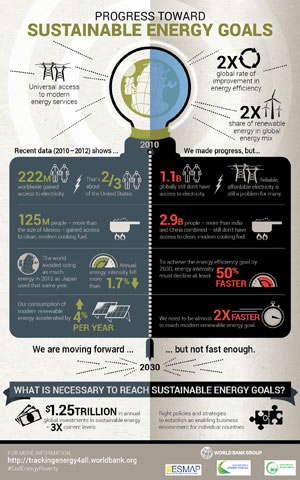 However, the reports charts out development and said the world has made sufficient progress to achieve sustainable energy requirements for all by 2030. But the world needs to move twice as fast to achieve modern renewable energy goal. At present the consumption of modern renewable energy is accelerated by 4 % per year.
There have been advances in electrification drives primarily by India but progress in Africa remains too slow. In India, 55 million people gained access over 2010 to 2012.
The global electrification rate rose from 83% in 2010 to 85% in 2012 with an additional 222 million people mainly in urban areas gained first time access to electricity (which is more than the population of Brazil, and well ahead of the 138 million population increase that took place over the same period). Overall, the global electricity deficit declined from 1.2 billion to 1.1 billion.
The report provides an update on how fast the world moved towards sustainable energy goals between 2010 and 2012. It tracks progress towards universal access to modern energy, doubling the rate of energy efficiency improvements and doubling the share of renewable energy consumption in the global energy mix.
Last summer, the two of us spent several weeks in rural Madhya Pradesh with a non-profit that works on gender justice through women’s self-help groups. We went in with a notebook full of laws. The Protection of Women from Domestic Violence Act. The Dowry Prohibition Act. Free legal aid for every wo
Digital payments have become a reflex for urban India, but the confidence earned in paying has not yet carried over to borrowing. That is the central finding of `How Urban India Pays Report 2026`, released by Pahlé India Foundation in collaboration with Amazon Pay. Based on a survey of 5,149 consu
Commerce and industry minister Piyush Goyal has called upon businesses in India and the United Kingdom to translate the opportunities created by the India-UK Comprehensive Economic and Trade Agreement (CETA) into expanded trade, investment, partnerships and job creation. Addressing the Bu
The Gandhian movement in India, after Gandhi’s death, failed, says Ramachandra Guha, and blames Vinoba Bhave for it. But the movement found new, fertile grounds around the world and succeeded in bringing about a change in South Africa, the US and elsewhere. It is high time it returned home. Of cour
Tavleen Singh, noted journalist and political commentator, has turned to fiction, with her debut novel ‘The Actor’ (HaperCollins India). Set in the near future, it has a superstar, Amit Singh, turning to politics, when the political landscape is dominated by prime minister Guru Gaynendraj
The union cabinet, chaired by prime minister Narendra Modi, on Tuesday approved the setting up of a Special Purpose Vehicle (SPV), called Integrated Transport & Logistics Authority (ITLA), to strengthen research, planning, appraisal, monitoring and impact assessment within the broad domains of Transp










