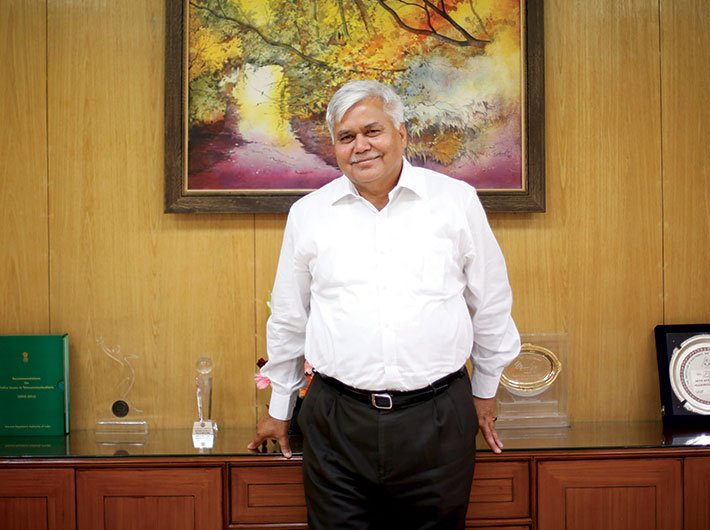
As call drops and poor network problems are being mentioned even by the prime minister, new telecom regulatory authority of India (TRAI) chairman Ram Sevak Sharma talks on the subject in an exclusive conversation with Governance Now. Sharma, a 1978-batch IAS officer, has been a major force behind the Digital India programme. In an interview to Taru Bhatia, Sharma talks about the industry, issues before the private operators like spectrum availability, taxes it involves, white space (the gap between two broadcast channels) and Digital India. Excerpts from interview:
Should the department of telecommunications come up with a uniform policy for mobile phone tower installation?
A common and transparent policy is certainly good for the industry. They will know who to approach for permission and how work can be completed in time. However, regarding tower installation sites there is an issue of jurisdiction over the area where the tower is to be installed. The central government, for example, can easily allow towers installation on its property. Similarly, it is for the state governments to decide about its properties and for the municipal authorities on theirs. I am, therefore, not sure whether a uniform, enforceable policy in this regard can be made by any one central government department. However, having a common policy or even uniform and transparent guidelines for adoption by various agencies will be very useful.
DoT has rejected suggestions from telecom service providers (TSPs) for omitting spectrum trading fee from the draft guidelines. TSPs say 30 percent of their revenue goes into taxes and fee. Do you think it will ultimately affect consumers?
The proposed one percent fee is a nominal fee to offset administrative costs. This should not affect the consumer charges.
The government asked TRAI to determine base or minimum price of telecom spectrum in all bands for the next auction. Has it been determined by the regulator?
Not yet. We are examining the issues involved and will come out with a consultation paper shortly.
Can you please elaborate the process that you are planning to monitor quality of service on ground level for every district and block – in Mumbai and Delhi? How will it be done?
This is the digital era and all the mobile phone towers in the country are connected to different networks. The infrastructure is present. The issue is to build a software environment in which required parameters can be collected, collated and pooled together to provide us with the desired information at a common point.
Eleven percent of airwaves remained unsold in the March auction, but the government claims that there is not enough spectrum available. Isn’t it a contradiction?
The issue of scarcity of spectrum for commercial utilisation in India being contradictory to 11 percent of the spectrum remaining unsold in the recent auction is not really a valid conclusion. Some spectrum remained unsold, as you point out, in the March 2015 auction. However, this was due to many reasons including the fragmented spectrum being auctioned, caps on the amount of spectrum that could be bought by a single bidder. In an auction where varying amounts of spectrum are offered across several spectrum bands, this kind of left-over at the margins is possible.
However, the issue of adequacy of spectrum, or otherwise, has to be seen at the macro level. There is certainly a need for making more spectrum available for commercial activities.
Is there any framework to utilise white space to create spectrum?
Some preliminary work is being done in this area by various departments and agencies. TRAI is also participating. We will, at some point, take a call on whether to issue any recommendations for a framework.
Telecom operators argue that it is not the case that they do not want to invest in infrastructure but the states and municipal authorities need to be more cooperative in allowing installation of towers. The authorities’ action causes loss to the TSPs. What do you think about this?
This is a difficult issue and a variety of reasons are being cited as to why the requisite numbers of towers are not being installed or made available. Government agencies at all levels must recognise the telecom sector as a critical infrastructure sector and assist in its development in a positive manner. To the best of my knowledge, DoT is working with various departments and states to have a collaborative approach in installation of towers.
For spectrum trading licence fee, operators have to pay double tax. Also the spectrum is costly in India. Can these issues be addressed as demanded by TSPs?
TRAI’s recommendations in this regard are in accordance with the current practices of calculating licence fee. TRAI in its revised recommendations on adjusted gross revenues (AGR) has clarified what can be taxed and what can exempted.
How will TRAI contribute towards the Digital India programme? Your predecessor, Rahul Khullar, said that Digital India by 2019 was impossible.
The Digital India programme is an extremely ambitious project which seeks to transform India into a digitally empowered society and knowledge economy. The government has embarked upon it as one of its flagship projects. I believe that this is eminently doable and must be done. TRAI has already put forth its recommendations to the government as to how one of its very important components – making broadband available to the citizens as a utility – can be done. We will continue to provide our advice and inputs to the government on various facets of Digital India, insofar as these relate to the issues being dealt with by the TRAI. We will need to have appropriate business models in place for providing broadband connectivity everyhere.
140 channels have been found violating the TRAI regulation of the 12-minute ad cap and the case is coming up soon. How will TRAI carry this forward and ensure that the rules are followed?
TRAI’s regulations regarding the 12-minute ad cap has been contested in the Delhi high court. Since the matter is sub-judice it is not appropriate for me to comment on this matter.
In 2013, TRAI proposed an increase in the FDI cap in TV broadcasting. What is happening with that and how is that being implemented?
Since I took over as the chairman, I am reviewing the status of implementation of the various recommendations that the TRAI has forwarded to the government. Several recommendations are still under consideration of the concerned departments. I intend to first review the situation and then take appropriate follow-up action with concerned agencies, as may be necessary.
(The interview appears in the October 1-15, 2015 issue)