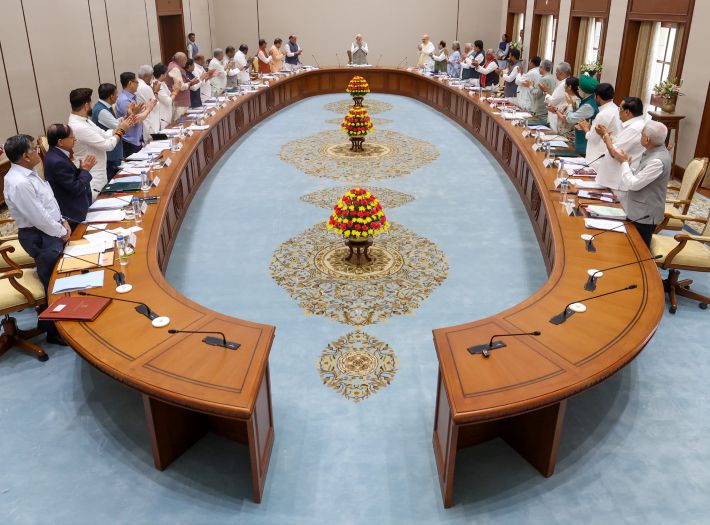
The Union Cabinet on Wednesday passed a resolution marking June 10, 2026, as a historic milestone in the journey of Indian democracy applauding Narendra Modi for becoming the longest-serving elected PM of the country. By establishing a record of 4,399 days of continuous service as an elected PM, he has surpassed the previous record held by Jawaharlal Nehru, who served for 4,398 continuous days from 1952 to 1964. The resolution states that this occasion stands as a symbol of India's democratic consciousness, public trust, and the power of public participation, reflecting the unprecedented support bestowed by the people upon a leader guided by the 'Nation First' resolve.
Extending its heartfelt congratulations and best wishes to the PM, the resolution highlights that this achievement coincides with the NDA government completing 12 years under his leadership. It also notes that the PM is approaching the historic mark of 25 years of continuous service as Head of Government. Taking pride in a leadership characterized by sensitivity, restraint, intent, and decisiveness, the official text emphasizes that it is after six decades that the country has given a mandate to the NDA government for a third consecutive term.
Outlining the PM's life as a symbol of continuous dedication to service and nation-building, the text recalls his 2014 declaration as the "Pradhan Sevak" committed to the mantra of 'Sabka Saath, Sabka Vikas'. Acknowledging that the welfare of the poor has been placed at the center of governance, the document details the unprecedented scale of amenities delivered,including pucca houses, electricity, clean water, and direct benefit transfers, alongside free rations for over 80 crore citizens and free medical treatment for over 60 crore poor individuals. The resolution records that these efforts collectively boosted national self-confidence and enabled over 25 crore people to defeat poverty, according to an official release.
The resolution further maps the empowerment of key demographics. It recognizes the focus on youth power that propelled India into becoming the world's third-largest startup ecosystem and a scientific power through Mission Chandrayaan. A new chapter of 'Women-Led Development' is detailed through comprehensive policies ranging from smoke-free kitchens and the Lakhpati Didi campaign to the historic 33 percent reservation for women in legislative bodies. Affirming farmers as a core pillar of a 'Viksit Bharat', the text applauds initiatives like PM Kisan Samman Nidhi and the provision of Kisan Credit Cards to pastoralists and fishermen, which have helped propel agricultural exports past the Rs 5 lakh crore mark.
Praising the decisive 'Nation First' spirit in enacting decades-pending reforms, the resolution commends landmarks such as the abrogation of Article 370, implementation of GST and OROP, the CAA law, the Bharatiya Nyaya Sanhita, and the consolidation of labor codes. The document strongly emphasizes the elevation of national security, evidenced by strict actions against terrorism like surgical and cross-border air strikes, 'Operation Sindoor', and the suspension of the unjust Indus Water Treaty. Commendable strides are also noted in the eradication of Naxalism, the signing of permanent peace accords in the North-East, and the resolution of the border dispute with Bangladesh.
The resolution attributes the advancement of India's manufacturing capabilities in sectors from defense to AI to the momentum gained by the 'Make in India' and 'Aatmanirbhar Bharat' campaigns. Simultaneously, it highlights India's strengthened global role through the successful G-20 presidency, International Yoga Day, and initiatives like the International Solar Alliance and Mission LiFE. By taking development and heritage ('Vikas' and 'Virasat') together, the text notes a cultural renaissance symbolized by the new Parliament building and Kartavya Path, driven by a spirit of public participation that successfully navigated global crises like the Corona pandemic.
Underlining that the political stability, dynamic governance, and far-sighted policies of the last 12 years have transformed India into the world's fastest-growing large economy, the Union Cabinet officially adopted the following resolutions to express its deep gratitude and future resolve:
Formal Resolutions Adopted by the Union Cabinet:
Conveys its heartfelt congratulations and best wishes to the Hon'ble Prime Minister Shri Narendra Modi on this historic achievement.
Expresses gratitude for the work done under his leadership for the welfare of the poor and the empowerment of marginalized sections.
Appreciates the policies of the Hon'ble PM that have enabled more than 25 crore poor people in India to defeat poverty under his leadership.
Expresses gratitude for his unique dedication and tireless hard work towards serving the nation.
Appreciates his efforts directed towards inclusive growth and social justice.
Praises his leadership in strengthening national security and protecting India's interests.
Expresses its full support for his visionary resolve and leadership in building a 'Viksit Bharat' (Developed India).
The adopted resolution concludes by extending best wishes for the excellent health and long life of the Prime Minister. It firmly expresses absolute confidence that under the leadership of Shri Narendra Modi, India will continue to achieve new heights as a self-reliant, secure, prosperous, and glorious nation, strongly paving the way to becoming a developed nation by 2047.