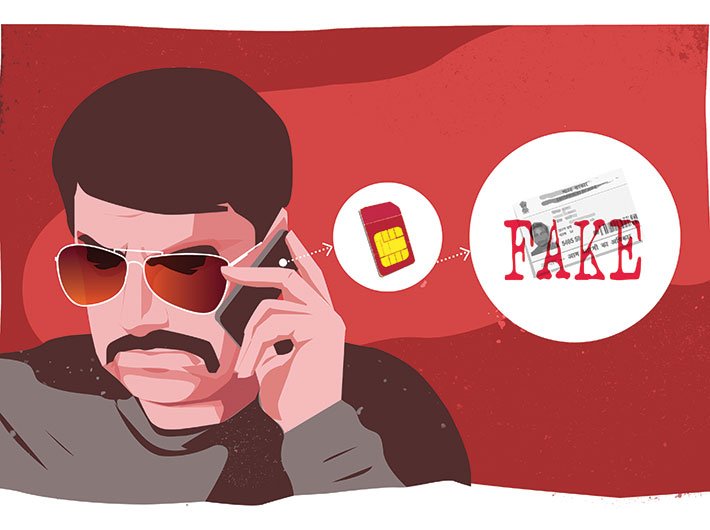
Criminals have been using forged documents to get SIM cards. Their free run can end soon as the customer’s identity will be verified with Aadhaar-based biometrics
Vijay Aggarwal, a 32-year-old businessman from Uttar Pradesh’s Aligarh city, last year received a call from an unknown person who introduced himself as an agent from Birla Sun Life Insurance. Vijay was told that he had got a bonus of Rs 75,000 on his policy, and to redeem it, he was asked to deposit Rs 14,000 in a bank account. He deposited the money, but didn’t receive any bonus. Instead, he got another phone call.
“The person told me that because of some technical error I hadn’t got my bonus yet. But if I gave Rs 11,000 more, I would straight away get a bonus of Rs. 1 lakh,” Vijay says. A series of phone calls continued, and Vijay claims in his FIR that he gave away Rs. 58 lakh to a stranger. The culprits were arrested, but Vijay couldn’t recover his money.
The police later found that forged papers had been used to get a SIM card from which the phone calls were made.
Vijay is not the only one to have fallen prey to this kind of crime. Chandrashekhar, a retired government employee from Lucknow, was duped of more than Rs. 20 lakh a year ago through a phone call by a person, who introduced himself as an agent from SBI Life Insurance. In that case too, the SIM card had been issued on forged documents.
Such crimes which include selling fake credit cards, insurance policy and loans on phone are termed white-collar frauds, and they are routinely committed across the country. And they all have a common thread – the criminals in such cases use fake documents to procure SIM cards.
In December last year, the Uttar Pradesh special task force (UPSTF) arrested more than 100 people for running fake call centres in Delhi and Noida and for duping people by posing as insurance agents. UPSTF additional superintendent Triveni Singh says that the accused procured records of people from insurance companies, got SIM cards on false identity, contacted people as insurance agents, and duped them.
“Last year, 342 people were arrested in UP for running fraud call centres, and more than Rs. 100 crore was acquired fraudulently,” he says, adding that people across the country are being duped through such means.
Who do we blame for such crimes? Singh feels telecom operators need to be made accountable for crimes committed over phone, and lacking a strict customer verification system in place.
Weak verification system
Committing crime via phones has become convenient due to easy availability of SIM cards, especially prepaid SIM cards. In fact, arranging an address and identity proof is enough to get a SIM card.
An individual can buy up to nine SIM cards as per the telecom ministry guidelines. It has come to light that a retailer can misuse genuine documents to issue a number to another person.
Moreover, technology is helping criminals to create fake identity in order to get a SIM card. Today, with the help of certain photo-editing softwares, one can forge an identity, and use it to activate mobile numbers. Since physical verification is not mandatory in activating SIM cards, such incidents are on the rise.
In January, the Delhi crime branch seized 205 pre-activated SIM cards of Vodafone and Idea. The sleuths also got hold of a thick bundle of forged documents that were used to activate those numbers. “There are some genuine cases when a person does not have an identity proof, and yet gets a SIM card. But such cases are limited in number. Majority of buyers of SIM cards that are illegally activated are criminals,” says sub-inspector Sanjeev Yadav from Delhi crime branch.
From cheating to extortion to terror, pre-activated SIM cards are being used due to poor verification mechanism, Yadav says.
“Such a faulty verification system can cause a threat to national security too. Telecom operators need to take responsibility. They carry out rigorous verification for postpaid SIM cards. But when it comes to prepaid SIM cards, verification is loosely done,” Yadav adds.
In the current system, to buy a prepaid SIM card, a person manually fills a customer acquisition form (CAF) and provides his or her identity proof and address proof along with a passport size photograph to the retailer, who in turn sends the CAF to the operator concerned. The user gets a verification call before the number is activated.
“Every day we are activating so many numbers, that it is not possible for us to physically verify each number,” says Sanjeev Arora, deputy general manager, Vodafone.
In case there are complaints against any number running on fake ID, we file an FIR as per the telecom ministry guidelines and deactivate the number and black-list the retailer who is involved in fraudulent activities, Arora adds.
There were 102.66 crore mobile phone subscribers till February 2016, as per the Telecom Regulatory Authority of India (TRAI). The number continues to rise.
On this matter, RS Sharma, chairman, TRAI, told Governance Now, “The present subscriber verification method cannot be said to be fully secure and robust.”
Making a secure channel
On TRAI’s recommendation, the ministry of telecommunications is planning to overhaul the current system of user verification.
Soon SIM card sale at the retail point will be linked to a user’s Aadhaar number and biometrics. This means the SIM card retailer at the point of sale will take the fingerprint or iris scan of the buyer, along with his or her Aadhaar number. Only after performing online know-your-customer (KYC) with Unique Identity Authority India (UIDAI), CAF will appear on the retailer’s computer screen, which will be submitted online.
“E-KYC verification will not only reduce the risk of identity fraud and document forgery, but it will also make the entire process of subscriber verification paperless,” Sharma says, adding that online verification will allow instant activation of SIM card. The process however will run parallel to the manual process.
“Aadhaar-based biometric e-KYC for paperless activation for telephone connection has been piloted by some telecom operators at 107 retail locations in five cities. Therefore, we hope that it would be accepted by DoT very soon,” Sharma says.
As per the government’s figure, total number of Aadhaar identities generated so far is 100.23 crore.
Now to implement the project successfully, operators need to equip each retail point with equipment to capture biometrics.
Moreover, ensuring internet connectivity for instant online verification is also important. Introducing biometrics for the sale of the SIM card will create a secure channel, and help detect fake documents.
[email protected]
(The story appears in the June 1-15, 2016 issue)