Dr. Arun Krishnan’s new book, ‘Mahakshana’ steps inside the minds of the men and women who shaped Bharatavarsha, capturing them at the instant when choice becomes destiny
In a time when every decision carries consequences and questions of ambition, power, loyalty, identity and moral choice continue to shape our lives, Dr. Arun Krishnan’s new book, ‘Mahakshana’ (Penguin India) offers a strikingly relevant retelling of the Mahabharata.
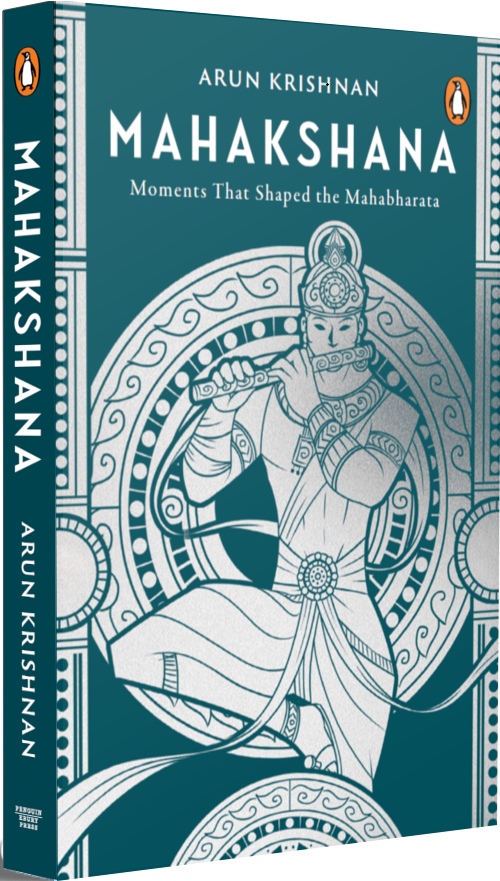
‘Mahakshana’ pauses at the defining moments when choices are made, emotions collide and destinies change forever. Through these moments, the ancient epic becomes a reflection on the dilemmas that remain deeply familiar even today.
From Devavrata’s transformation into Bhishma and Amba’s turn towards vengeance, to Karna’s dilemma over the Shakti, Bhima’s wait to confront Kichaka, and Abhimanyu’s contemplation before entering the Chakravyuha, ‘Mahakshana’ explores the epic through moments of decision, consequence and irreversible change.
These are not stories of Gods and heroes. They are stories of desire and doubt, rage and love, ambition and guilt—of ordinary human emotions colliding with extraordinary destinies.
In this extraordinary retelling of the Mahabharata, Mahakshana, Arun Krishnan steps inside the minds of the men and women who shaped Bharatavarsha, capturing them at the instant when choice becomes destiny.
Here is an excerpt from the book:
The Right Way
‘I have taught you everything. It is now your choice as to what you want to do,’ said Krishna, as he finished the great song.
There was a hush around the battlefield. The only sounds were the fluttering of the pennants and the flags. Even the animals were unusually quiet. And Arjuna? He seemed to have been stunned into silence by the eloquence of one man. Man? God? Avatar? Who can tell? Who truly knows?
The man at the centre of it all, Arjuna, still sat at the bottom of his chariot, deep in thought. But this wasn’t a figure of haplessness. The silence of the man was contemplative, as if weighing the import of the words that had just been delivered to him.
He had been sunk in a morass of self-doubt just a short while back. When they had ridden out earlier that morning to war, he had been full of zest and energy. His chariot was slightly behind that of Drishtadyumna, the son of Drupada, who had been made the commander of the Pandava forces.
Next to him were all his brothers. Their polished armours glittering in the morning sun, resplendent like diamonds.
In front of them were arrayed the might of the Kaurava forces. Arjuna had asked his charioteer, Krishna, to drive his chariot to the centre of the battlefield. And there, standing between the two armies, looking at the faces of those near and dear to him on the Kaurava side, the first seeds of doubt had started sprouting deep within his heart.
There was Bhishma, the man who had been more than a father figure to them all. Over there stood Dronacharya, his guru, teacher and mentor. The man who had taught him everything he knew. He saw his uncle Shalya, the brother of mother Madri. He had been tricked by Duryodhana into siding with them against his own nephews. But, whether against his will or not, he now stood on the other side, ready to take up arms against his own flesh and blood, and he was as formidable a fighter as there ever was.
All around them were gathered grandfathers, uncles, nephews, cousins and friends. That little sprout of doubt was starting to grow. What am I doing here? What do I gain from fighting and killing all my relatives and friends? What good deeds can accrue from my being the cause of their deaths?
Is this how we want to regain our kingdom? By annihilating those closest to us? What would such a victory even mean? Is it even the right path? The path of dharma? Wouldn’t it be better if I refused to fight? To kill my own? Wouldn’t that truly be the dharmic path to tread?
He was confused. A strange lassitude seemed to envelop him. He sank into the warm embrace of inertia. The strength seemed to leave his arms. The very arms that could string even the strongest of bows. The Gandiva, the bow gifted to him by the God of Fire, Agni, slipped from his nerveless grasp and clattered to the chariot floor.
Krishna had turned around at the sound but hadn’t said anything. Arjuna had himself verbalized his confusion, pouring out his heart in a deluge of emotion, but which, strangely, didn’t seem to trouble Krishna at all. At some level, he grew angry that even as he poured out his heart in front of the two armies, Krishna remained unmoved. He had that same smile upon his face—an all-knowing smile, that, at that moment, he had resented.
He had vented his anguish at having to fight his brethren. He had argued brilliantly—at least he thought that he had—about the futility of fighting such an unjust war and regaining their kingdom.
What use of such a victory, where all the loved ones die? He had asked.
Wouldn’t the Gods themselves look down upon it? He had questioned.
‘Wouldn’t the path of dharma be to withdraw from this battle without killing one’s kinsmen?’ He had queried.
And through it all, Krishna had maintained his silence, allowing him to speak and get everything off his chest. Then, once he had exhausted all his arguments and had plopped down on the floor of the chariot in utter despair, and asked for help from Krishna, only then had Krishna started speaking.
* * *
He had started off by explaining to him about the nature of humans.
‘All living beings are based on their characters, Arjuna. The characters themselves are built upon one’s innate nature or tendencies. There are three such tendencies— sattva or the intellectual and pure, rajas or the active and physical and tamas or the indolent nature. Every living being is a combination of these three tendencies, and the proportion of these tendencies defines how the being acts in life.’
He had continued to expand on this by saying that all of creation was built upon the single, underlying life force, or the brahman.
‘The goal of each individual, Partha, is to do his own karma according to his innate characteristic and to try and remove the darkness of ignorance about the true nature of reality, by shining the torch of truth and knowledge. Each person has to do it in his or her own way, based on which tendencies are strongest in them. There is no one way.’
‘For those intellectually inclined, Bharata, there is the intellectual path, where one can use reason and turn the eye of logic inward, uncovering the underlying reality. For those more energetic is the path of action, where one performs one’s actions without worrying about the fruits of those actions, thereby detaching oneself from immediate cause and effect, pleasure and pain, and all manner of duality. The third option that exists is the path of bhakti, or devotion, that enables those who are neither intellectually oriented, nor energetic to still understand reality by focusing on the Gods. It doesn’t matter which God, because the Gods themselves are a product of the underlying reality. As long as one uses devotion to the Gods to ultimately discover brahman, it is a perfectly valid path.’
Krishna had gone on to expound on the qualities of the brahman.
‘The brahman, dear Kaunteya, is immutable, unchanging, beyond pairs of duplicates. It is the underlying reason for reality, but it is unaffected by reality. All of us have a part of the brahman within us, because the underlying reality is the same for all of us, whether living or nonliving, human or animal. Only the truly knowledgeable understand this oneness.’
Krishna had pointed out to him that life and death were an inevitable concomitant of reality.
‘Death follows life, which is again followed by rebirth and rejuvenation. If you think, my dear Arjuna, that you will be the cause of the death of your relatives, you are wrong. Because, I, Krishna, am the cause of all that has been, or is, or will ever be. I am the underlying reality. Aham Brahmasmi. I am brahman. Everything rises from Me and falls back into Me.’
[The excerpt reproduced with the permission of the publishers.]












