Exciting possibilities ahead, but the systems must be continuously monitored to prevent bias and civic audits to establish trust and validity
The First Industrial Revolution in the 18th-19th centuries ushered in a paradigm shift in how cities were imagined. Fueled by railways, factories and grids, and obsessed with speed and scale, it was an ode to efficiency, which spurred unprecedented economic growth. Now, as the Fourth Industrial Revolution promises to metamorphose our cities through Artificial Intelligence, efficiency remains the watchword yet again.
Cities like Varanasi and Pimpri-Chinchwad, powered by the government’s flagship Smart Cities Mission, are on a path to societal transformation with AI integration. The technology is being employed in different departments like traffic and waste management, energy, weather forecasting, and policing to handle enormous datasets, improve current workflows, and make predictions. This is, in fact, indispensable, since 70% of the global population is expected to live in cities by 2050, according to the UN. But if efficiency was the obsession of the Dickensian “town of machinery and tall chimneys,” must it remain so? What’s wrong with a perfectly efficient system?
It’s similar to asking someone why their grandmother’s dal tastes better than the one from a restaurant. It's a simpler recipe with a less sophisticated method, yet it has what the chef cannot conjure: the way she remembers you don’t like it too spicy or with cilantro, adds in an extra spoonful of desi ghee because you've been looking thin lately, and saves you a bowl for the next day because you enjoy leftover dal. The restaurant replicates its recipe, portions and flavour for every customer, but grandma’s cooking sees you. This is what our AI-driven cities must remember: that optimization serves the system, while care serves the human.
Equity and Inclusion
For cities to be truly sustainable, inclusion must be built into the design of the system. Accessibility comes as a footnote in most urban plans, but AI can help flip the script. Computer vision and mobility data can be used to audit public buildings and highly frequented spots for accessibility gaps affecting older adults and individuals with disabilities, and “mobility-poor zones” can be flagged. AI devices, like digital sentinels, can keep a close eye on the essential health parameters of individuals, tracking conditions like Alzheimer’s and dementia, as well as recognizing falls or unusual movements. In an increasingly nuclearized society, this establishes a safety net that supports autonomy and dignity.
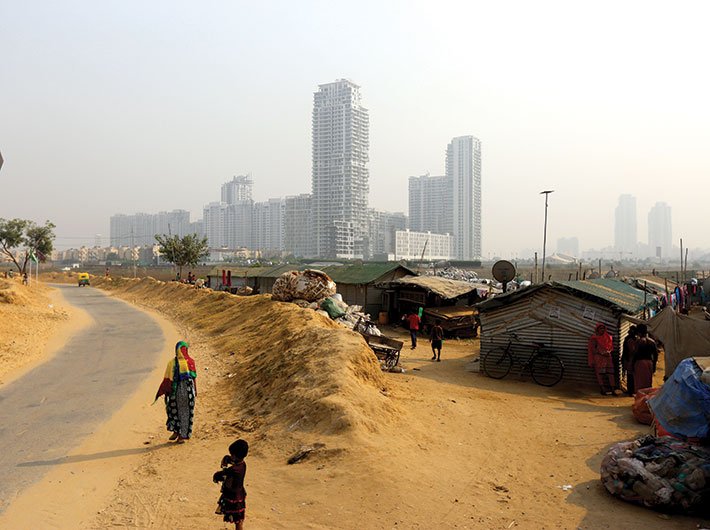
The invisible Vishwakarmas of Indian cities—the migrants—lack documentation, housing security, and a stake in governance, even as they constitute a third of India’s urban population. AI can feed into MoSPI’s Periodic Labour Force Survey and lead to the identification of migrant locations through satellite and phone data that would allow for the dynamic delivery of services. It can provide real-time translation for civic participation, transforming migrants into active, integrated citizens. Yet, inclusion isn’t just about access—it’s also about belonging.
Social Commons & Well-being
Our cities, built in a scramble, often forget to save space to pause, play, and meet. This is where AI can come in as a placemaker and help us reclaim these spaces. Barcelona’s ‘Superblocks’ initiative is an example; it follows a concept known as Tactical Urbanism, proposing simple, low-cost modifications for built-up areas. AI can study footfall patterns and satellite images, and identify abandoned or underutilised land parcels, providing suggestions for repurposing them into community hubs, thereby becoming a tool for social solidarity.
Mental well-being is yet another sacrifice at the altar of modernity. In the midst of the hullabaloo of city life, feelings of stress, anxiety, and depression can easily creep in. The National Mental Health Survey (2015–16) shows that 10.6% of urban Indians grapple with some form of mental disorders. AI has the potential to sift through call data from helplines like Tele MANAS and enable interventions for better clinical access, peer-support groups, or green patches, encouraging a sense of belongingness and resilience.
Quite a number of cities are also characterized by neighbourhoods that are poorly equipped with schools, clinics, or parks which are very far below the demand. AI can illuminate the silent corners of cities by overlaying demographic and mobility data to forecast future demand and suggest micro-interventions - from mobile health vans to pop-up libraries. This is the logic behind Urban Data Observatories, a concept championed by UN-Habitat, providing efficiency and fairness guided by data.
Identity & Memory
As cities scale new heights, it is equally essential for them to stay grounded. Culture and heritage form the lifeblood of their roots. The loss of oral history, folk songs, and shared memory traditions risks these communal treasures becoming empty cultural vessels. Moreover, hidden art forms and events like ‘Phool Waalon ki Sair’ of Delhi and ‘Bathukamma’ of Telangana can fade into obscurity without conscious preservation.
AI can be the bastion of conserving cultural assets in subtler ways. These age-old traditions can be saved and made accessible through various technologies such as Natural Language Processing. Imagine walking through Delhi or Jaipur with an AI-driven AR app that narrates not just the backstory of a monument, but collective memory in the form of songs, rituals, and belief systems—along with further recommendations for tourists. This concept was pioneered in Singapore. AI-powered drones can also monitor heritage buildings to detect damage and prevent unseemly tourist behaviour, fusing a common urban identity with rich cultural practices.
Governance and Trust
Apart from a common identity, trust is an equally important factor that holds a city together, keeping citizens emotionally invested. With governments already pushing e-governance to optimize administration, AI has the potential to build public trust in institutions by enhancing transparency and facilitating greater use of evidence-based policymaking. Like the all-seeing and all-hearing Heimdall, the administrative structure’s ability to keep a tab on public sentiment and policy outcomes allows it to respond more swiftly and empathetically to citizens’ needs.
The UK’s ‘Policy Lab’ uses AI to process thousands of citizen comments, identifying concerns and suggestions on proposed policies. With interactive dashboards, individuals get the opportunity to monitor local government budgets vis-a-vis welfare programs, assessing them for unrecognized biases. The urban cities like Pune and Bengaluru can employ the AI-powered multilingual chatbots that facilitate services to citizens in tracking public services, receiving alerts, and being actively involved in requesting services from government officials.
Conclusion
Nevertheless, the data-driven nature of AI and the large datasets it is trained on can result in harmful unintentional biases, particularly for marginalized populations. The global AI market is projected to reach $4.8 trillion by 2033 (UNCTAD), but its credibility rests on responsibility. These systems must be continuously monitored through algorithmic audits to prevent bias and civic audits to establish trust and validity.
The First Industrial Revolution reduced people to merely “hands” in the larger industrial machinery; the latest one should refrain from reducing them simply to data points for dashboards. As Ashutosh Gowariker’s Swades puts forth, progress that does not put people at the centre is hollow. It must be grounded in local realities, shaped by collective voices, and measured by dignity just as much as by data. It should not be about “how much”, but “how well”.
Muskaan Jain is a policy researcher at Tata Institute of Social Sciences, Hyderabad.