
An inquisitive reader’s guide to Ramayana, Mahabharata and the Puranas

Gaurang Damani’s ‘Fifth Veda’ also offers location of places mentioned in the epics and scriptures on today’s maps

GN Bureau | January 15, 2022

#Ramayana   #Mahabharata   #Hinduism   #Literature   #Spirituality   #Books   #Gaurang Damani  


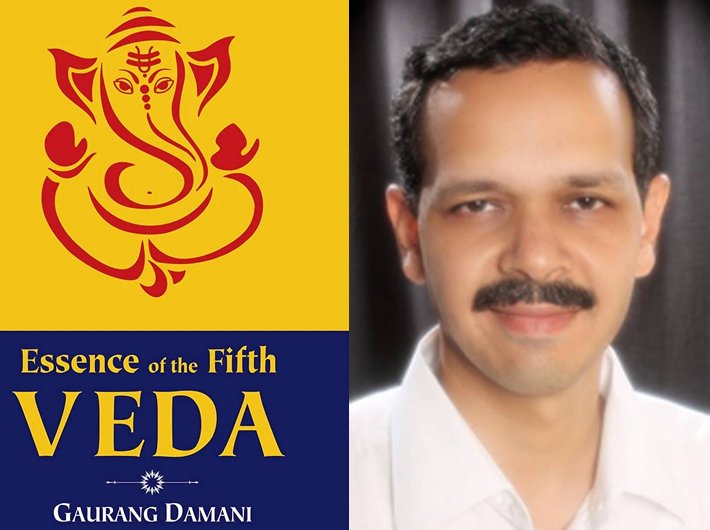
Essence of the Fifth Veda
By Gaurang Damani
Divine Destination, 234 pages, Rs 350

‘Veda’ literally means ‘knowledge’. There are four of them, but Itihasa – that is, the two historic epics, Ramayana and Mahabharata – and Purana are collectively called the Fifth Veda. Whenever Gaurang Damani finds time from his entrepreneurial career and civic activism, he dips into this knowledge base, and here, in the first of a proposed series of works, he presents a highly readable collection of nuggets from the Fifth Veda.

Less a retelling of the famed stories, this selection of 44 articles under three sections is more an inquisitive reader’s guide to Ramayana, Mahabharata and the Puranas. The unique feature here is an exercise in locating places mentioned in these epics and scriptures on today’s maps. It thus gives a bird’s-eye view of India’s sacred geography.

The opening section, ‘Tirupati Balaji and Ramayana’, includes not only lesser-known legends like Maya Sita’s relation with Sita and God Tirupati Balaji, but also has a chapter devoted to ‘The Philosophy of Yoga Vasishtha’. The text, also known as Maha Ramayana, Arsha Ramayana, Vasiṣṭha Ramayana and Yogavasistha-Ramayana, brings together several strands of Indian philosophy. It is held to be an exceptionally great guide to spiritual liberation. Damani gives the reader a succinct summary:

“The text advocates four paths to moksha:
* Self-control meaning not delighting in pleasure and not getting distressed in pain, but resting the mind on the Supreme Soul.
* Spirit of inquiry wherein there is a constant asking of the question, ‘Who am I?”
* Santosha (contentment) which means there is nothing to acquire and nothing to reject
* Satsanga, the good company of holy men, is superior to charity, fasting, penances, rituals and pilgrimages.”

The second section is devoted to ‘Miracles of God Krishna’, also answering questions like why God Krishna has 16,108 wives. The third and final section is about ‘The World War Called Mahabharata’. In mere 21 chapters, it gives a good overview of the voluminous epic and also distills its life lessons.

Damani wears his deep and wide reading lightly and the writing is ever so reader-friendly. In his next work, he plans help the reader go deeper within, based on the prescribed Vedic path to happiness and spirituality. That would be anxiously awaited by curious readers.


Comments


Other News

“India AI Impact Expo a powerful convergence of ideas, innovation & intent”

Prime minister Narendra Modi on Tuesday hailed the India AI Impact Expo 2026 as a powerful convergence of ideas, innovation, and intent. Sharing highlights of the event’s inauguration, he said the Expo, which got underway here on Monday, highlighted the extraordinary potential of Indian talent in sha

BMC polls: 24% winners have declared criminal cases against themselves

As many as 54 (or 24%) out of the 227 winning candidates of the Brihanmumbai Municipal Corporation (BMC) elections have declared criminal cases against themselves, according to an analysis by the Association for Democratic Reforms (ADR) and Maharashtra Election Watch.   As many as 29 (13

PM`s first decisions from Seva Teerth reflect spirit of Seva

In his very first set of decisions after shifting to Seva Teerth, the new address of the PMO, PM Narendra Modi signed important files relating to decisions that reflect the spirit of Seva. These decisions touch every section of society: farmers, women, youth, and vulnerable citizens. 1.

AI@Work: Driving productivity, jobs, and innovation

Key Takeaways     India ranks 3rd in Stanford University`s 2025 Global AI Vibrancy Ranking.     Data infrastructure, entrepreneurship and demography are key enablers for AI adoption.     In India the relative penetration of AI skills was 2.5 ti

Urban Blind Spot: Animals, governance, and the cost of ignoring coexistence

India’s cities are expanding at an unprecedented pace, absorbing people, infrastructure, and economic activity at scale. What urban governance frameworks have been slower to absorb is a reality already playing out on the ground: animals are an inseparable part of urban life. From community dogs and p

How India uses AI in the field of culture and languages

* India is institutionalising AI for culture and languages through national platforms such as BHASHINI, Anuvadini, Gyan Bharatam and Adi Vaani etc. * AI is being used to make cultural and knowledge assets usable by digitisation of manuscripts, translation of academic content, and in


Archives

Current Issue

Opinion

Facebook Twitter Google Plus Linkedin Subscribe Newsletter

Twitter






