
‘Robin Hood of Kathiawar’ by The Paperclip is a collection of unusual, lesser-known stories told in an engaging way
GN Bureau | May 24, 2026

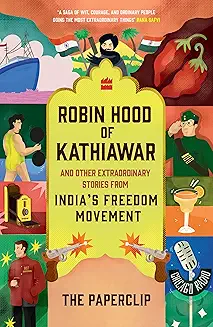
Robin Hood of Kathiawar and Other Extraordinary Stories from India’s Freedom Movement
 Social media and the age of the internet have opened new vistas for storytelling. Creative memes and quirky humour, citizen journalism and detailed analysis: Twitter/X and Instagram are full of content that would amuse and astonish. But few have done what a team of youngsters from Kolkata has been doing. The Paperclip narrates stories of a particular kind – from the world of culture or politics, business or trends. Usually going back in history. This is not about looking at the world from some ideological viewpoint. It is somewhat like chatting with an exceptionally well-informed friend: you pick up something – say, a packet of Parle-G biscuits, and this friend gives you the background story. In this case, it would be replete with references, sepia photos and URLs. (In a release, the Paperclip team says, “Paperclip was born out of late-night conversations during the pandemic, sparked by a group of friends who refused to let India’s hidden histories fade away.”) The story is told, with an engaging presentation, in a few tweets. The length is not too short though it certainly goes counter to the trend of ‘long-form’ storytelling. The choice of themes is eclectic, and they are treated in a right tone – neither frivolous nor serious.
For centuries, the urban framework of Varanasi was defined not just by its relationship with the sacred Ganga but by its multifaceted network of urban commons. Historic kunds, seasonal talabs (ponds), and open maidans served as the city’s basic ecological infrastructure. Th
India’s skill development programmes were designed with a goal to make the young population ready with market-required skills and competencies, and to provide them with better employment opportunities. Yet the outcomes have fallen short of that goal: though over 1.6 crore individuals were trained acr
The Union Cabinet on Wednesday passed a resolution marking June 10, 2026, as a historic milestone in the journey of Indian democracy applauding Narendra Modi for becoming the longest-serving elected PM of the country. By establishing a record of 4,399 days of continuous service as an elected PM, he has s
A teacher was appointed in 1999, before the Right to Education (RTE) Act came into force, and appointed under the rules that existed at that time. She gave the necessary test, passed it, passed the interview, and was appointed. Over the next 26 years, she taught thousands of children, faced transfer orde
In a step towards the operationalisation of the Bharat Audyogik Vikas Yojana (BHAVYA), union minister of commerce & industry Piyush Goyal launched the BHAVYA Portal on Monday in New Delhi. Addressing the gathering, Goyal said that the BHAVYA scheme will adopt a competit
The finance ministry on Friday announced a series of measures aimed at enhancing the ease of investment for individual Persons Resident Outside India (PROIs) and Foreign Portfolio Investors (FPIs), and to attract stable long-term foreign capital flows. Building on the recent in





