In this excerpt from one of his two new collections of essays, read about the inimitable Justice Scalia of the US
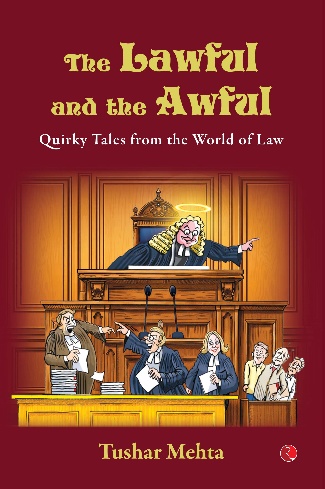
The Lawful and the Awful: Quirky Tales from the World of Law
By Tushar Mehta
Rupa Publications, 336 pages, Rs 995
Tushar Mehta, a Senior Advocate practising before the Supreme Court of India and the Solicitor General of India since 2018, has come out with two collections of essays on the world of law. (The other title is, ‘The Bench, the Bar and the Bizarre: The Unfamiliar, the Curious, and the Extraordinary in Law’).
In ‘The Lawful and the Awful’, he takes readers into the lesser-known corners of the legal world, where personality presses against principle and the courtroom reveals its more curious, unpredictable side. Drawing on real cases from across the world, this collection brings together episodes that are surprising, insightful, and often quietly astonishing.
From judges who defied convention in dramatic ways to flashes of wit, irony, and courtroom humour, these stories show how the practice of law is shaped as much by human behaviour as by legal doctrine. There are moments of sharp observation, instances of unintended absurdity, and occasions where authority gives way to individuality
Here’s an excerpt from one of the essays:
The Court of One
The Inimitable Justice Scalia
Few judges have managed to combine intellectual rigour with theatrical flair quite like Justice Antonin Gregory Scalia. Brilliant, bold and famously uncompromising, he reshaped American constitutional interpretation—and the craft of judicial writing itself. His judgments were not merely legal pronouncements but performances: sharp, quotable, and often stinging with irony. A towering conservative voice on a divided court, Scalia made dissent an art form and controversy a habit. To his admirers, he was the Constitution’s staunchest guardian and to his critics, its most eloquent provocateur. Either way, he was, as many have said, ‘a Court of one’.
Appointed by President Ronald Reagan in 1986, Justice Scalia became the first Italian-American to serve on the US Supreme Court, a position he held until his death in 2016. Whether one agrees with his views or not, it cannot be disputed that he was an intellectual giant: a scholarly jurist, skilled in judicial problem-solving, and a devoted originalist and conservative. More importantly, he possessed the self-confidence to shape his own jurisprudence and to express his views boldly, even in minority opinions. Justice Scalia is among the most memorable judges in history, blessed with the rare ability to produce both gems and brickbats—often in the same paragraph.
A committed originalist, he firmly believed that the Constitution and the statutes must be read as they were intended to be read, not as judges might prefer to reinterpret them in the light of contemporary fashions. His view was clear: the Court’s task is to determine what the Constitution is, not what it should be under present circumstances. Addressing an audience at the University of Minnesota Law School in October 2015, he made clear his rejection of the idea that the Constitution could be updated to reflect modern values. He declared that the Constitution ‘means what it meant when it was adopted’ and that it could not be revised ‘according to the policy preferences of the nine unelected, unrepresentative and unaccountable justices of the US Supreme Court.’
By his own admission, Justice Scalia was ‘a faint-hearted originalist’, guided by precedent or other authoritative sources to give the Constitution its proper meaning. He believed that the originalist approach limited judicial discretion, keeping judges within constitutional bounds and preventing them from becoming social reformers, activists, or utopian dreamers—in short, from playing the role of judicial revolutionaries imposing their personal philosophies on the nation. As he often reminded people, social reform must rise from within society, not from court judgments.
Justice Scalia also earned a reputation for writing vitriolic and mordant dissents, biting concurring opinions, and sharply worded majority opinions. His dissents frequently displayed open scorn for the majority—though notably without rancour or intent to wound or insult his brother judges. The sting of his writing style was tempered by its confinement, more often than not, to dissents.
He once remarked about dissenting opinions that ‘when history demonstrates that one of the Court’s decisions has been a truly horrendous mistake, it is comforting—and conducive of respect for the Court—to look back and realize that at least some of the justices saw the danger clearly, and gave voice, often eloquent voice, to their concern.’
He defended the value of a dissent, arguing that an honest dissent revealed the Court’s work as the product of ‘independent and thoughtful minds’, rather than an indoor exercise by judges in consensus-seeking for the ‘supposed good of the institution’.
Unlike many populist judges, Justice Scalia maintained that the role of the judges of constitutional courts was to interpret the Constitution and not to invent or rewrite it. This phenomenon of judicial invention, which began in the United States, has since ‘infected’ other jurisdictions as well. Too often, constitutions were rewritten in line with populist moods, organized propaganda, clever narrative building, or orchestrated campaigns of vocal minorities whose views were neither traceable to the Constitution nor widely accepted among law-abiding citizens who were in silent majority.
If Scalia resisted the temptation to rewrite the Constitution, he was equally unflinching in exposing another judicial temptation—the quiet dependence on law clerks. Though there was always a distinctive ‘Scalia touch’ in all his opinions, he had the rare honesty to publicly acknowledge what most judges prefer to conceal: that much of the first draft of their opinions rarely come from their own pens and are often the handiwork of law clerks.
One of his longest-serving law clerks, Paul D. Clement, wrote a beautiful tribute after Scalia’s death. In his article, he revealed that while clerks prepared the first drafts, Justice Scalia’s revisions were extensive:
“Although he did ask his law clerks to provide first drafts, he was routinely handed a stone and returned a sculpture. Indeed, his revision was so transformative, and the final product so distinctly Scaliaesque, that I wondered why he bothered asking for a draft at all. My sneaking suspicion, then and now, is that the Justice did not know how to format a new document on the computer.”
Justice Louis Brandeis, explaining why Supreme Court justices once commanded public respect, famously quipped: ‘The reason the public thinks so much of the Justices of the Supreme Court is that they are almost the only people in Washington who do their own work.’
Times, however, have changed. Nowadays, most—if not all—judges, in the US and elsewhere, rely on their law clerks to prepare drafts of their judicial opinions that bind the entire nation as constitutional precedents. The thought is quite scary! No one can deny that some degree of wisdom, after all, comes only with age, and judicial intellect is honed by experience—qualities that cannot be expected to be found in fresh graduates, however brilliant they might be. To be fair, such drafts are prepared, in most cases, under the judge’s supervision and after discussion of the hearings.
Justice Scalia, however, made clear that his clerks’ draft was merely the starting point when he said: ‘After the law clerk delivered the first draft there was still a great deal of “Scalia to do”. I take the opinion apart and put it back together. I do not think anybody claims not to be able to recognize a Scalia opinion.’
His writing style was unique and unmistakable. It struck directly at the heart of the issue. Justice Scalia believed that a judgment should do more than merely pronounce a decision; it should persuade.
[The excerpt reproduced with the permission of the publishers]
Photo credit: https://commons.wikimedia.org/wiki/File:Antonin_Scalia_2010.jpg