
S. Devarajan’s ‘Designed to Win: The Tata Elxsi Story’ is a saga of a unique company
GN Bureau | January 7, 2026

While many technology success stories are loud and headline-driven, Tata Elxsi’s journey is marked by quiet, consistent innovation—an approach that helped it overcome serious challenges and engineer a remarkable turnaround. ‘Designed to Win: The Tata Elxsi Story’ (Penguin India) brings this understated success into focus, tracing how one of the Tata Group’s most influential companies built global leadership across transportation, media and telecom, and healthcare through design-led thinking and cutting-edge technology—even at a time when Ratan Tata himself questioned the brand’s name.
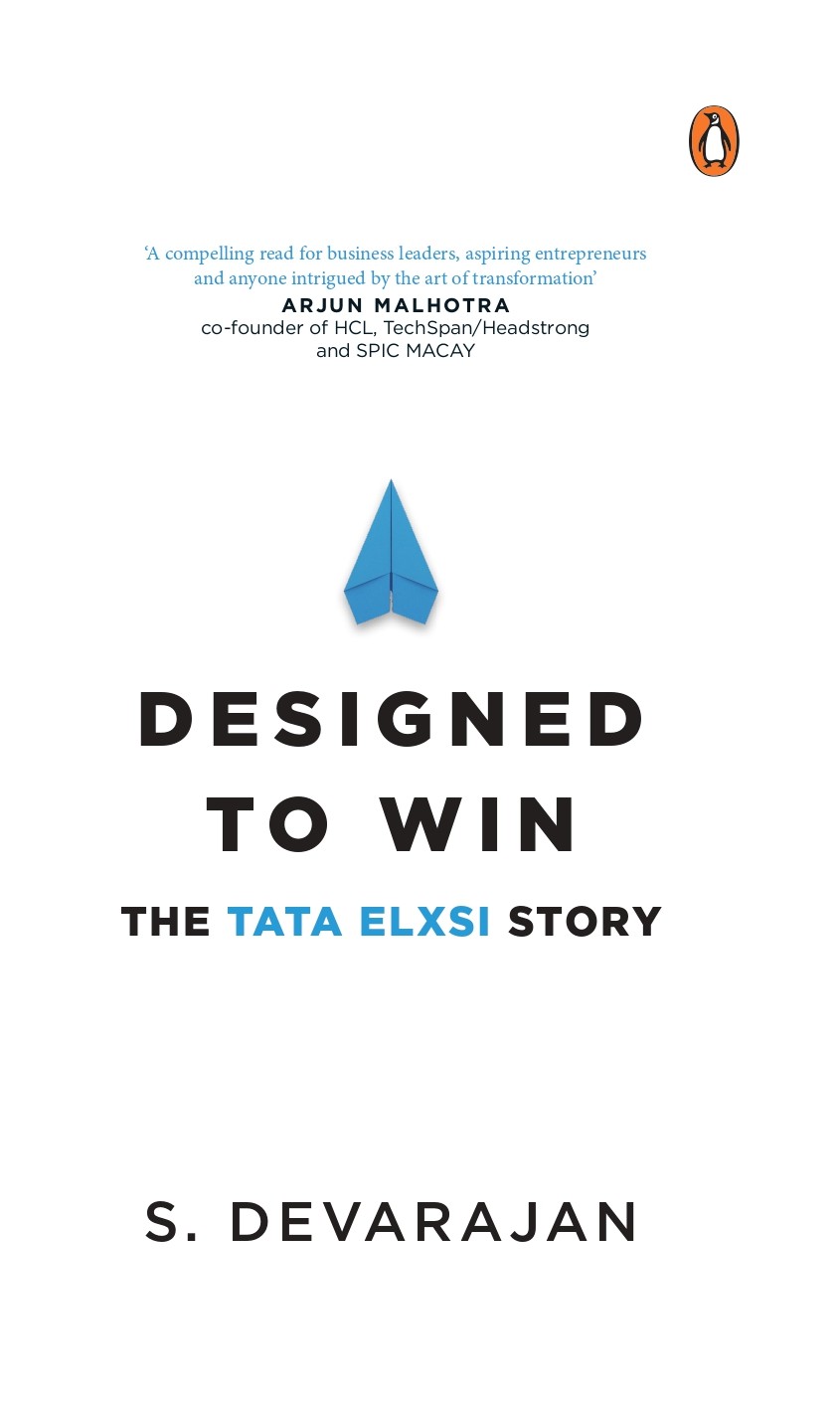 Authored by S. Devarajan, former managing director of Tata Elxsi, the book draws on firsthand experience to offer practical lessons in leadership, strategy, and innovation—making it a compelling read for business leaders, professionals, young engineers, and startup founders alike.
Tata Elxsi, a highly valued member of the Tata Group, is revolutionizing the fields of transportation, media and telecom, and healthcare. Today, it offers innovative solutions in the advancement of electric vehicles, connected cars, design-led passenger experiences and software defined vehicle solutions. It also supports media and telecom companies by transforming network operations, enhancing advertising technology and improving content monetization for broadcasters and streaming platforms. Furthermore, the company develops intelligent medical devices and pioneers novel patient care practices.
With a diverse client base that includes prominent names such as Ford, Jaguar Land Rover, Nissan, Mahindra, Comcast, Echostar and Panasonic, Tata Elxsi has dramatically transformed itself into one of the most valued companies of the Tata Group, consistently delivering growth.
What drives Tata Elxsi’s success? What strategies has it employed to overcome significant challenges and emerge as an immensely successful organization benefiting shareholders, investors and consumers alike? What lessons can we learn from Tata Elxsi in entrepreneurship, sales, marketing, strategy and many other management areas? This book is an attempt to answer these and many such questions to enlighten readers about a little-known but unique Tata group company.
Here is an excerpt from the book:
Tata Elxsi: Origins
On joining Tata Elxsi, I got to hear in bits and pieces, how this company came to be and it was fascinating to me then as it is now. I didn’t get a chance to research the origins story then, but I spent a few weeks now reaching out to its founders, for the purposes of this book. Its story should be told since there aren’t many companies like this in India, leave alone IT companies. It’s also a unique company within the Tata Group. So let’s take a dive.
In 1998, five years after I joined, I stumbled upon Jayan Ramankutty, founder of Lara Technologies, in the Bay Area, California. We were working out of a business centre in Sunnyvale, California. I had a fantastic sales manager, heading the West Coast, Ramakrishnan (Ramki), who was working out of that office. I was visiting for customer meetings along with him. One day, we found a business card pushed under the office door, when we returned to the office after meetings. It read, ‘Jayan Ramankutty, Founder, Lara Technologies’. Then we realized this gentleman was also operating out of our premises.
When we met him the next day, he was surprised to see us and asked whether we worked with Tata Elxsi. He was under the impression that the company had wound up and no longer existed. During further conversations, we realized he was one of the founding engineers of Tata Elxsi. This was a bolt out of the blue and we chatted with him relating stories about the early beginnings and early days of Elxsi in the US.
We told him how we had manufactured some Elxsi systems out of our facilities in Bangalore. We also talked about how we no longer manufactured ELXSI systems, instead making Silicon Graphics (SGI) servers for a while. He wanted to know whether we had any of these Elxsi CPU boards with us from our facilities back home, and if we did, he would be happy to have one as a memento. I arranged to have one shipped to him on my return to India, and he was extremely happy and grateful. When I met him again, I saw that he had mounted and framed the beautiful large Elxsi CPU board in his office.
Our relationship with Jayan blossomed over time, and he began outsourcing a significant amount of work through us for Lara Technologies. He later sold out and started a few more start-ups, and we continued to partner closely with him. Our association has spanned nearly thirty years, and our friendship has only grown stronger over this period.
When I was finalizing the contents for my book a few of months ago, I reached out to Jayan for some insights into the early days and to connect me with Elxsi’s founder, Thampy Thomas. He was more than happy to introduce me to Thampy, his fellow alumnus from BITS, Pilani. I am deeply grateful to Thampy for sharing the stories of the humble beginnings of this great company.
Electronic X System Integration = Elxsi
Dr Thampy Thomas, a graduate from BITS Pilani in 1968, embarked on a pioneering journey in the field of computer architecture. After completing his MS, he joined National Semiconductor to design a custom ‘calculator chip’ for Sony. His work was groundbreaking, especially considering that one of his seniors at Stanford, Ted Hoff, had joined Intel to create a custom chip for a Japanese calculator company, Busicom. That chip was introduced by Intel in 1971 as the very first commercial microprocessor, the Intel 4004.
Thampy returned to Stanford to complete his PhD and joined Intersil, a pioneer in using complementary metal oxide semiconductor (CMOS) technology for largescale integrated (LSI) circuits. He developed a single-chip microprocessor using CMOS technology, Intersil 6100. It used the same instruction set as the PDP-8, a minicomputer introduced by Digital Equipment Corporation (DEC), a large company of that era that was acquired by Compaq in 1998 which itself was acquired by Hewlett Packard in 2002.
The idea behind Elxsi came about while Thampy was an LSI designer. During the mid-seventies, all LSI circuit simulations were on timeshare machines. Then, the VAX-780 from DEC was introduced, and that was the first time one could afford a superminicomputer (as people later called it) to run engineering simulations.
‘And you know, as has happened ever since you got a computer, you think it is ten times more powerful than you thought you would use, then in ten days, it’s saturated,’ Thampy told me. At that time, the lead time to procure a VAX 780 was close to eighteen months and cost about $ 2,00,000. Thampy and his team saw a market opportunity for a computer that could expand seamlessly in processing power and memory capacity. Elxsi, which stood for Electronics x System Integration, was founded in 1979 to focus on the market for engineering applications.
This was the first computer start-up founded by an Indian in the United States.
Elxsi was the first symmetric multiprocessor computer system in the world. This means that it was a computer system with multiple processors that shared a common memory. The cofounders of Elxsi included Joe Rizzi, Thampy Thomas, B. Kumar (an assistant professor at Stanford), and Len Shar, who oversaw the HP 3000 operating system at Hewlett Packard. Most of the founders were PhD students under Prof. Ed Davidson at Stanford.
The multiprocessor system design required a very high-performance bus that the processors could be plugged into. The cofounders recruited Mac McFarland, who had worked on the PDP 11 under Gordon Bell at DEC. Mac was an undergraduate at Carnegie Mellon when Gordon was a professor there. When Bell joined DEC, he recruited Mac (even before Mac graduated) as a PDP 11 architecture team member. Mac designed the PDP-11 instruction set and its Unibus architecture. Before Unibus, the central processing unit generated a bus to which peripheral devices were plugged in. There was another bus between the processor and memory. Mac was the first to ask, ‘why can’t we have all the units operate on the same bus?’
Mac invented the Elxsi central bus, known as the ‘Gigabus’, into which processors, memory and peripheral controllers could be plugged. This was a significant innovation as it was the fastest bus by a factor of ten, at the time it was introduced. One could plug in 16 processors and 192 megabytes of memory and was a compact and powerful machine that could compete with mainframes. This was the first time a computer system was built where the user did not need to know how many processors were inside the computer system. Even though a single job did not run any faster, multiple jobs (typical in engineering environments) could share the available number of processors to run faster (instead of queuing up and taking turns at one central processing unit).
Enter the Tatas
You cannot do a book about Tata Elxsi without talking about the Tatas as it is essential to understand their motivation. The Tata empire dates back to 1868 when it started as a trading firm set up by Jamshetji Tata and then ventured across many businesses such as textile mills, steel making, hydroelectric power, trucks, and even airlines. The airline was nationalised, becoming Air India, and recently, the Tata Group was able to repurchase it. The Tatas have always been in the leading edge of technology—as mentioned earlier, TCS started in 1968—almost three decades before India’s IT industry broke into the global spotlight.
When it came to computers and information technology, there was little development in India because of the regulatory environment. So, the Tatas had to look for technology from outside. They formed a reasonably successful joint venture with Burroughs Corporation. While the JV brought a lot of computational capability and computers into the country, the Tatas didn’t get any technology.
So, when Ratan Tata met Thampy Thomas, the thinking was: ‘I can invest in a Silicon Valley company. They need me, they need my money, and we need technology’. Under the JV between Tatas and Elxsi, the Tatas would get all Elxsi technology of the past and in the future, free of charge, to exploit markets outside of North America and Europe. This technology would find its way into a company owned by both Tatas and Elxsi.
That company would be Tata Elxsi.
[The excerpt reproduced with the permission of the publishers.]
Diplomacy is akin to an art, wherein the summitry, conflict resolution and negotiations form apt constituents of the entire context of deal making and “playing for keeps” in the international arena. The Xi-Trump summit in Washington last week, in which the American president broke all conside
Moving to Delhi-NCR for education can be an exciting experience for students from Northeast India. It gives us a chance to meet new people, experience a different culture and become more independent. But living away from home also comes with challenges that people who have not experienced them may not al
The government has reduced the Basic Customs Duty (BCD) on major imported crude edible oils with a view to moderating domestic edible oil prices, providing relief to consumers and mitigating inflationary pressures arising from the sharp increase in international edible oil prices.
In his opening address at the 18th BRICS Summit in New Delhi on September 12, prime minister Narendra Modi did something India`s diplomacy has been building towards for three years: he moved the ‘Voice of the Global South’ from a slogan to a work plan. Addressing the leaders, he argued that t
The Pradhan Mantri Jan Arogya Yojana (PM-JAY), a welfare scheme which covers approximately 45 crore beneficiaries across India, provides cashless health cover of Rs. 5 lakh per family per year. It is the largest health insurance scheme which helped crores of poor families by reducing out-of-pocket expend
Every pregnancy requires two people. Yet India`s family planning programme continues to ask only one of them to bear almost all of its medical consequences. The newly released National Family Health Survey-6 (2023-24) confirms just how entrenched this asymmetry remains: 36.5% of currently married women a











