Read an excerpt from Tavleen Singh’s debut fiction which promises to become a talking point
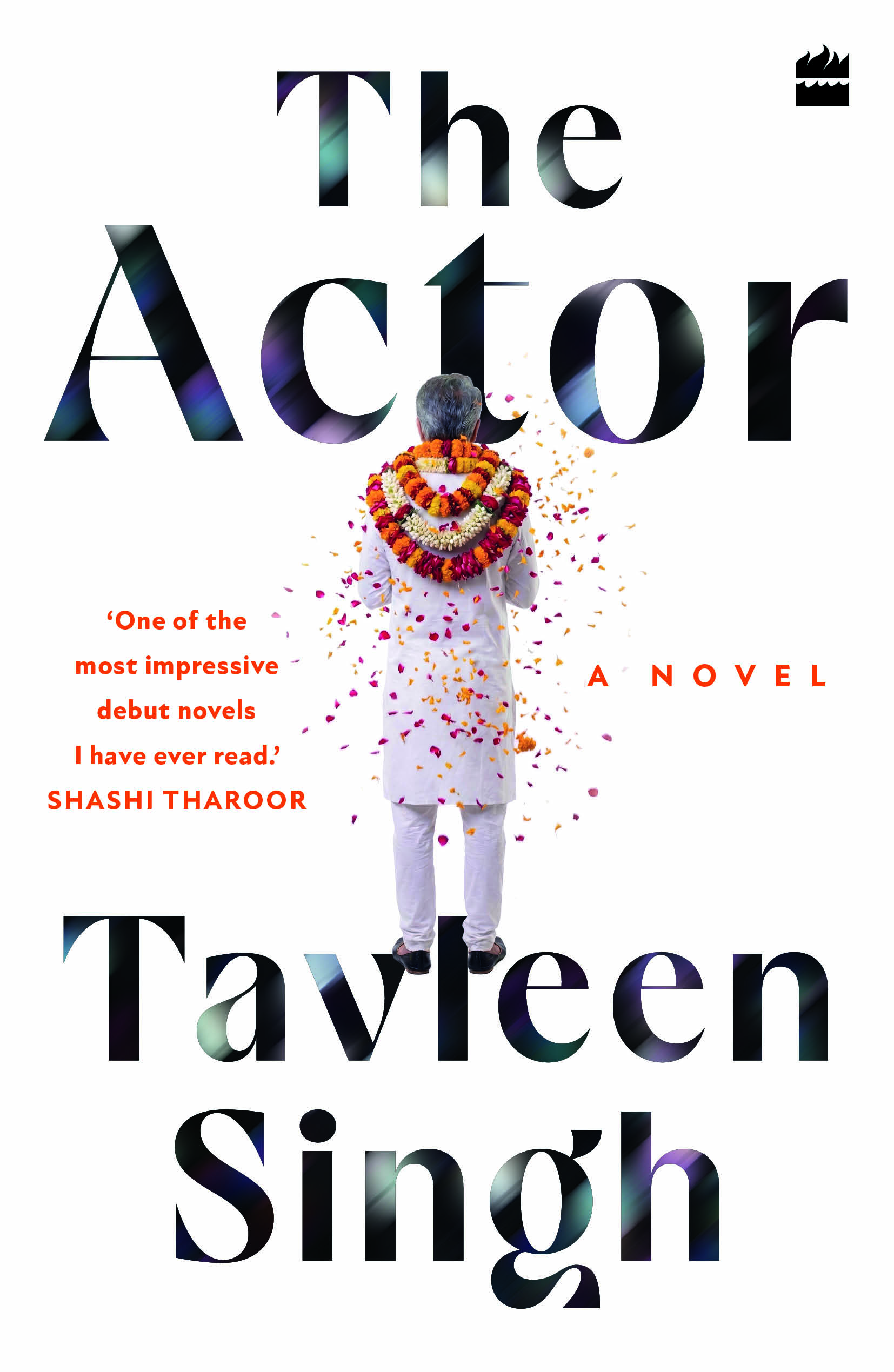
Tavleen Singh, noted journalist and political commentator, has turned to fiction, with her debut novel ‘The Actor’ (HaperCollins India). Set in the near future, it has a superstar, Amit Singh, turning to politics, when the political landscape is dominated by prime minister Guru Gaynendraji Maharaj, originally a religious leader. The plot, thus, has all the elements of India’s popular culture – politics, organized religion, Bollywood – only cricket is missed out. Early reviewers have praised Singh’s “ability to combine her penetrating journalistic insight with the narrative flair of a gifted storyteller”.
Here is an excerpt from the book:
The press conference to announce the formation of the party took place two days later, after the actor had been suitably prepped. It was held at the Constitution Club—a club Amit had never heard of. On the way there, Naresh explained why he had not chosen a hotel. ‘I don’t want to create the impression that our party is elitist. That word is as good as the kiss of death now. The ultimate insult. According to Guruji, all of us who constituted the old ruling class fit the charge of being elitist.’
‘Why has he found it so easy to convince voters that he’s right?’
Naresh frowned. ‘It’s a long story, but to cut it short, he basically invented a persona for himself. He claims that only he comes from the real people—that he’s a self-made man from the grassroots—and that the rest of us are spoilt and useless people who only work for our families and not the country. Ah, we’re almost there. Like I said earlier, I want you to say nothing until I make the announcement that you’re joining the party. If you find any of the questions hard to answer, just say that you would prefer not to comment.’
They had driven down an obscure road that ran from the Chelmsford Club to Parliament Street. Amit remembered being brought on winter mornings to the Chelmsford Club by his grandfather. As he’d eat platefuls of greasy wafers dipped in tomato ketchup, his granddad would chat to his old friends about what he called ‘Partition days’. Delhi now seemed so changed. There was so much construction everywhere that it felt as if a new city was being built over the remains of the old.
During their drive to the Constitution Club, Amit had noticed a massive construction site that had been concealed by green corrugated-metal sheets. This would be the prime minister’s new residence, Naresh told him. It would have an underground tunnel that led straight to his office and there would be a conference hall and a helipad.
‘Was it necessary to build a new residence for the prime minister?’
‘Probably not. But Guruji wants to impose what he calls an “Indian aesthetic” on the colonial architecture that defines New Delhi. Hence the new Parliament and the new government offices.’
The SUV pulled up in front of a squat building that had seen better days. It pleased the actor that he was immediately recognized by the doormen, who gazed at him in wonder.
He followed Naresh into a large hall that was already filled with journalists and bright with the lights of TV cameras. Many of the reporters stood up to take pictures of Amit with their phones.
A table had been placed on a small stage at one end of the hall. On it were plastic water bottles and plastic flowers in plastic vases. There were only two chairs on the raised platform. The party workers Amit had seen at his friend’s house were seated in the front row, but only he was allowed to sit beside Naresh.
Before they could take their seats, a swarm of cameramen and photographers crowded onto the stage, taking pictures of the actor and shouting for him to turn towards them. He posed and smiled, and it was only when his friend demanded that the stage be cleared that he remembered he was no longer in Bollywood. Naresh asked as politely as possible to be allowed to begin the press conference. A cacophony of voices rose from the reporters, whose view of the raised platform was blocked by flashing cameras. When silence and order finally descended over the room, Naresh spoke in a mixture of English and Hindi.
‘Friends, thank you for coming. The purpose of this press conference is twofold. Many of you know that I have, for some time now, been trying to persuade leaders from different political parties to come together. I believe we need to form a new political vehicle to bring about real change. This has become necessary because the existing opposition parties have shown that they are incapable of taking on Guruji, who has, as you know, become more autocratic by the day. He must be stopped if India is to be saved. The divisions between Hindus and Muslims that have been created are so dangerous that there are those who believe that another Partition is virtually a certainty. We cannot allow this to happen. All of us, including you in the media, have to come together to stop this. So I seek your support for the new party I have formed—the Parivartan Party. As the name indicates, it will work towards bringing real change in India.
‘The second reason for this press conference is to announce that my friend Amit Singh will be joining this new party. I have appointed him as a senior general secretary. He will not just be standing for elections from a yet-to-be-decided constituency, but he will also be working beside me to build the party. Now, we’re ready for any questions you have.’
Several hands went up as cameras clicked and flashes went off. A young man in jeans and a white kurta appeared from somewhere and stood beside Naresh. ‘Everyone’s questions will be answered,’ he said, ‘but we must do this in an orderly fashion. I’ll choose the order in which the questions will be asked. Before asking your question, identify yourself and the organization you work for. Okay, over there at the back …’ He pointed to a pretty girl with blow-dried hair who wore studio makeup.
‘Chitra from Aaj Tak. My question is for Amit Singh,’ she said in Hindi. ‘Sir, can you explain how you plan to continue making movies if you intend to become a full-time politician?’
The actor looked at his friend, who indicated that he should answer. ‘The answer to your question,’ he replied, ‘is that I’m not planning to take on new films. I have some unfinished commitments that I’ll complete, but I’ll be dedicating all my time to building this new party.’
‘What do you know about politics?’ The question came from another young woman with similarly straightened hair and heavy makeup.
The young man in jeans intervened: ‘Identify yourself, please.’
‘Rohini from India Today,’ the woman said.
‘It’s true that I don’t know much about politics,’ the actor replied, ‘but I have every intention to learn. Remember, when I became an actor, I didn’t know much about acting either, but I learnt.’
There was general laughter from the audience and more questions about acting and Bollywood until Naresh finally asked for some questions about the new party.
‘Why do you think you will succeed in taking on a leader as popular and powerful as Guruji?’ The question came from a skinny, bespectacled man who said he worked for The Times of India.
‘I’m not saying that we will succeed,’ Naresh said. ‘What I’m saying is that a new political party is needed, and since nobody else seems ready to take a chance, I decided that I would. As I said, I believe we need to fix the fissures in society that have widened dangerously. We need to heal the wounds that have been created by animosity with some love … In this time of hatred, this is necessary.’
[The excerpt reproduced with the permission of the publishers.]