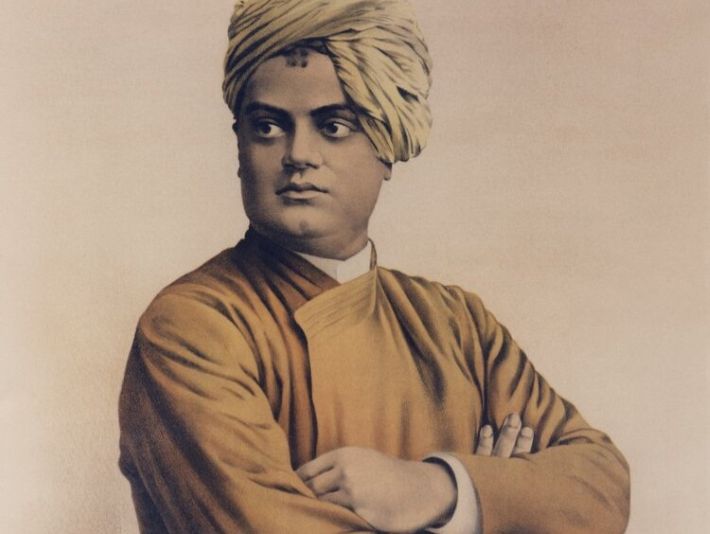
It is time to recognise him as the true intellectual progenitor of India’s struggle for independence
Swami Vivekananda for Our Times
Edited and compiled by Rajiv Sikri, with Introduction by S. Gurumurthy
Rupa Publications, 552 pages, Rs 695
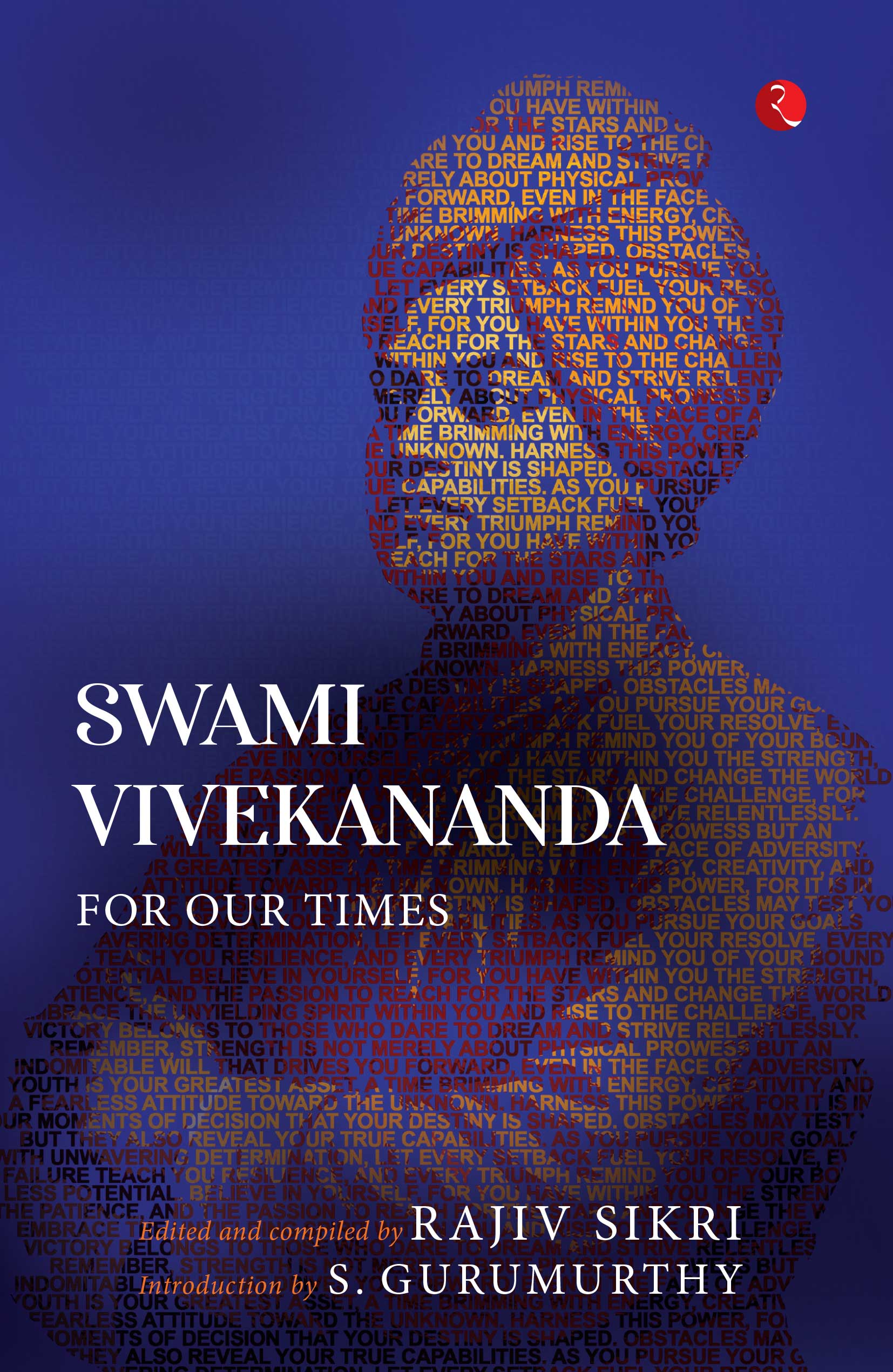 Swami Vivekananda, one of India’s greatest spiritual leaders, remains an icon – a role model for youth, a source of inspiration for spiritual seekers. This book, with curated selections of his writings and speeches, reveals Vivekananda’s vision of Vedanta, universal religion, self-realization, and nation-building rooted in strength, service, and faith.
Edited and compiled by Rajiv Sikri, with an introduction by S. Gurumurthy, it bridges India’s spiritual heritage with modern challenges—offering guidance for youth, professionals, and seekers alike. A powerful call to rediscover courage, compassion, and purpose in everyday life.
Here is an excerpt from the preface by Sikri, an IFS officer who retired as secretary in the ministry of external affairs.
What prodded me to explore the personality and thoughts of Swami Vivekananda? Looking back over my life, I cannot but be deeply grateful for the many things it has given me over the decades—the privilege of studying in prestigious educational institutions, rich and varied experiences through travel across the world, and a fulfilling professional career. Yet, as I grew older, I increasingly felt that something had been missing from my education and experience.
In the early decades after India’s Independence, the dominant national narrative portrayed India as a poor and backward country, inhabited by a meek people given to non-violence. We grew up in an insular society beset by shortages of every kind. For young Indians, the West was the ‘promised land’, embodying hope, success, and prosperity. My generation, educated within the constricting framework of an inherited colonial template, remained relatively ignorant of our country’s vast cultural and spiritual heritage, since our sources of knowledge were confined to what we picked up from family and society.
The Christian community ran the ‘best’ educational institutions—‘best’ in the sense that they offered the greatest opportunities for career advancement. In schools and colleges, we were not taught anything about India’s cultural and spiritual traditions or about the great personalities from diverse fields in our long history. History teaching relied heavily on the works of British historians and left-oriented Indian scholars. British constitutional history was considered important enough to be included as an optional subject in the civil services competitive examination! In school, French was available as an optional subject, but not Sanskrit.
Among the figures of India’s freedom movement, it was Mahatma Gandhi and Jawaharlal Nehru who dominated our mental space. There was no shortage of information about their stellar contributions to the ‘non-violent’ freedom movement— indeed, there was always a question on Gandhiji’s thoughts in the General Knowledge paper of the civil services examination! By contrast, the intellectual and material contributions of giants such as Swami Vivekananda, Lala Lajpat Rai, Bal Gangadhar Tilak, Bipin Chandra Pal, Subhas Chandra Bose, Sardar Patel, Sri Aurobindo, Veer Savarkar, Shaheed Bhagat Singh, Chandrashekhar Azad, and many others to India’s freedom struggle received only superficial treatment, if at all, in educational institutions and public discourse.
This neglect could not have been mere oversight. At least in the case of Swami Vivekananda, paeans of praise for him had flowed from the lips and pens of acknowledged stalwarts of our freedom movement—among them Jawaharlal Nehru, Subhas Chandra Bose and Mahatma Gandhi. Nehru observed that Vivekananda came as a tonic to the depressed and demoralized Hindu mind and gave Indians a sense of pride in their inheritance. Subhas Chandra Bose wrote that it was Swami Vivekananda’s rich, profound, and full-blooded masculine personality—‘reckless in his sacrifice, unceasing in his activity, boundless in his love, profound and versatile in his wisdom, exuberant in his emotions, merciless in his attacks, but yet simple as a child’—that explained his influence on his countrymen, and that ‘if he had been alive, I would have been at his feet.’ Swami Vivekananda also inspired a key element in Gandhiji’s philosophy: the concept of ‘Daridra Narayana’—God manifested in the hungry and destitute—which Vivekananda coined and Gandhiji later popularized.
This book is a selected compilation of Swami Vivekananda’s quotations on three broad themes. The first concerns the nature of religion. Across societies and cultures, religion is often misunderstood and frequently misused for political and social ends. It is, all too often, a principal trigger for conflict and war. Hence, it helps to have a clearer and deeper understanding of the true nature of religion and the underlying unity of all faiths.
This logically leads to the second theme of the book: India’s philosophical and religious traditions and practices. Religion was the trigger for the Partition of India in 1947—a gut-wrenching and decisive turning point in our modern history. Nearly eight decades later, it remains a core element in the Indian psyche, regardless of faith. Anyone seeking to understand India must understand this powerful force that continues to shape our politics and society.
The third theme is Swami Vivekananda’s dream of making India a great country—a remarkable vision at a time when India was still firmly under British rule and there was no organized nationalist movement. All these themes have immense contemporary relevance.
The dedicated band of workers and followers of the Advaita Ashrama, the Ramakrishna Mission and the Vivekananda Kendra have selflessly taken upon themselves the task of spreading awareness of Swami Vivekananda’s spiritual message and thoughts on religion. They have done magnificent work, including the construction of the Vivekananda Memorial at Vivekananda Rock.
Sadly, despite the high praise accorded to Swami Vivekananda by the leading lights of India’s freedom movement, successive governments over the decades made little effort to popularize his inspiring thoughts on Indian society and nationalism. It is imperative that we keep his message alive and fresh in the minds of Indians across generations. There has, however, been a welcome change with the coming to power of Narendra Modi, who, in his youth, was so inspired by Swami Vivekananda’s teachings that he retreated for a couple of years into the Himalayas on a voyage of self-discovery. After his victory in the 2024 general elections, he meditated at the Vivekananda Memorial.
Strength, faith and fearlessness are recurring themes in Swami Vivekananda’s thought. Are these not also the pillars of nation-building implicit in Prime Minister Narendra Modi’s vision of a ‘Viksit Bharat’ by 2047? Should we not turn to Swami Vivekananda to motivate and guide us as we seek to make India once again a great and globally influential country?
India, like every nation, needs inspirational heroes. While many stalwarts of the freedom movement such as Subhas Chandra Bose, Veer Savarkar and Sardar Patel have in recent years been visibly honoured for their contributions, Swami Vivekananda remains somewhat in the background. Although he believed that ‘the highest men are calm, silent and unknown,’ I firmly believe that Swami Vivekananda deserves wider public recognition— not only as a philosopher, thinker, reformer, internationalist and humanist, but also as a great freedom fighter, richly deserving an elevated place among the giants of the freedom movement.
Although he stayed away from politics, he spoke and wrote on issues that can legitimately be regarded as political. As the person who gave civilizational confidence to Indians and intellectual ballast to the freedom struggle of the 19th century, he set in motion the flywheel that culminated in India’s independence. At a time of political divisiveness and competing reassessments of India’s freedom fighters, perhaps it is time to recognize Swami Vivekananda as the true intellectual progenitor of India’s struggle for independence.
It is my humble suggestion that there would be great gains for our country and society if young minds in schools and colleges were to be made familiar with his glorious thinking and vision.
[The excerpt reproduced with the permission of the publishers.]