The 2019 parliamentary election in India is a humungous affair. This dance of democracy will decide who will lead the next government. Governance Now tries to capture the election spirit through images

Arun Kumar | May 17, 2019 | Delhi
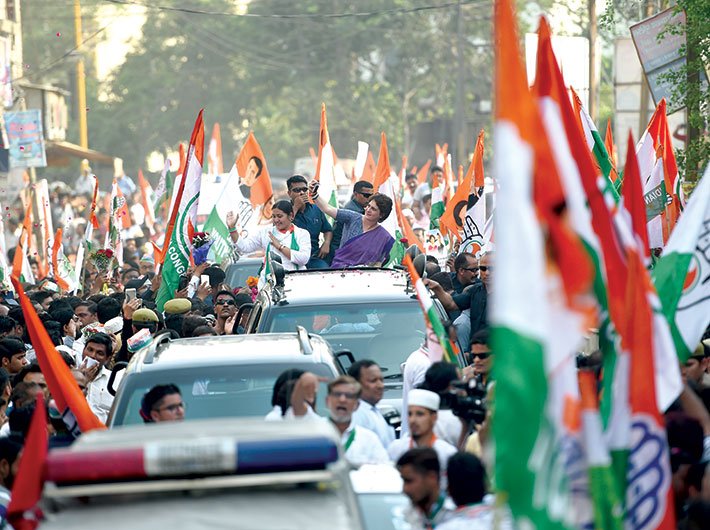
The 2019 parliamentary election in India is a humungous affair: about 890 million voters, nearly thrice the population of the United States, many months of planning, over a month of actual voting and a few days of tallying of results. Some seats have more than 150 candidates. This dance of democracy will decide who will lead the next government. More importantly, it will decide whether the people want to give prime minister Narendra Modi, perhaps the most towering political figure in recent times, a second term.
The Congress is pulling all stops: it has even roped in Priyanka Gandhi, sister of the party president Rahul Gandhi and a purported heir in looks to their grandmother Indira Gandhi, to energise their campaign. On the other hand, if the sales of Modi merchandise (inset photo) is any indication, for the BJP, it’s Modi all the way. Governance Now tries to capture the election spirit through images.


Electronic voting machines have taken much of the pain out of voting and tallying. They have also made elections more secure: first-time voters wouldn’t have heard of booth-capturing. But EVMs need to be primed and tested, especially to obviate chances of electronic rigging.Doing that is an army of personnel, for whom election time is perhaps as taxing as it is for candidates.


For Muslims in Muzaffarnagar, in western Uttar Pradesh, the 2019 elections are loaded with emotion: the last election, in 2014, which the saffron party had won in a big way, had come in the year after a communal riot from which they were yet to recover fully. Muslim women (left) and (right) a woman veiled against the heat at a polling station in Muzaffarnagar district.


Maharashtra`s fiscal management has come under sharp scrutiny after the Comptroller and Auditor General (CAG) of India, in its State Finances Audit Report for 2024-25, flagged significant budgetary inefficiencies, accounting irregularities, understatement of key fiscal indicators and widespread governanc
Some neglect is loud. This kind is quiet. It sits in research never commissioned, data never collected, questions never asked. In South Asia, that quiet has let the region’s worst health problems stay understudied, underfunded, and out of sight of those who could act.
Mumbai Metro Line 3 (Aqua Line), the city`s first fully underground metro corridor and one of its largest public transport investments, represents a major engineering achievement and has been widely welcomed by commuters. However, the overall commuter experience continues to be constrained by accessibili
Amid uncertainty in the southwest monsoon due to the potential impact of El Niño, the government is addressing the situation with comprehensive preparedness, a clear strategy, and strong ground-level action. While challenges remain, the entire system has been activated in advance and is working proa
On June 28, Delhi recorded a maximum temperature of 41.3°C, four degrees above the seasonal normal. But the “feels like” temperature, which factors in humidity, showed more than 51°C. What the body experienced was very different from what the thermometer recorded. India`
India today finds itself in an unusual position. At a time when geopolitical conflicts, trade fragmentation, and supply-chain disruptions are reshaping the global economy, the country`s macroeconomic fundamentals remain relatively upwards. Growth remains among the highest in the world, inflation has larg