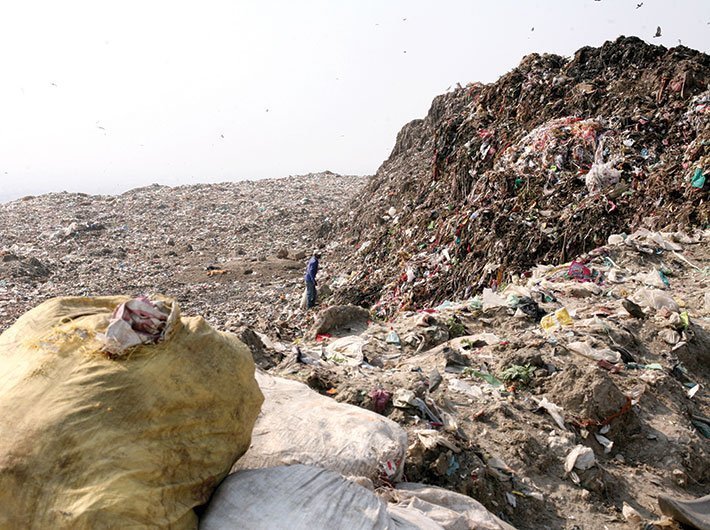
The death of two people after a mountain of trash collapsed in Delhi must be a wake-up call for civic authorities across the country.
The tragedy at Ghazipur landfill prompted Lieutenant Governor Anil Baijal to ban dumping of any more solid waste there. The officials are now looking at using the trash to build highways.
Days later, the Pimpri-Chinchwad Municipal Corporation (PCMC) in Maharashtra swung into action to flatten a massive waste mound.
On Monday, the administration showed great alacrity in employing three JCBs, three trucks and several employees to flatten the heap of garbage, reported
Indian Express.
The problem is quite serious and it is compounded by the fact that the country does not have efficient waste management systems in place. Across the country, the trash is simply dumped in land fill sites, which over a period of time turn into trash mountains.
Rao Inderjit Singh, minister of state in the ministry of urban development, informed the Lok Sabha on July 27, 2016 that the “total amount of solid waste generated in urban areas of the country till June 2016, is 1,54,647 MT/D, of which 17.45% is being treated”.
He said: “As per the assessment made by Central Pollution Control Board (CPCB) for 2015, the sewage generation in the urban areas of the country is estimated about 61,948 MLD. Sewage treatment capacity is 23,277 MLD which is 37.6% of total sewage generation.”
The minister said that urban sanitation is a state subject and it is the responsibility of the state/urban Local Bodies (ULBs) to collect, transport, process and dispose of solid wastes and treatment of sewage before disposal.
“Government of India is implementing “Swachh Bharat Mission” (SBM) since 2nd October 2014. One of the admissible components under SBM is solid waste management including collection, transportation, processing treatment and disposal of solid waste with central support up to 35% of the project cost in the form of Viability Gap Funding (VGF)/Grant. Also, Government of India has launched “Atal Mission for Rejuvenation and Urban Transformation (AMRUT)” and “Smart Cities Mission” on 25th June, 2015. Sewage Management is one of the admissible components under the missions. State Governments may set up new sewage treatment plants as per their requirement under these missions,”
said Rao Inderjit Singh.
Economist Isher Judge Ahluwalia observed that in India, the segregation of waste at source is rare.
On November 30, 2016, Ahluwalia wrote in the
Indian Express: “Recycling is mostly with the informal sector, although some municipalities are trying to integrate this sector into their waste management systems. More than three-fourths of the municipal budget on solid waste management goes into collection and transportation, which leaves very little for processing/resource recovery and disposal. This neglect is perhaps due to lack of awareness, in our cities, of the hugely adverse impacts of poor waste disposal on the air we breathe and the water we drink.”
There is no doubt that India faces major environmental challenges associated with waste generation and inadequate waste collection, transport, treatment and disposal.
“Current systems in India cannot cope with the volumes of waste generated by an increasing urban population, and this impacts on the environment and public health. The challenges and barriers are significant, but so are the opportunities,”
said a paper in the Royal Society Open Science.
“A priority is to move from reliance on waste dumps that offer no environmental protection, to waste management systems that retain useful resources within the economy. Waste segregation at source and use of specialized waste processing facilities to separate recyclable materials has a key role.
Disposal of residual waste after extraction of material resources needs engineered landfill sites and/or investment in waste-to-energy facilities. The potential for energy generation from landfill via methane extraction or thermal treatment is a major opportunity, but a key barrier is the shortage of qualified engineers and environmental professionals with the experience to deliver improved waste management systems in India,” the paper added.
Now that the country is moving towards smart cities, waste management needs to be addressed at the incipient stage.
Samar Lahiry, former adviser, Planning Commission and chief executive, Haryana Environmental Management Society, wrote in Down to Earth that around 100 cities are set to be developed as smart cities.
“Civic bodies have to redraw long term vision in solid waste management and rework their strategies as per changing lifestyles. They should reinvent garbage management in cities so that we can process waste and not landfill it (with adequate provisioning in processing and recycling).To do this, households and institutions must segregate their waste at source so that it could be managed as a resource. The Centre aims to do away with landfill sites in 20 major cities. There is no spare land for dumping garbage, the existing ones are in a critical state,” he
wrote.