
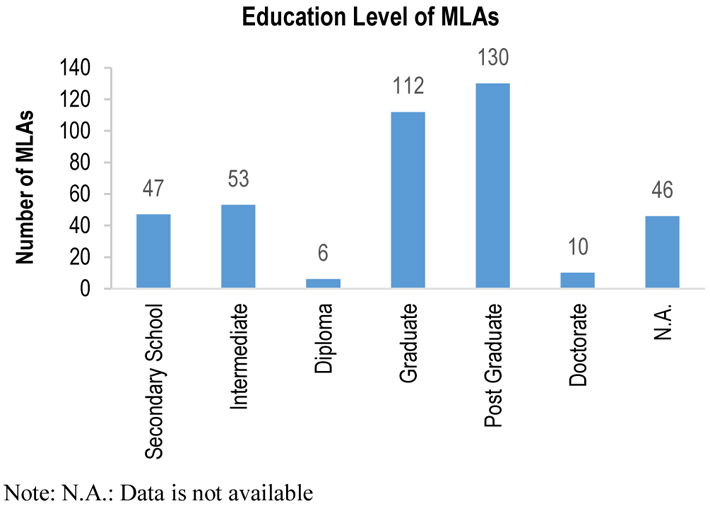
Of the MLAs, 13% completed secondary school (10th standard), while 15% completed intermediate (12th standard)
GN Bureau | January 13, 2017

A staggering 58 percent of MLAs did not ask any question, showed data compiled by PRS legislative research on the participation of members of Uttar Pradesh legislative assembly (2012-2017).
On average, each MLA asked 32 questions. Three MLAs asked more than 500 questions each.
The polls in Uttar Pradesh will staggered across seven phases for its 403-member assembly. The first phase will be on February 11 and
the last phase will be on March 8. The results will be announced on March 11.
Out of the current MLAs, 62% are between the age of 45 years and 65 years, while just 2% are below the age of 35 years.
Read: UP assembly vital statistics
Of the 404 MLAs, 13% completed secondary school (10th standard), while 15% completed intermediate (12th standard). Additionally, 31% have a graduate degree and 36% obtained a post graduate degree.
Incidentally, several MLAs declared more than one profession. 76% of MLAs declared that they were associated with agriculture, 33% MLAs with business and 9% with law. Some of the other professions MLAs are associated with are teaching, healthcare, journalism and social work.
On average MLAs with college degrees asked 70% more questions than MLAs without college degrees.
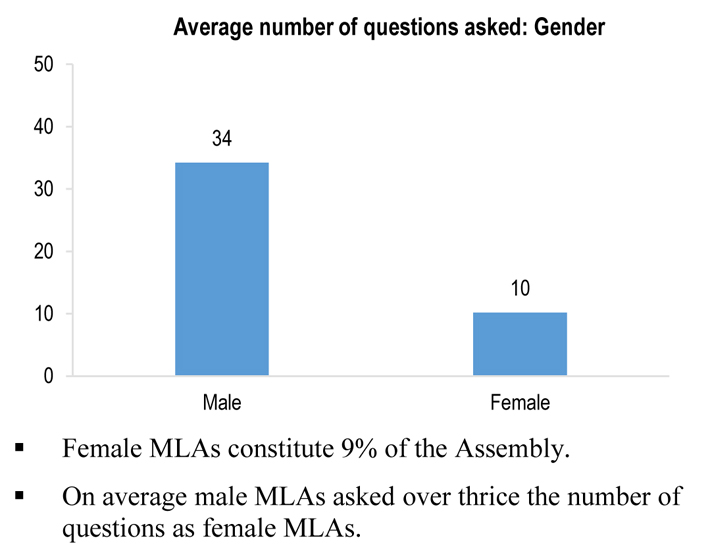
Female MLAs constitute 9% of the Assembly. On average, male MLAs asked over thrice the number of questions as female MLAs.
The 16th Legislative Assembly met for a total of 126 days. Of this, data is publically available for 107 sitting days (until 2015).
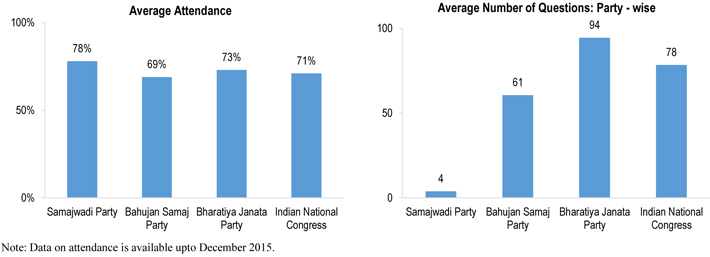
The average attendance of Samajwadi Party (SP) MLAs is the highest with 78% and that of the Bahujan Samaj Party MLAs is the lowest on average with 70%. MLAs from the ruling SP asked fewer questions on average (about 4 per MLA) compared to MLAs from the opposition parties (about 70 per MLA). This differs from the trend in Parliament where there is little difference between the numbers of questions asked by MPs from the ruling or opposition parties.
Read: Will Modi go UP or down? Here’s why all eyes are on Uttar Pradesh polls
Every pregnancy requires two people. Yet India`s family planning programme continues to ask only one of them to bear almost all of its medical consequences. The newly released National Family Health Survey-6 (2023-24) confirms just how entrenched this asymmetry remains: 36.5% of currently married women a
Delivering the IXth Chief Justice M.C. Chagla Memorial Lecture on ‘Human Rights and Sustainable Development Goals’, in Mumbai Friday, former Chief Justice of India Bhushan R. Gavai questioned whether conventional economic indicators such as gross domestic product (GDP), national income,
Seventeen years after the centre first approved the widening of National Highway 66 between Mumbai and Goa into a four-lane highway, a fresh RTI reply has revealed a sharp escalation in the project`s sanctioned cost. According to the RTI reply obtained by activist Jeetendra
Prime minister Narendra Modi on Thursday inaugurated SEMICON India 2026 in New Delhi. Addressing the occasion and highlighting the significance of the event`s fifth edition, the PM drew a parallel between the launch of Semicon India and Vishwakarma Diwas. He pointed out the beautiful coincidence of
The union cabinet, chaired by the prime minister, has approved the proposal of the Ministry of Labour & Employment to enhance the wage ceiling for mandatory coverage under the Employees’ Provident Fund Organisation (EPFO) from Rs.15,000 to Rs.25,000 per month. The decision is expected to bring
The new UPI framework introduced has no impact on any person to person transactions, and UPI will continue to remain completely free for all person-to-person transactions, irrespective of the amount transferred, the finance ministry clarified on Tuesday. Payments to merchan











