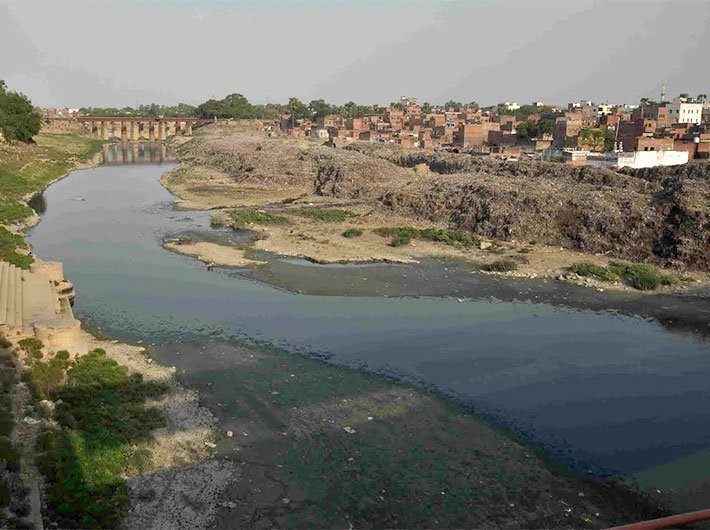
Bihar chief minister Nitish Kumar has repeatedly demanded desilting of rivers so that it prevents floods
The issue of desilting of rivers has been brought up from time to time, particularly when floods caused extensive damage. Bihar chief minister Nitish Kumar has infact been quite vocal for his demand to desilt rivers so that floods do not ravage the state.
Union minister Nitin Gadkari has now called for a new comprehensive law to deal with the issue of desilting of rivers.
Addressing the meeting of the consultative committee of parliament, he said this new law will be framed in consultation with states. Expressing concern on the plight of people of the flood prone areas of the country, Gadkari said there is an urgent need to effectively meet the challenges of flood in the country.
He was also of the opinion that measure like inter-linking of rivers and construction of check dams should also be given priority to mitigate the flood fury.
An expert had earlier said that desilting of canals, rivers and dams should be done on a regular basis.
S M Virmani, retired principal scientist of natural resource management from International Crops Research Institute for the Semi-Arid Tropics in Delhi, said if desilting had been done, flooding would not have been so bad.
Virmani told the
Times of India that the damage caused to top soil was very difficult to repair and it would take at least 3-7 years for farmers to bring it back to cultivable form.
MC Varshneya, ex-vice chancellor of Anand Agriculture University in Gujarat, said that about Rs 30,000 would be needed to remove sand from one hectare of land and about Rs 70,000 would be needed to bring in silt that will replenish the top soil.
The argument against desilting is that it will endanger acquatic ecosystem. While there is an urgent need to desilt the Ganga near Varanasi, a seven km stretch is home to turtles and desilting will cause grave damage. Even near the Farakka barrage, desilting is required for better flow of water.
The lack of an official policy has been a hindrance. What is now needed is scientific, and not reckless, desilting.
Political leaders have been repeatedly calling for a policy on desilting.
Nitish Kumar had last year met prime minister Narendra Modi and told him that desilting the river Ganga is the only solution to avoid the almost annual occurrence of floods. Modi had said that immediate and positive action will be taken on his demands, including formulating a national silt management policy.
He also linked the Namami Gange project with better silt management in Bihar. “The very serious condition that we see today never occurred earlier. The only way to get rid of this is desiltation. There is a need for national silt management policy,” the
Indian Express quoted him as saying.
In March this year, the Times of India report that the Centre will soon come out with a national silt policy which will enlist measures to scientifically desilt rivers which have over the years lost the capacity to hold water due to deposition of excessive silt.
In the backdrop of such a situation elsewhere in the country as well during Monsoon, the Union water resources ministry on Friday held a detailed consultations on its preparedness to come out with a nation policy to deal with the problem as early as possible.
The Central Water Commission's (CWC) chairman Narendra Kumar
said that many committees have been constituted in the past to look into the silting problems in rivers of India and suggest suitable remedial measures.
He said as of now there is general feeling that flood prone rivers are undergoing change in carrying capacity, leading to rise in flood level.