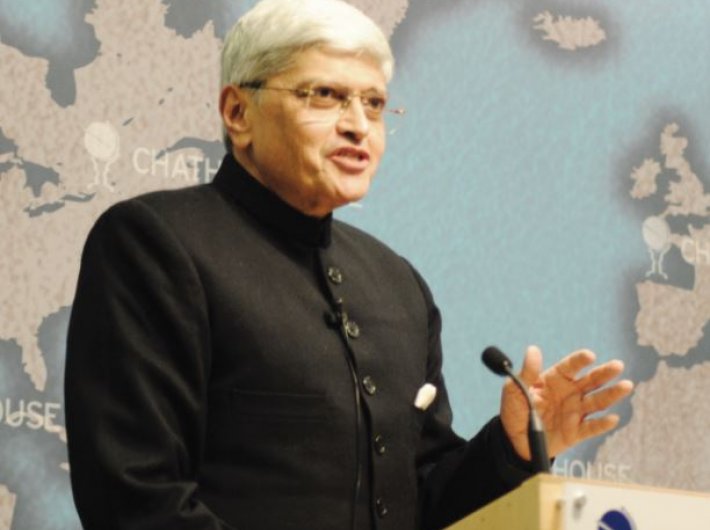
Selective reference to mercy plea for Yakub Memon ignore his principled campaign against death penalty per se
Gopalkrishna Gandhi, many believe, is one of the last few examples of probity in public life, with a spotless career as administrator and governor. But, even for him, it would be too much to expect “a civilised debate” – what he said he expected while contesting for the post of vice president.
His principled campaign against death penalty is well known over the years, from his columns and essays to petitions and finally a book (‘Abolishing the Death Penalty: Why India Should Say No to Capital Punishment’, December 2016, Aleph). But it is not well known enough: Shiv Sena leader Sanjay Raut criticised the unified opposition’s candidate for making a mercy plea for Mumbai blast convict Yakub Memon. By evening, in a section of the media and on social media, the matter was portrayed as if Gandhi had supported Memon.
The fact, beyond political mud-slinging, is that Gandhi did not “back” or defend Memon; Gandhi did not contest the court verdict; all he did was to oppose capital punishment for him – just he has opposed the same for all the others.
“Gandhi had used all his powers to save Yakub Memon. He even had written to the president. I want to ask (opposition) what kind of mindset is this,”
NDTV quoted Shiv Sena leader and Rajya Sabha MP Sanjay Raut as saying.
Yakub Abdul Razak Memon was convicted for his involvement in the March 12, 1993 Mumbai bombings on July 27, 2007. Over 250 people were killed in 12 coordinated blasts that rocked Mumbai. Yakub Memon was the brother of one of the prime suspects in the bombings, Tiger Memon. He was hanged on July 30, 2015.
Gopalkrishna Gandhi, grandson of Mahatma Gandhi, had written in July 2015 to president Pranab Mukherjee to reconsider the rejection of Memon's mercy plea.
“Yakub Memon submitted to Indian jurisdiction, when he may quite easily have evaded justice. A respected officer of Indian intelligence has spoken of his cooperation with the law, thus rendering the death penalty completely inappropriate in his case. Former Supreme Court judges have openly said that his execution would be unjust. Public protestations of this nature and from such quarters are rare. They must give us pause, for whether or not there was a secret understanding with Memon that is being disregarded, a doubt would irretrievably be cast on India’s integrity of process if in the face of this, Yakub Memon is executed,”
wrote Gandhi.
He went on to say that the head of the Indian republic, as president KR Narayanan memorably said, is guided by the prerogatives the Constitution gives him, and the privilege of intervention which his vast moral influence confers on him.
Gandhi had also referred to the supreme court’s Kehar Singh judgement.
The jugement said: “The power to pardon is a part of the constitutional scheme and it should be so treated also in the Indian Republic. It has been reposed by the people through the Constitution in the Head of the State, and enjoys high status. It is a constitutional responsibility of great significance, to be exercised when occasion arises in accordance with the discretion contemplated by the context.”
“It is open to the president in the exercise of the power vested in him by Art. 72 of the Constitution of scrutinise the evidence on the record of the criminal case and come to a different conclusion from that recorded by the court in regard to the guilt of, and sentence imposed on, the accused. In doing so, the President does not amend or modify or supersede the judicial record. The judicial record remains intact. and undisturbed. The President acts in a wholly different plane from that in which the court acted. He acts under a constitutional power, the nature of which is entirely different from the judicial power and cannot be regarded as an extension of it. And this is so, notwithstanding that the practical effect of the Presidential act is to remove the stigma of guilt from the accused or to remit the sentence imposed on him,”
said the judgement.
Gandhi had reiterated his argument against hanging while delivering the 35th J.P.Memorial lecture on March 23, 2015.
“India must move determinedly forward to the abolition of the capital punishment,” he
said.
Gandhi’s argument was reflected in a way in the Law Commission’s report no. 262, which said: “The death penalty does not serve the penological goal of deterrence any more than life imprisonment. Further, life imprisonment under Indian law means imprisonment for the whole of life subject to just remissions which, in many states in cases of serious crimes, are granted only after many years of imprisonment which range from 30-60 years.”
“Retribution has an important role to play in punishment. However, it cannot be reduced to vengeance. The notion of “an eye for an eye, tooth for a tooth” has no place in our constitutionally mediated criminal justice system. Capital punishment fails to achieve any constitutionally valid penological goals,” said the
report.