‘Truth is it simply does not pay to be a farmer in India.’ And it is going to get worse
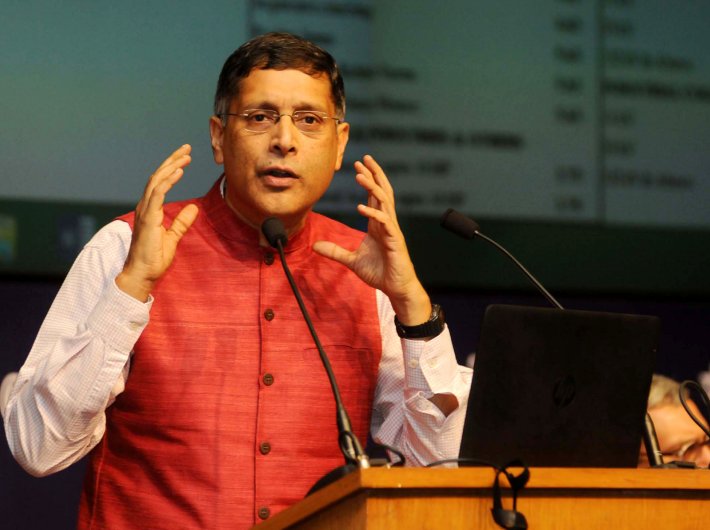
Just as farmers in Madhya Pradesh, Maharashtra and elsewhere were gathering for violent protests to press their demands, the chief economic advisor to the government of India, Arvind Subramanian, delivered a lecture on agricultural economy which helps put the matters in perspective.
Here are some relevant excerpts from Subramanian’s
lecture at the National Academy of Agricultural Sciences on June 5, titled ‘Transforming Indian Agriculture: By Loving Some Agriculture Less and the Rest More’
‘Glass less-than-half full’
Indian agriculture has seen a great success story in green revolution. “But (and you knew a ‘but’ was coming), despite these successes, the honest story here is one of the glass being less than half–full.” Primarily, there are two data points: (a) overall agricultural labour productivity is less than a third of China’s and about 1 percent of that in the frontier countries. Yield per hectare is also too poor. For example, for rice, India’s yield is half of China’s and a third of the US’s.
(b) Agricultural incomes (as measured by income from cultivation, net of cost and unsold produce valued at local market rates) are meagre. “The median household net farm income was about Rs 19,250 in 2012-13 or about Rs 1,600 per month, which is not very far above the poverty line. To be sure there is enormous variation [from one state to another], but the truth is it simply does not pay to be a farmer in India.”
‘The New Malthusian Challenge’
As if these two challenges were not enough, there’s more: “Raising agricultural productivity and reducing vulnerability are going to get harder because of what I call the re-emergence of the Ghost of Malthus. The four key agricultural resources – atmosphere, water, land, and soil quality – are all moving in very unfavourable directions.” The culprit of course is climate change.
‘Smothering with love: cereal-centricity’
The government in India has been traditionally supporting cereals – especially rice and wheat – with MSPs and so on, neglecting other produce – especially pulses (think of price swings in recent times) and fruits and vegetables.
Yet, the benefits of this ‘cereal-centricity’ go to a limited few, “mainly to farmers who produce marketable output and that too mostly in cereals and wheat, which in turn is confined largely to a few states, notably in the north (Punjab and Haryana)”.
“We then provide subsidies for power, water, fertiliser (now the second largest subsidy), seeds, credit, we exempt agricultural income from income taxes, and we periodically grant loan waivers.” A chart shows how agricultural incomes in Punjab and Haryana exceed those in the rest of India. It gives “a sense of this biased smothering with love”.
‘Smothering with love: big not small farmers’
Here comes the crux of the problem. “There is a second aspect to this smothering with love: not only does it mainly benefit the cereal farmers, it also tends to favour larger farmers, or at least it does not adequately reach the smaller farmer. Several examples: by definition, the exemption of agricultural income from tax favours those with larger incomes. In fertilizer, we estimated in the Economic Survey that only about one-third of the total subsidy went to small and marginal farmers. On agricultural credit, there is now growing evidence that not all of this goes to farmers. On the loan waiver, it is surprising how little the small and marginal farmer borrow from formal financial institutions (less than 50%) and how much from informal sources, while the large farmer relies on formal sources to the extent of about 75%; on power, we estimated in the Economic Survey that the bottom quintile [that is, one-fifth] received about 10% of the total subsidy while the top quintile about 37% because of highly skewed electricity consumption.
“But is there something as loving too much? The experience of Punjab is perhaps suggestive. Thanks to support, incomes are high and amongst the highest but there is growing evidence that this is proving now to be counter-productive. Punjab has lost most of its earlier agricultural dynamism. Between 1971-72 and 1985-86, agricultural growth was 5.7% compared to the All-India number of 2.3 percent. Since 2005-06, its average agricultural growth has declined to 1.6% compared to India’s 3.5%.
“Consequently, overall dynamism has suffered as its overall growth has slipped from being substantially above the Indian average to well below and one can hazard that Punjab’s dynamism will only be restored if it weans itself off its agriculture that has taken a toll of its water resources, soil quality, and human health [there is high prevalence of cancer, also see:
The Cancer Train]. Its fading dynamism may be in part due to the excessive support that its agriculture receives.”