
The country tops the list for sex selective abortions
GN Bureau | May 2, 2015

More than 1,27,71,043 girls are missing in India. These girls have not vanished overnight but were killed in the uterus between 2000 and 2014.
This is almost half of the total sex selective abortions across the globe in this period and also the highest in the world followed by China and Pakistan. Around the world, as many as 2,45,61,345 girls disappeared before birth in the last 14 years.
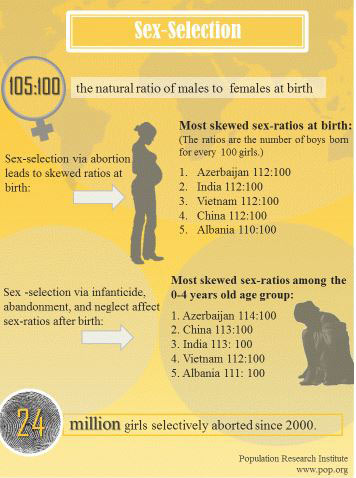 The Population Research Institute, a non-profit research group, revealed these data estimating that the daily average sex selective abortion in India is 2,332.6. China and Pakistan fall in the same line with 96,15,875 and 12,80,228 sex selective abortions between 2000 and 2014.
See how many sex-selective abortions are happening around the world
This calculation is based on averages from the countries where the problem is widespread. Many other countries practice sex selective abortions but it is not as frequent so as to affect the average sex ratio of the country. The countries on the list are those in which sex-selective abortions occur so frequently that they skew the national average. Therefore, the number of female fetus killed or aborted in this period may be even more than 24 million.
Over the last 14 years, there was an average of 4,575 abortions every day across the globe. That comes to about one abortion motivated by gender every 18 seconds.
In India, the declining sex ratio is evident when drawing a comparison in the census figures. According to Census 2011, the child sex ratio (the number of girls per 1,000 boys) in India has gone down from 976 in 1961 to 918 in 2011. This ratio was 962 in 1981, 945 in 1992 and 927 in 2001. This is happening at a time when women are competing with men in all spheres of life.
Another astonishing fact about the skewed child sex ratio comes from Census 2011 that reports maximum sex selective abortion from Surat district of Gujarat. The child sex ratio in Surat is 814 which is lowest in the country among urban agglomerations.
See facts about sex ratio in India
The interaction between active Western Disturbances, increased atmospheric moisture and the region’s complex topography aswell as global warming are important factors behind intense rainfall in the Himalayas, leading to flash floods in Nepal, according to meteorologists. Nepal
Last summer, the two of us spent several weeks in rural Madhya Pradesh with a non-profit that works on gender justice through women’s self-help groups. We went in with a notebook full of laws. The Protection of Women from Domestic Violence Act. The Dowry Prohibition Act. Free legal aid for every wo
Digital payments have become a reflex for urban India, but the confidence earned in paying has not yet carried over to borrowing. That is the central finding of `How Urban India Pays Report 2026`, released by Pahlé India Foundation in collaboration with Amazon Pay. Based on a survey of 5,149 consu
Commerce and industry minister Piyush Goyal has called upon businesses in India and the United Kingdom to translate the opportunities created by the India-UK Comprehensive Economic and Trade Agreement (CETA) into expanded trade, investment, partnerships and job creation. Addressing the Bu
The Gandhian movement in India, after Gandhi’s death, failed, says Ramachandra Guha, and blames Vinoba Bhave for it. But the movement found new, fertile grounds around the world and succeeded in bringing about a change in South Africa, the US and elsewhere. It is high time it returned home. Of cour
Tavleen Singh, noted journalist and political commentator, has turned to fiction, with her debut novel ‘The Actor’ (HaperCollins India). Set in the near future, it has a superstar, Amit Singh, turning to politics, when the political landscape is dominated by prime minister Guru Gaynendraj










