
758 million adults remain illiterate: International Literacy Day

250 million children lack basic literacy skills and 124 million children and adolescents receive no schooling at all

GN Bureau | September 8, 2016

#International Literacy Day   #Literacy Rate   #Census 2011   #Literacy   #UNESCO  


World is observing 50th International Literacy on Thursday under the banner of ‘Reading the Past, Writing the Future’. The event was first observed by the UNESCO in 1966.

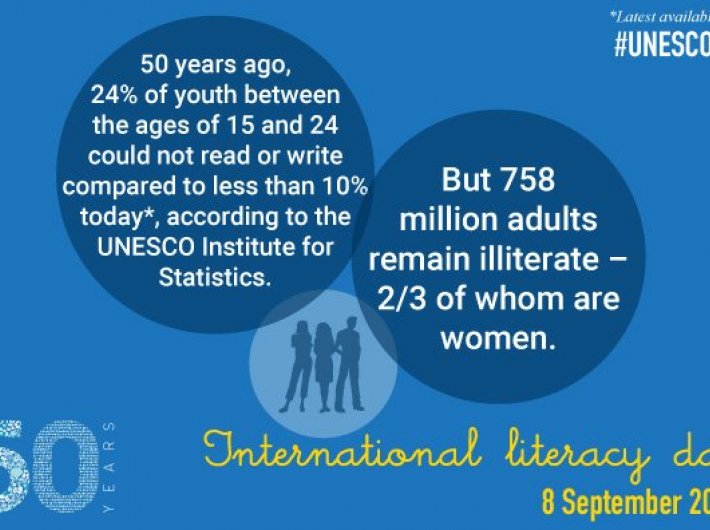
According to UNESCO, 758 million adults (aged 15 years and above), including two-thirds of whom are women, are illiterate. Some 250 million children of primary school age lack basic literacy skills and 124 million children and adolescents receive no schooling at all.

These figures are a reminder that renewed efforts will be needed in order to reach Sustainable Development Goals 4 and 5 and the Education 2030 targets.

Check latest data on world literacy

Facts about India


According to 2011 census, India’s literacy rate is 64.84 %. This was 53.67% in 2001.

According to 2011 census, Kerala is the most literate state with 93.91 per cent, Lakshadweep at 92.28 per cent, Mizoram at 91.58 per cent, Tripura at 87.75 percent and Goa at 87.40 percent. Bihar and Telangana have the lowest literacy rates with only 63.82 percent and 66.50 percent respectively.

Illiteracy is highest among Muslims (42.72 percent). This followed by Hindus (36.40 percent), Silks (32.49 percent), Buddhists ( 28.17 percent) and Christians (25.66 percent).

As per UNESCO’s new Global Education Monitoring (GEM) report, India is expected to achieve universal primary education in 2050, universal lower secondary education in 2060 and universal upper secondary education in 2085.

“The illiterate men and women are more vulnerable to ill heath, exploitation and human rights abuse. They are more likely to be unemployed and paid less. Unable to read or write, they are held back from their full potential, and whole communities are locked into vicious cycles of poverty that lay the conditions for violence and strife… Illiteracy remains synonymous with exclusion and poverty – we must turn this around,” UNESCO said in an official statement.

Check UNESCO’s e-Atlast on literacy

Comments


Other News

India faces critical shortage of skin donors amid rising burn cases

India reports nearly 70 lakh burn injury cases every year, resulting in approximately 1.4 lakh deaths annually. Experts estimate that up to 50% of these lives could be saved with adequate access to skin donations.   A significant concern is that around 70% of burn victims fall wi

Not just politics, let`s discuss policies too

Why public policy matters Most days, India`s loudest debates stop at the ballot box. We can name every major leader and recall every campaign slogan. Still, far fewer of us can explain why a widow`s pension is delayed or how a government school`s budget is actually approved. That

When algorithms decide and children die

The images have not left me, of dead and wounded children being carried in the arms of the medics and relatives to the ambulances and hospitals. On February 28, at the start of Operation Epic Fury, cruise missiles struck the Shajareh Tayyebeh school – officially named a girls’ school, in Minab,

The economics of representation: Why women in power matter

India’s democracy has grown in scale, but not quite in balance. Women today are active participants in elections, influencing outcomes in ways that were not as visible earlier. Yet their presence in legislative institutions continues to lag behind. The Nari Shakti Vandan Adhiniyam was meant to addres

India will be powerful, not aggressive: Bhaiyyaji

India is poised to emerge as a global power but will remain rooted in its civilisational ethos of non-aggression and harmony, former RSS General Secretary Suresh `Bhaiyyaji` Joshi has said.   He was speaking at the launch of “Rashtrabhav,” a book by Ravindra Sathe

AI: Code, Control, Conquer

India today stands at a critical juncture in the area of artificial intelligence. While the country is among the fastest adopters of AI in the world, it remains heavily reliant on technologies developed elsewhere. This paradox, experts warn, cannot persist if India seeks technological sovereignty.


Archives

Current Issue

Opinion

Facebook Twitter Google Plus Linkedin Subscribe Newsletter

Twitter






