
A campaign to make more women tech-savvy

Maharashtra women commission to organise Digital Literacy Abhiyan for women from November 15

geetanjali

Geetanjali Minhas | November 7, 2019 | Mumbai

#Technology   #gender   #Maharashtra State Commission for Women  
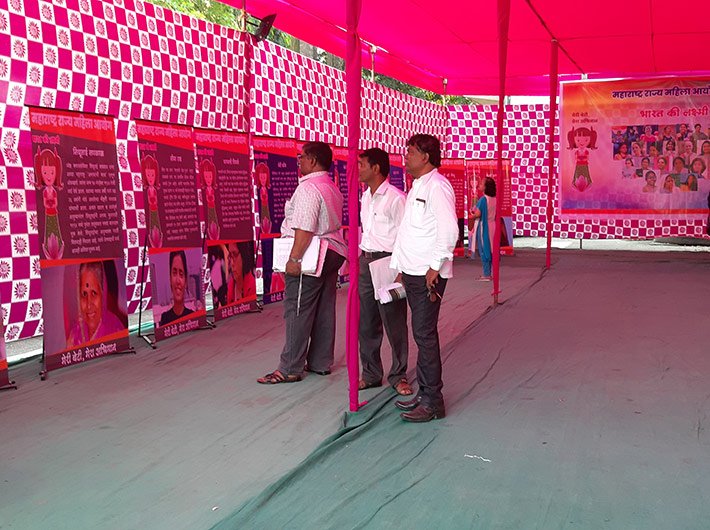
The ‘Bharat Ki Laxmi’ exhibition in Mumbai on November 5-6 showcased the stories of 36 brave women achievers.

To enable women to be tech-savvy so as to be able to easily use technology in their daily life, Maharashtra State Commission for Women (MSCW) is organizing a ‘Digital Literacy Abhiyan’ from November 15 to December 31.

The exercise aims to specially educate women from rural areas as they lack knowledge on use of technology. It will also reach out to urban poor who do not use their phones beyond accessing basic facilities and social media.

As many as 465 NGOs along with the MSCW will help impart skills on the use of mobile technology to women across the state. Some 100,000 women across all districts of Maharashtra will be trained to use government apps like Digilocker, GeM, and UMANG, fin tech apps like UPI, BHIM, and Google Pay, along with apps like IRCTC and state government apps like Aaple Sarkar among several others. If successful, the Abhiyan will be scaled up further.

The commission also organized an exhibition called ‘Bharat Ki Laxmi’ on November 5-6 in Mumbai showcasing the narratives of 36 brave women achievers across different fields. Some of them are Pranjal Patil, India’s first visually impaired IAS officer who has recently taken charge as Thiruvanthapruam sub-collector, Tessy Thomas, the first woman to head an Indian missile project, Anurima Sinha, the first woman amputee to climb the highest peak of Antarctica, Gauri Mahadik, who will now be joining the army after losing her husband, army major Prasad Mahadik in a firing at Arunachal Pradesh, Rahibai Popere, a farmer and conservationist who has created a seed bank of native varieties. These super-achievers help bring out their stories and inspire other women.

“Women are the backbone of their families. Not only they look after their families but also manage their careers successfully in different fields. Many women achieve outstanding success in their respective fields. We are showcasing some examples of such exemplary women achievers across different fields in the country,” said Vijaya Rahtakar, chairperson, Maharashtra State Commission for Women. Rahatkar added that as a society we must rise above gender discrimination and facilitate such women achievers. This helps remove gender discrimination and inspires others.

Comments


Other News

What the US–Iran peace deal means for India

After months of rising tensions, the United States and Iran have reached a memorandum of understanding called the "Islamabad Agreement." This agreement allows for the immediate reopening of the Strait of Hormuz without tolls and provides Iran with relief from sanctions, depending on its complianc

V. M. Tarkunde: A legal luminary par excellence

14 Lawyers: Portraits from The Bar By Raju Ramachandran  Juggernaut, 248 pages, Rs. 799  

The Cost of Obesity

The latest episode of Checks and Balances focuses on the ticking time bomb of obesity in India, and Geetanjali Minhas of Governance Now spoke with a panel of experts. You can watch the episode here: https://youtu.be/mH

US-Iran deal: Path to peace or prelude to deeper regional quagmire?

In the midst of deep mistrust, the US and Iran are reported to have reached a framework deal for ending the West Asian conflict. But whether it will result in any meaningful breakthrough or pave the way for any lasting peace in the region, is in the realm of speculation.   During

Lived life, philosophy, spirituality and other enigmas

The Ashes Are Warm: Memories of a Lifetime Spent with UG Krishnamurti By Mahesh Bhatt and Sunita Pant Bansal Rupa Publications, 384 pages, Rs 495  

In Varanasi, fringe expansion vs. core heritage

For centuries, the urban framework of Varanasi was defined not just by its relationship with the sacred Ganga but by its multifaceted network of urban commons. Historic kunds, seasonal talabs (ponds), and open maidans served as the city’s basic ecological infrastructure. Th


Archives

Current Issue

Opinion

Facebook Twitter Google Plus Linkedin Subscribe Newsletter

Twitter







