
Aadhaar presupposes privacy is fundamental right: Jaitley

“Parliament cannot abrogate its job of legislating if apex court is hearing a petition”

GN Bureau | March 16, 2016

#Aadhaar   #UIDAI   #arun jaitley   #parliament   #law   #supreme court   #privacy   #fundamental rights  


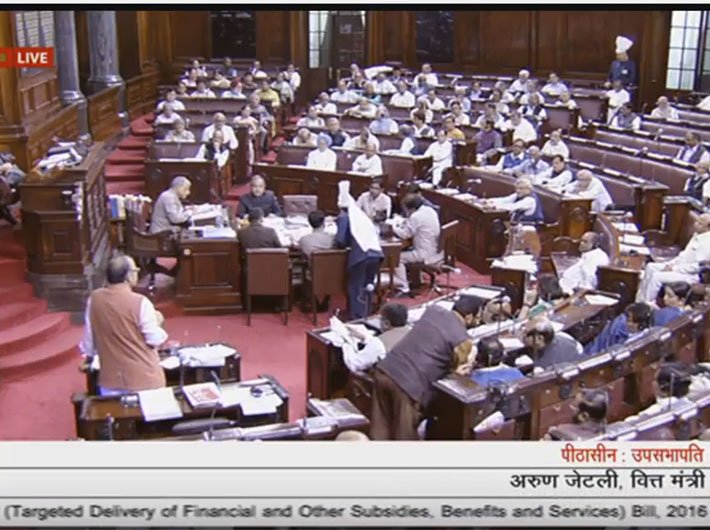
Right to privacy is one of the hotly debated issues when the matter of Aadhaar comes up. On Wednesday, initiating a discussion in the Rajya Sabha on the Aadhaar bill, finance minister Arun Jaitley said this legislation presumes the right to privacy is a fundamental right.

 
That is quite a conclusive statement from the government, though it was immediately followed by fine print which would dilute it a lot. Jaitley added that the right to privacy is part of Article 21 of the constitution – the right to life and liberty. However, as the right to life and liberty is not unrestricted, and is subject to law, the question, according to Jaitley, is only if the restrictions applied on this right to privacy in this legislation are just and fair.
 
He said the new bill had improved upon the UPA version and had stringent provisions to protect privacy, as it makes mandatory to have a committee’s ok for sharing a person’s biometrics and that decision can be reviewed by a committee headed by the cabinet secretary, and this sharing will be done only for one purpose – national security.
 
“Individual right has to give way to national security,” he said. He, however, did not respond to the argument that “national security” is a term undefined and open to interpretation or even misuse.
 
Meanwhile, Jaitley also defended the move to legislate on privacy when the supreme court is seized of the matter. He insisted that parliament cannot abrogate its power to legislate just because the court is hearing a petition on this matter.


Comments


Other News

What is colonialism? A relook at modern history

The Chromatic World Order: The Fiction That Rules Our World  By Sajid Mohamed Aakar Books  

Monsoon session of parliament adjourns sine die

The Monsoon Session, 2026 of Parliament which commenced on July 20 was adjourned sine die on Thursday. The session provided 19 sittings spread over a period of 25 days.   During the session 11 Bills were introduced in Lok Sabha and 2 Bills were introduced in Rajya Sabha. 12 B

Consumer Justice at a Crossroads

Over the past four decades, India`s consumer protection landscape has undergone a remarkable transformation. What began with the Consumer Protection Act, 1986 as a simple mechanism to empower ordinary citizens has evolved into a comprehensive framework capable of addressing challenges ranging from mislea

Doctors, experts call for ban on junk food ads, mandate warning labels

More than 30 doctors, medical scientists and public health professionals have urged the government to take decisive action against the aggressive advertising and marketing of junk food, calling for a watershed ban on advertisements for foods high in fat, sugar and salt (HFSS) and ultra-processed foods (UPF

Asiatic Lion population rises from 523 in 2015 to 891 in 2025

On World Lion Day 2026, environment, forest and climate change Minister  Bhupender Yadav celebrated India’s remarkable journey in lion conservation and reaffirmed the country’s unwavering commitment to protecting wildlife and biodiversity.   In a post on soc

Railways imposed ₹5.13 crore fine for food quality and hygiene violations

Indian Railways serve about 58 crore meals every year on an average. About only 0.0008% food quality related complaints are received on average. Based on complaints during the last three years, appropriate penal actions have been taken by IRCTC. Such actions include imposition of fines amounting to ₹5.13

Upcoming Conferences


-->

Archives

Current Issue

Opinion

Facebook Twitter Google Plus Linkedin Subscribe Newsletter

Twitter







