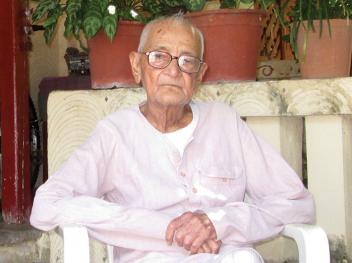
An old-school civil society activist, Chunibhai Vaidya seems more energetic than ever as he fights for the rights of poor farmers – and for Gandhi-Vinoba’s ideals – in Modi-land
Reclining in an easy chair with the evening sunlight filtering through the wooden trellis of the window, he is the picture of the sunset years of life. Like any other nonagenarian, he is thin and frail.
He can barely walk, and talking is obviously a strain – on him as well as the listener.
Which is a stark contrast to the enfant terrible I have known him to be. In Ahmedabad, Mahuva, Mandal and other hotspots of people’s agitations against the Narendra Modi government in recent years, he is a fiery fighter. And soon as he is amid protesting farmers, he undergoes a metamorphosis. His limp turns into saunter, his whisper into a roar, and he shouts “gaon ki jameen gao ki, sarkar ki nahin (village land belongs to villagers and not to the government)”. His voice – and views – have found resonance in different pockets of agrarian Gujarat, guiding farmers to channelise their opposition to the growth which is steamrolling their agricultural land, waterbodies, and pastureland.
Chunibhai Vaidya, the 97-year-old president of the Gujarat chapter of the Lok Samiti (a non-profit organisation founded under Jayaprakash Narayan’s guidance during the anti-emergency protests), is the force behind all land-related agitations in Gujarat.
Chuni-kaka, as he is fondly called, says as long as he lives he won’t let the government usurp farmers’ land. “I am involved, directly or indirectly, in 22 land-related movements in the state,” Vaidya says.
“Chuni-kaka is the alternative and much-needed voice in the otherwise cacophony of Gujarat’s development narrative,” says Prakash N Shah, an eminent civil society activist who was Vaidya’s companion in jail during the emergency.
Surprisingly, in these cynical times, that voice has succeeded too. When about 5,000 farmers in Mehsana district marched to Gandhinagar, the state capital, this July, shouting “gaon ki jameen gaon ki, sarkar ki nahin’’ in unison against the forced acquisition of their fertile land for a special investment region (SIR), the mighty Modi government was pushed to the wall and for the first time in 12 years of his rule, the chief minister rescinded his order.
In 2008, Vaidya along with Kanubhai Kalsaria, then a rebel BJP legislator, spearheaded a protest by farmers from 15 villages around Mahuva in Bhavnagar district against the government move to allot to the Nirma group a piece of land without bothering about a waterbody there which had revived agriculture in the region. Touring the affected villages, Vaidya exhorted farmers to protect their land and other natural resources against the greed of the government and the corporate sector. The ‘Mahuva struggle’ lasted for three years and ended with a victory in March 2011 when the ministry of environment and forests revoked environment clearance given to the cement factory.
“The first step towards empowering the farmers is to educate them – that they alone have the right on their land, and if they wish to say no to the government they can do so. And we have been able to educate them through the slogan gaon ki jamin gaon ki, sarkar ki nahin,” he says.
Vaidya, already associated with various people’s movements since the 1970s, threw his weight behind land-related agitations in 2005 when he learnt about a government notification that announced the revocation of an earlier policy that allowed distribution of land to the landless and instead argued for giving large tracts of land to big farmers who would use it for production on a large scale.
This policy incensed him. “I travelled to villages where the landless had been given land and saw how effective the last policy was. How could the government do away with it without assigning any reason?” Vaidya asks. He challenged the government, asked it to withdraw its policy, and threatened agitation.
May 16, 2006 was announced as the day of the agitation. That day, Lok Samiti members and volunteers were to stop rail and road transport across the state. The call for a total bandh forced the government to start a dialogue with the Lok Samiti and after a series of meetings it agreed to revoke the new policy and return to the old scheme of things.
The government thereafter distributed 20,000 acres to 6,723 landless people. It was during this agitation that Vaidya says he came to realise in the deep sense that land truly belongs to people in the first place, and not to the administration which claims ownership over it. This realisation finds its pithy expression in his slogan.
Lessons learnt from Vinoba
Of course, as a close associate of Vinoba Bhave and a staunch supporter of his Bhoodaan movement, Vaidya’s empathy for land-related movement was obvious. “His Bhoodan movement, which advocated distribution of excess land captured by landlords among the landless, caught my imagination,” he recalls. So impressed was he by Vinoba that in the early years of independence, he volunteered to work for his Sarvodaya fortnightly journal, Bhoomiputra, in Vadodara.
In the 1960s Vinoba asked him to go to Assam and take charge of the Sarvodaya-related publication work there. Vinoba entrusted him the task of spreading his message in the northeast. Vaidya stationed himself in Assam, learnt the language and stayed on for 12 years in the state.
Talking about his period in the Northeast, Vaidya says initially he wanted to “run back to Gujarat” but Vinoba would not let him. “Once, in 1962, when China invaded India, I had nearly packed my bags to leave Assam. That very night I had a scary dream that China had captured the entire Northeast and people were in trouble. That made me realise I could not quit when the people I had come to serve were in trouble,” he says.
He returned to Gujarat in 1974 as editor of Bhoomiputra. A year later, Indira Gandhi had clamped emergency. This was the time when censorship was the order of the day and majority of the news publications in Gujarat were forced to toe the line of the Congress government.
Vaidya, who in his youth had participated in the freedom struggle and distributed anti-government pamphlets, was not to be cowed down and published an anti-emergency resolution on the front page. The modest journal became a talking point across Gujarat, and the mild-mannered Gandhian a hero of the masses. Soon, Bhoomiputra became the platform of anti-establishment voices, publishing speeches of two great public intellectuals: Purushottam Malvankar and Umashankar Joshi (difficult to believe today, but the former was a member of Lok Sabha and latter of the Rajya Sabha).
The government, however, did not arrest him immediately and when the cops finally came knocking at his door a year after that famous anti-emergency resolution was printed, Vaidya could not help but smile. “Why did it take you so long?” he told them. He was imprisoned for 17 months.
Neeta Mahadev, Vaidya’s adopted daughter, recalls his popularity in those days. “I was in Surat and had heard of this man who had devoted his life to public service and was taking on the mighty Indira Gandhi government through his paper Bhoomiputra,” she says.
Then a young woman in her 20s, Neeta left home to work with Vaidya and never returned. “I stayed on to take care of him and since then have always been with him,” she says.
After the end of emergency Vaidya moved from Vadodara to Ahmedabad, and took over the reins of the Gujarat chapter of Lok Samiti. He always wanted to work at the grassroots level and his association with Vinoba pushed him towards the landless and destitute. “He made it his mission to work for the underprivileged and deprived,” said Sagar Rabari, a long-time associate and member of the Gujarat Lok Samiti.
Born in 1918 in Sander village in Patan district of north Gujarat, Vaidya was a rebel from a very young age. After his matriculation he joined the Surat municipality as a clerk. He however did not like his job much and wanted to join the freedom movement. His inspiration was Mahatma Gandhi (whose glimpse he had once).
Thus during the day he worked as a clerk loyal to the British government, and by night he helped print and distribute anti-government posters and pamphlets. This arrangement, of course, could not last long. Police got wind of the underground group that indulged in nationalist activities. And, one fine day they came calling at his office. Fortunately for him they took along his namesake, a colleague at his office. When Vaidya learnt of the news he left Surat. Heeding Gandhiji’s call to work for villages, he embarked on a journey to the hinterland. It was during this time that he decided to devote his entire life to social service. He decided not to marry, lest the responsibilities that come along should hinder his work. For years he travelled all across India, from Gujarat to Bihar to Uttar Pradesh to Tamil Nadu and Kerala.
His years of travel to villages across the country have endowed him with great understanding of the issues at the grassroots, says N Shah. “It is with this background that when he talks to villagers in their language, they listen to him and follow him,” he explains. Not surprisingly, therefore, Vaidya is the lynchpin of a whole range of ‘people’s movements’ going on in Gujarat—from Mandal Becharaji (against the proposed SIR) to Mithi Virdi (against the proposed nuclear power plant) to Kevadiya (for rehabilitation of the Sardar Sarovar dam affected people).
His age is no deterrence against hectic travelling. “It’s unbelievable how he keeps going at this age,” Mahadev says. There are times when he is seriously ill and bed-ridden for months, but then whenever any of the people’s movement needs him he is there in person. Ask him about what keeps him going and he invokes his hero, Gandhi. Pointing to a portrait of the Mahatma that hangs on the wall next to one of Vinoba, he says, “This is Gandhiji’s land and he firmly believed in the power to villagers, and their control over natural resources. With the Narendra Modi government hell-bent on destroying both, how can I rest?”