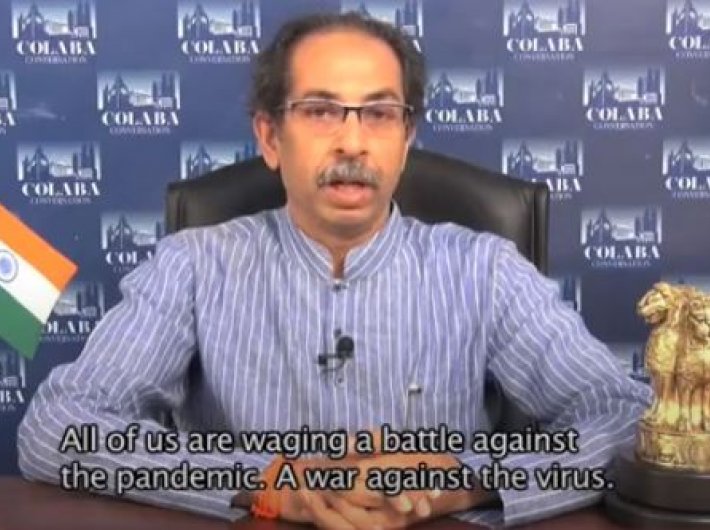
Following is the rendering in English of Maharashtra chief minister Uddhav Thackeray’s inaugural address during the webcast of ‘Colaba Conversation 2021: Creativity, Community and Commerce in the Indo Pacific’ held by Observer Research Foundation (ORF) in collaboration with the government of Maharashtra.
The two-day virtual online conference has 70 speakers from 20 countries including policy makers, business leaders, experts and community leaders. Discussions are being held to discuss international policy issues affecting the city, nation and world, rethinking a new global governance architecture which requires short-term responses guided by the evolving nature of the pandemic and long-term responses guided by the fundamental shifts in global affairs.
We never realized the power of a virus that would make us understand the meaning of pause and reset in our lives. Even as we are confronting this, it is only now that a vaccine has been made available. There is still no medicine and vaccination has just begun. Even today there is no fourth alternative other than wearing masks, maintaining social distance and washing hands. Although the pandemic has forced us to maintain physical distance, online media has brought us closer. This is one of the positive outcomes of pandemic which has made us believe that we have made great progress. Earlier we never had the time, stopped or took stock. But Coronavirus pressed the pause button, made us look back and take stock. It made us question: Where do we stand? What do we mean by progress? What is the way ahead if this situation continues?
Climate is an important element in our lives. Corona has made us realize the importance of oxygen. In the absence of medicine, oxygen has saved lives. This is universal truth. But our actions have depleted oxygen levels. We are responsible for environmental degradation. Mumbai is not only the financial capital of India but also an important financial centre. It has seen many disruptive upheavals and also created ripples. One does not know where to begin when you talk about Mumbai. It is a unique city. It is progressive, industrious, tenacious, resolute and resilient. It has the sea as well as the hills, jungles and caves. It also has skyscrapers. It has Bollywood, some of the world’s top industrialist and businesses and its people are hard-working. It has the power of youth and it is secure. It has everything. Besides being the financial capital and the centre of India it also leads the country in many other aspects.
Even in the absence of medicine or vaccine, the Dharavi pattern of Mumbai has earned global recognition. Just by following strict discipline and through exercising determined tracking and tracing protocols Mumbai was able to rescue a locality like Dharavi from the scourge of pandemic.
Mumbai has faced several disasters but it did not fear or stop. Be it flash floods, terror attacks or now the pandemic, Mumbai has resolutely stood strong. Mumbai has been the beacon of India on several counts. I was talking about environment and then about Mumbai because it is the only city in the country which has a jungle. It is not a concrete jungle but is rich in biodiversity. Till now the forest department did not have adequate recognition. It has now declared 800 acres Aarey colony as a reserved forest area. Ancient caves coexist with innovative thinking in Mumbai.
Unique experiments are taking place in Mumbai. The pause enforced due to pandemic has made us identify the challenges. From where and how the next challenge is going to arise… corona has made us aware of the environment. The question is whether we have learnt the lessons. What do we mean by global warming? Why do cloud bursts happen?
We witnessed mass migration from rural to urban areas. Mumbai tops the list of cities that witness high migration. In the name of development, migration led to increase in demand of jobs. Migration has caused an escalation of construction activities and mechanization. This is the challenge that migration has caused to all global cities. Global warming does not happen in forests or in villages. My hunch is that cities have contributed hugely to climate change. This can be verified by experts. In this way what is the way ahead? Should we stop all development work? We must gauge the need of the hour and rise to the occasion. Cities are witnessing population growth. Issues like affordable housing and ecofriendly mass transportation are gaining significance. Over the past few months we have introduced e- buses to the fleet of BEST which is Mumbai’s public transport lifeline. This means that people want development. In this context the pandemic has forced us to understand the distinction between claims of development and real development. The pandemic has brought us together. This year we have made a beginning in the online format. I invite you all to Mumbai next year and welcome you to Mumbai the capital of Maharashtra and financial capital of India and would be glad to meet you in person. Next year we would have fought the war against corona and figured the way forward.