
DDA doesn’t know how much land it owns

CAG audit revealed shortages in land vis-à-vis the area reported by DDA in its records.

GN Bureau | January 19, 2017

#Delhi government   #land management   #Delhi development authority   #DDA   #CAG  
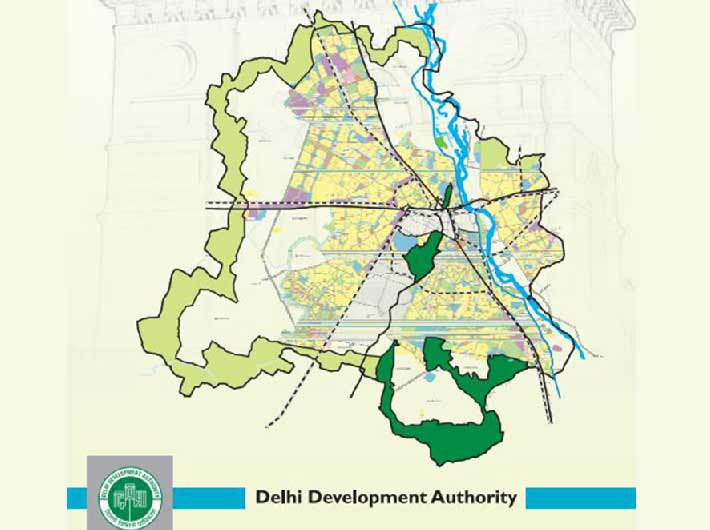
Master plan for Delhi - 2021

DDA had no consolidated information/database in respect of land acquired and utilised for various schemes as well as vacant land in hand, said the Comptroller and Auditor General (CAG) in a report.
 
The CAG report on land management in Delhi Development Authority (DDA) said that the information relating to vacant land lying with DDA and acquired land during 2010-11 to 2014-15 provided by different wings of DDA was at variance. Further, joint inspection carried out by audit revealed shortages in land vis-à-vis the area reported by DDA in its records.
 
The report said that Delhi, being a city state and also the capital of the country with an area of 1,483 sq km and a population of 1.67 crore (as per census 2011), has a great need for planned development to make it a world class city. Further, with the explosive growth of population, the importance of providing necessary infrastructure in a reasonable time and effective manner cannot be overstated.
 
The Delhi Development Act, 1957 (DD Act) enacted by the central government in 1957 provides that the objective of the DDA shall be to promote and secure the development of Delhi according to the Master Plan. Thus, DDA is responsible for acquisition and development of land for various developmental schemes as per the Master Plan approved by the Central Government. The land is acquired through Delhi Government and placed at the disposal of DDA for development purposes as approved under the various development schemes.
 
 
The CAG report said that budget estimates of land acquisition, development and disposal were not prepared on a realistic basis keeping in view actual receipt/ expenditure.
 
Also, monitoring and periodical review of Master Plan of Delhi (MPD)-2021 was not conducted as prescribed in the Master Plan. The monitoring unit set up in August, 2007 was not provided with modern data processing facilities and other necessary resources required for carrying out the task.
 
MPD-2021 had envisaged alternative options for development of areas identified for urbanization in MPD-2021 through involvement of the private sector in land assembly and development. For this purpose, a land pooling policy was approved by the Central Government in September, 2013, but due to lack of coordination between DDA and Delhi Government, on pre requisite formalities such as declaration of development areas, the policy has not been operationalised yet (October 2016).
 
There was lack of coordination between DDA and Delhi government in acquisition proceedings, release of compensation/ enhanced compensation, receipt of land from Delhi government, reconciliation of accounts and proper utilisation of funds by Delhi government, which resulted in non-reconciliation of compensation amount between DDA and Delhi government, non-receipt of utilisation certificate from Delhi government, non-receipt of land even after release of full payment and double payment of enhanced compensation.
 
The CAG report went on to say that there was delay in completion of land acquisition process. Time taken for release of compensation to Delhi government, after receipt of demand from Delhi government, ranges from seven month to more than eight years. Further, the time taken for transfer of land to user departments (or non-transfer of land up to October 2016), after taking possession of land from Delhi Government, ranged from one month to more than nine years.


Comments


Other News

India faces critical shortage of skin donors amid rising burn cases

India reports nearly 70 lakh burn injury cases every year, resulting in approximately 1.4 lakh deaths annually. Experts estimate that up to 50% of these lives could be saved with adequate access to skin donations.   A significant concern is that around 70% of burn victims fall wi

Not just politics, let`s discuss policies too

Why public policy matters Most days, India`s loudest debates stop at the ballot box. We can name every major leader and recall every campaign slogan. Still, far fewer of us can explain why a widow`s pension is delayed or how a government school`s budget is actually approved. That

When algorithms decide and children die

The images have not left me, of dead and wounded children being carried in the arms of the medics and relatives to the ambulances and hospitals. On February 28, at the start of Operation Epic Fury, cruise missiles struck the Shajareh Tayyebeh school – officially named a girls’ school, in Minab,

The economics of representation: Why women in power matter

India’s democracy has grown in scale, but not quite in balance. Women today are active participants in elections, influencing outcomes in ways that were not as visible earlier. Yet their presence in legislative institutions continues to lag behind. The Nari Shakti Vandan Adhiniyam was meant to addres

India will be powerful, not aggressive: Bhaiyyaji

India is poised to emerge as a global power but will remain rooted in its civilisational ethos of non-aggression and harmony, former RSS General Secretary Suresh `Bhaiyyaji` Joshi has said.   He was speaking at the launch of “Rashtrabhav,” a book by Ravindra Sathe

AI: Code, Control, Conquer

India today stands at a critical juncture in the area of artificial intelligence. While the country is among the fastest adopters of AI in the world, it remains heavily reliant on technologies developed elsewhere. This paradox, experts warn, cannot persist if India seeks technological sovereignty.


Archives

Current Issue

Opinion

Facebook Twitter Google Plus Linkedin Subscribe Newsletter

Twitter






