
Demonetisation hits handicraft business at Rann Utsav

Additional costs and lack of knowledge about digital payments has affected the artisans’ profits

taru

Taru Bhatia | December 23, 2016 | Kutch

#Rann of Kutch   #Gujarat   #cashless   #Rs 1000   #Rs 500   #currency   #demonetisation   #Reserve Bank of India   #RBI   #black money   #craftsmen   #artisans  
Demonetisation hits handicraft business in Rann Utsav

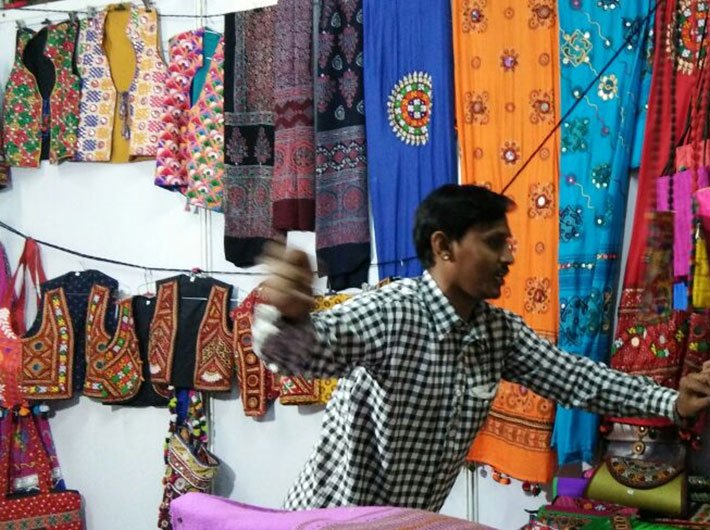
Mangal Bhai Rama Harijan is a craftsman from Kawada village, 50 kilometres from the Great Rann of Kutch in Gujarat, the place where India’s most prominent cultural festival takes place every year.

The festival, Rann Utsav, is a 110 days cultural festival. It begins in November and will go on till February. It gives the opportunity to local artisans to display their ‘Kutchchi’ handiwork. This year however, demonetisation has hit them hard and has taken down their business.

Harijan has set up his stall of ‘paka’ work, a form of handmade embroidery of Kutch. He has been seeting up a stall every year for the past 10 years. But this year he saw a dip in his business. He blames demonetisation. “It is been a month now and I have been able to earn around Rs 15,000 only. Last year, in three months, I managed to earn Rs 2 lakh,” he says. He says that melas like these are a good opportunity for local artisans like him to earn money.

Harijan brings local handicraft work from 10-15 villages. He says women who do embroidery work at villages earn from Rs 200 to 300 per day. But unfortunately, only 10 percent of the business took place this month.

On asked why he is not using his mobile phone to do cashless transactions, he says that the process is complicated and he doesn’t know how to use it.

Many handicraft stall owners at the Rann Utsav complained that they were not given any training on how to use digital payment channels.

Lalji, another stall owner from Dholavira, about 300 kilometres from Kutch says, “They told us to go cashless but didn’t teach us how to do it.” Lalji, who opened his stall on December 1, says that in 15 days he has earned Rs 2,000 to Rs 4,000 only. Last year in the same time period, he managed to earn about Rs 40,000. 

The government official did come once to discuss cashless channels with the local handicraft sellers but never returned. “They came once to collect our account numbers and said that they will come again to teach them how to use digital wallet Paytm. But they never came,” says Arun Vanakar, another seller of Kutch handicraft. 

Vanakar mentions that many visitors wish to pay through Paytm, as they want to save their cash. “One lady taught me how to use Paytm. It wasn’t that difficult.  If official had trained us earlier, we would have not been struggling,” he adds.

Moreover, the Gujarat government this year started to charge Rs 100 per day rent from the stall owners, which was earlier rent-free. This has added more to the artisans’ woes. “Already the business is slow and now we have to pay rent too every day. We are not able to make a single rupee profit so far,” Harijan adds.


Comments


Other News

UPI completes 10 years of digital payments revolution

The Unified Payments Interface (UPI), launched on August 25, 2016 by the National Payments Corporation of India (NPCI) under the regulatory oversight of the Reserve Bank of India (RBI), has completed 10 years of transforming digital payments in India. UPI has emerged as the backbone of India’s digi

Here’s an I.D.E.A. for career growth and success

Success in today’s professional organisation is no longer solely determined by academic qualifications, technical expertise or years of experience. While these attributes do matter, organisations increasingly value individuals who demonstrate the right mindset and behavioural qualities. The ability

PM interacts with CEOs, founders of space startups

Prime minister Narendra Modi interacted with CEOs and Founders of 20 Space Startups at Seva Teerth on Friday.   CEOs of leading companies in the space sector working in diverse fields ranging from building rockets and reusable semi-cryogenic launch vehicles, avionics, satelli

From one cow to a dairy business

In 2012, Anita Dash wasn`t dreaming of building a dairy brand. She wasn`t studying business models or planning market expansion. Like countless mothers across India, her focus was on something much simpler: giving her children a better future.   At the time, her most valuable

Ethanol blending: The two sides of a story

India`s crude oil consumption is estimated to be around 88.5% imported from abroad. This one single figure is also responsible for why ethanol has become both an economic strategy and fuel policy at the same time. In an economy like India, which depends so heavily on foreign oil, any increase in internat

Food inflation: Not a macroeconomic statistic but a developmental indicator

India`s retail inflation shows a reassuring picture at first glance. According to the latest data, Consumer Price Index (CPI) inflation edged up to 4.38% in June 2026 from 3.93% in May 2026, but continued to remain within the Reserve Bank of India`s (RBI) target band of 4% (+/- 2%). However, beneath this

Upcoming Conferences


-->

Archives

Current Issue

Opinion

Facebook Twitter Google Plus Linkedin Subscribe Newsletter

Twitter






