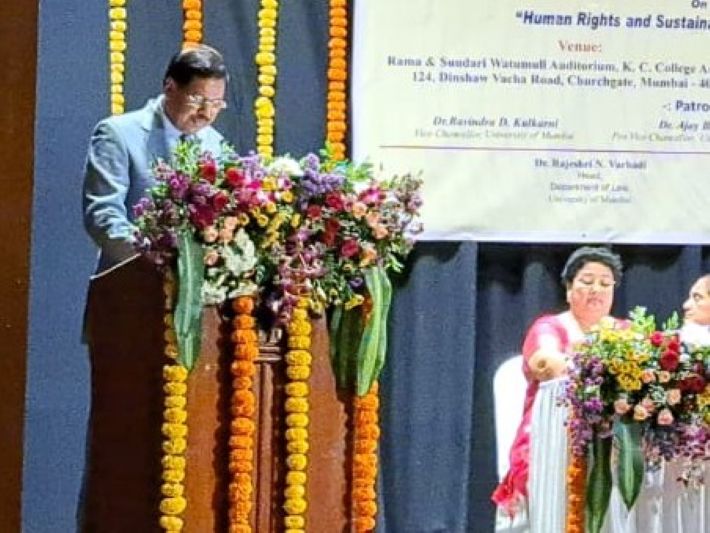
Delivering Chagla memorial lecture, former CJI Gavai emphasizes the need to ask who bears the environmental costs of development and whose voices are represented in decision-making processes
Delivering the IXth Chief Justice M.C. Chagla Memorial Lecture on ‘Human Rights and Sustainable Development Goals’, in Mumbai Friday, former Chief Justice of India Bhushan R. Gavai questioned whether conventional economic indicators such as gross domestic product (GDP), national income, investment and production are sufficient measures of development.
Justice Gavai said the assessment of development must go beyond the scale of economic activity and examine how its benefits are distributed, whether people enjoy greater freedoms, and whether economic activity damages the environment on which communities depend.
He pointed out that a development project may create employment and infrastructure, but its assessment must also take into account the people who may lose their homes, livelihoods or access to natural resources as a consequence.
“These losses raise questions of justice that cannot be answered merely by an increase in overall prosperity,” was the thrust of his argument, as he linked the idea of development with environmental and climate justice.
Justice Gavai emphasized the need to ask who bears the environmental costs of development and whose voices are represented in decision-making processes. He said the assessment must consider whose surroundings are polluted, whose lives are placed at risk and whether communities facing the greatest impacts have adequate resources and support to protect themselves.
Marginalised communities bear disproportionate burden
Referring to the Indian context, Justice Gavai observed that marginalized sections of society, including low-income groups, women and Adivasi communities, often bear a disproportionate burden of climate change and environmental degradation.
He stressed that income remains important, but its significance ultimately lies in what it enables individuals to do. The central question, he said, is whether people have genuine opportunities to access education, healthcare, livelihoods and meaningful participation in their communities.
Economic growth can contribute to these opportunities by generating employment and providing resources for public services. However, growth must be considered alongside its social and environmental consequences.
Fundamental rights and Directive Principles
Justice Gavai also referred to the constitutional relationship between Fundamental Rights and the Directive Principles of State Policy.
He noted that, prior to 1973, the Supreme Court had taken the view that where Fundamental Rights and Directive Principles came into conflict, Fundamental Rights would prevail.
The Constitution Bench of 13 judges in Kesavananda Bharati v. State of Kerala subsequently recognized the importance of harmony and balance between Fundamental Rights and Directive Principles as part of the constitutional framework.
The discussion, he suggested, has continuing relevance to questions of development, particularly when economic or infrastructure objectives come into tension with individual rights and community interests.
Development cannot override constitutional rights
Justice Gavai stressed that a development target, by itself, cannot justify a violation of constitutional rights.
He illustrated the point through the example of settlements that may appear on a city plan as an obstruction or unauthorized occupation. While such settlements may be viewed purely from the perspective of urban planning, for their residents they can determine whether they are able to reach their workplaces, send their children to school and maintain sustainable networks of community support.
A constitutional assessment, he said, must therefore account for these human considerations while also taking into consideration the broader aspirations of sustainable infrastructure and development.
A broader understanding of development
The address ultimately called for a broader conception of development -one that measures progress not only through economic output, but also through human dignity, equality, environmental protection, access to opportunities and constitutional rights.
He noted that the pursuit of sustainable development should not leave behind those who are already vulnerable to bear an unequal share of its social and environmental costs.