
Endorsement guidelines issued for celebs and social media influencers

‘Endorsements Know-hows!’: Disclosures must be prominently and clearly displayed, says guide issued in accordance with the Consumer Protection Act of 2019

GN Bureau | January 20, 2023

#Consumer Protection Act   #consumer affairs   #advertisement   #media   #social media  


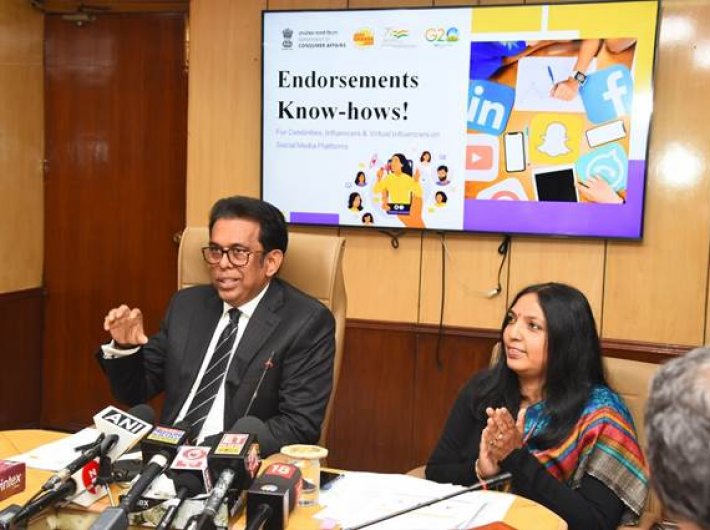
The department of consumer affairs under the ministry of consumer affairs, food and public distribution released a guide, ‘Endorsements Know-hows!’, for celebrities, influencers and virtual influencers on social media platforms here on Friday. The guide aims to ensure that individuals do not mislead their audiences when endorsing products or services and that they are in compliance with the Consumer Protection Act and any associated rules or guidelines.

Rohit Kumar Singh, secretary, department of consumer affairs, released the guide in response to the rapidly growing digital world at a time when advertisements are no longer limited to traditional media like print, television, or radio. With the increasing reach of digital platforms and social media, such as Facebook, Twitter and Instagram, there has been a rise in the influence of virtual influencers, in addition to celebrities and social media influencers. This has led to an increased risk of consumers being misled by advertisements and unfair trade practices by these individuals on social media platforms.

The ‘Endorsement Know-hows!’ specifies that disclosures must be prominently and clearly displayed in the endorsement, making them extremely hard to miss. Any celebrity, influencer or virtual influencer who has access to an audience and can influence their purchasing decisions or opinions about a product, service, brand, or experience must disclose any material connection with the advertiser. This includes not only benefits and incentives, but also monetary or other compensation, trips or hotel stays, media barters, coverage and awards, free products with or without conditions, discounts, gifts and any family or personal or employment relationship.

Endorsements must be made in simple, clear language and terms such as "advertisement," "sponsored," or "paid promotion" can be used. They should not endorse any product or service and service in which due diligence has been done by them or that they have not personally used or experienced.

The guide is released in alignment with the guidelines set by the Consumer Protection Act of 2019. The Act established guidelines for protecting consumers from unfair trade practices and misleading advertisements. The Department of Consumer Affairs has published Guidelines for prevention of Misleading Advertisements and Endorsements for Misleading Advertisements, 2022 on June 9, 2022.

These guidelines outline the criteria for valid advertisements and the responsibilities of manufacturers, service providers, advertisers, and advertising agencies. These guidelines also touched upon the celebrities and endorsers. It states that misleading advertisement in any form, format or medium is prohibited by law.

Multiple social media influencers and agencies participated via video conferencing in the press conference to release of the guidelines. The industry appreciated and supported the release of these guidelines. They stated that this will further strengthen the industry and protect consumer interests.

Comments


Other News

How Rafi, Raj Kapoor helped pave the way for a great uranium deal

There`s a certain moment in diplomacy that`s too personal to be captured in a communiqué, too small to make the front page, but more revealing than the front page. This week, prime minister Narendra Modi reached Tashkent and, amid the pomp of state visits, managed to evoke the old Bollywood tunes

Distinguishing Fish 1 and Fish 2: The pragmatism behind India’s WTO ratification

 India became the 123rd WTO member to ratify the multilateral Agreement on Fisheries subsidies (AoFS) when it deposited the Instrument of Acceptance for Phase 1 on July 20, 2026. The ratification is restricted to disciplining Illegal, Unreported and Unregulated fishing (IUU), protection for overfished

The 7% growth problem: Why the next 7% will be harder

India has become accustomed to hearing the 7% growth number. It is now less a milestone than an expectation. Yet the paradox is becoming clearer: maintaining 7% growth may be considerably harder than achieving it once. India’s real GDP grew 7.7% in FY2025–26, following growth of 6.5% in FY202

The Constitution cannot be altered: Justice Abhay Oka

Justice Abhay Oka, who retired from the Supreme Court in May 2025, has said that the Constitution of India cannot be altered. Explaining the landmark Kesavananda Bharati judgment (1973) on the basic structure of the Constitution, he said, “This is one judgment that has saved democracy in India.&rdq

How the flora and fauna evolved in the Indian subcontinent

Mammals of India  By A.J.T. Johnsingh and P.O. Nameer HarperCollins India in association with Bombay Natural History Society  

India`s renewable race is moving beyond megawatts

When Shell bought Sprng Energy in 2022, India`s renewable energy market appeared to offer precisely what global energy majors were seeking: scale, growth and a place in one of the world`s largest energy transitions. Four years later, Shell is selling the same business to Aditya Birla Group for an enterpris

Upcoming Conferences


-->

Archives

Current Issue

Opinion

Facebook Twitter Google Plus Linkedin Subscribe Newsletter

Twitter






