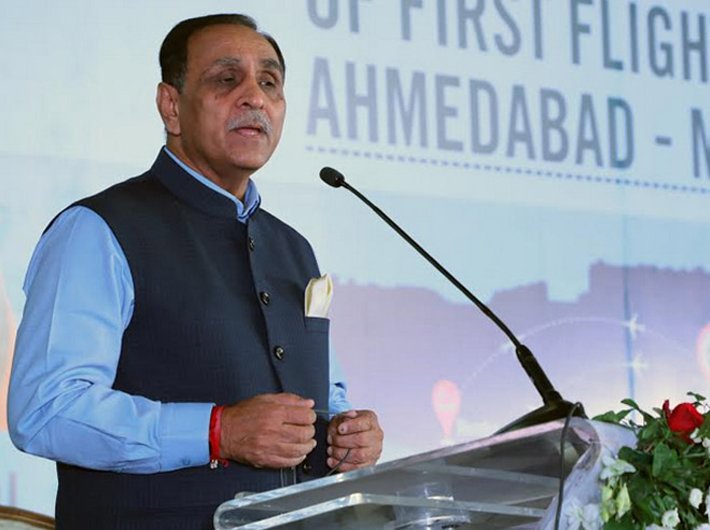
Gujarat chief minister Vijay Rupani asserts that he is sure his party, BJP, will repeat the performance of 2014 Lok Sabha election in the 2019 national elections as the “Modi magic” is still intact and has not withered away. “Let us not look at the 2019 Lok Sabha election from the prism of Gujarat Assembly results,” Rupani says.
In a freewheeling interview at his official residence in Gandhinagar on Tuesday, a day before he attended a conference of BJP chief ministers and deputy chief ministers in the party's Delhi headquarters, Rupani exudes confidence and points out that those belittling the BJP’s victory in Gujarat Assembly elections in December 2017 are failing to gauge the pulse of the people. “We won that election against immense odds,” he says.
“After a long gap, there was a determined attempt by the Congress to push Gujarat into a vortex of sectarian conflicts on caste and communal lines,” he adds, referring to the emergence of caste-based campaigns led by Jignesh Mevani, Alpesh Thakor and Hardik Patel. “This is a transient phase which has practically blown over,” he says confidently.
Rupani, however, does not see any possibility of Mevani emerging as an influential leader such as Kanshi Ram or Mayawati solely on the basis of Dalit assertion. “That is nearly impossible as Dalits and tribals closely identify themselves with the BJP,” he says, adding “We have more Dalits and tribal legislators than our rivals.” Referring to a debate on Dalit welfare in the Assembly, he says, “I gave details of schemes initiated by my government for welfare of Dalits and it caused silence in the camp of our adversaries.”
Asked if there was any need for introspection within the party after Gujarat’s election results, which is often described as a moral defeat for the BJP, Rupani says, “We are quite alert to the possibility of attempts to create social divisions by the Congress and others, and we are working on a political project to neutralise it.” The way he puts this indicates the BJP has something up its sleeve for the next year’s Lok Sabha polls.
Would he share the details of this project? “Of course, we would neutralise them by launching our own political project of unleashing robust nationalism to counter social division... We are trained in the RSS culture where caste divisions and linguistic conflicts have no meaning.” He adds that at the government level, he has been initiating several measures to overcome the rural distress and take care of socially and economically marginalised people. “Social engineering will be integral to our project of nationalism,” he says, adding that caste factors in Indian reality could not be ignored.
Contrary to his first stint (2016-17) as chief minister when Rupani looked tentative and taciturn, he seems to have found his bearing in the second stint. He does not seem perturbed over the impression that the BJP barely scraped through in the Assembly elections. “You see, when I came here as the chief minister there was the pressure of coming elections,” he says, explaining his tentativeness during those initial days. “Now I am determined to build our governance on three pillars: Transparency, honesty and good administration.”
But is he aware of the fact that there is a perceived drift in governance under his watch?
He candidly replies that it would be wrong to compare his style of functioning with that of his predecessors: especially Narendra Modi. “Modi ji kahan aur hum kahan! (Modi is a leader of altogether different class!),” he says, with a tinge of admiration bordering on awe and respect for the prime minister. “Of course, such comparisons are erroneous as every individual develops his own style,” he says by way of explaining that the perception of drift in governance has nothing to do with the ground reality.
There are reports of growing rural distress in Gujarat, but Rupani dismisses the impression out of hand. “This is untrue as we scored major victories even in rural areas in the Assembly elections,” he says, adding that his government has been planning in tandem with the Union government to evolve a mechanism to ensure remunerative prices for farmers. Asked if he is planning a parallel Minimum Support Price structure (MSP), he says, “It will be a sort of MSP structure to ensure better price for agriculture produce.” Also, “At the same time, we are planning to modernise agriculture.”
Asked if his government has any scheme to introduce corporatisation of agriculture, he says that such a scheme was on the cards with a precondition that farmers would retain the ownership of land. “Large farms could be leased out to corporates for modernisation of agriculture,” he says, adding that the state had seen diversification of agriculture at a large scale with farmers cultivating flowers, vegetables and fruits. At the same time, he points out that the state government has planned to develop a chain of cold storage units to preserve perishable agriculture produce and ensure good prices for farmers.
“We are focussing on youth and roping in about 1 lakh youth for apprenticeship to develop their skills for jobs,” he says, referring to the government’s plan to organise a 'rojgar mela' or employment camp to give nearly four lakh jobs to youngsters. “I am sure these measures would substantially take care of providing jobs to needy.” Referring to a slew of welfare measures initiated by the state, he says his government is going ahead with the plan to take care of ageing population. Those above 60 years of age, with annual income less than Rs 6 lakh, would be given free medical facilities up to Rs 3 lakh on selected ailments.
Despite all his bravado and welfare measures, is Rupani really confident of the BJP winning all 26 seats in 2019 as it did in 2014? Rupani pauses for a moment, collects himself and begins listing statistics of the party’s victory run in local bodies. “Even in the state Assembly elections, if votes were to be counted in terms of Gujarat’s 26 Lok Sabha constituencies, we would have won 18 seats. You see, our biggest trump card is the name of Narendra Modi and let me tell you his charm has only increased these past years,” he sums up.
[This interview has also appeared on FirstPost.com]