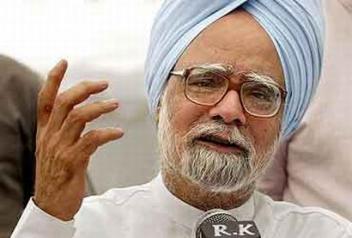
The PM ends up contradicting better sense and expert committees' recommendations in his public policy posturing
The ongoing development debate, dominated by themes like Vedanta, acquisition of farmland for industry, and food security, deposits a thick layer of irony and contradiction on Prime Minister Manmohan Singh’s utterances at the September 6 meeting with a group of editors.
“India has no option but to industrialise. The only way we can raise our heads above poverty is for more people to be taken out of agriculture,” Singh was quoted by The Hindu as telling the editors.
Let’s juxtapose this wise-sounding statement with the recommendations of two committees set up by UPA-I whose agenda continues with UPA-II and defines a very important role for Manmohan Singh to perform. Both these committees dealt with the ‘unfinished agenda’ of land reforms and agrarian relations.
“As a general proposition it may be stated that land reform should remain an essential element of national agricultural and rural development strategies not only because land-based agricultural occupation must continue to provide livelihoods to a vast majority of rural population, but also because macro economic growth in most contexts has failed to create improved prospects for the rural poor to acquire assets, gain employment,” observed the working group on land relations (WGLR) for formulation of 11th Five Year Plan, set up in March 2006 by the Planning Commission.
“Large-scale conversion of agriculture land for non-agricultural purposes is threatening livelihoods of the people who heavily depend on agriculture. To add, inequitable distribution of benefits from the new land use, quantity of compensation not commensurating with the market value, and social trade-offs like rehabilitation not done properly are leading to immense dissatisfaction among the project affected people,” said the Committee on State Agrarian Relations and Unfinished Task of Land Reforms (CSARLR), chaired by the rural development minister, in its recommendations made public in September 2009.
The recommendations of CSARLR have since been considered by a committee of secretaries (CoS) in its four meetings. The CoS will pass them on, with its observations, to the National Council for Land Reforms (NCLR), which is chaired by Manmohan Singh and has several chief ministers as its members. The stated objective of the NCLR is to formulate a ‘national land reforms policy’ and possibly introduce a legislative bill.
The NCLR, which was set up by UPA-I in January 2008 along with the CSARLR, has not convened yet but continues to be “very much in existence,” a senior official of the ministry of rural development told Governance Now. It’s also interesting that CSARLR attributed its existence partly to the common minimum programme of the UPA-I that stated: ‘‘Landless families will be endowed with land through implementation of land ceiling and land redistribution legislation. No reversal of ceiling will be permitted.”
While the UPA-I, headed by Manmohan Sigh, resolved to carry out land reforms to keep even the landless in agriculture (and still does because land reforms agenda continues with UPA-II), Manmohan Singh of 2010 sees “no option but to industrialise” and wants “more people to be taken out of agriculture”.
It’s important to realize that both the committees mentioned above considered it axiomatic that agriculture is the only viable employment opportunity for the vast majority of Indians, including small, marginal and landless farmers, in the foreseeable future.
Both the committees pitched for strict imposition of land ceiling in rural areas (which goes against the grain of SEZ, contract farming and several other policies favoured by UPA government and which has, interestingly, been criticized by the Planning Commission recently), recommended strong measures against conversion of agricultural land to industrial land, expressed strong disapproval of the alienation of the tribal land, strict implementation of Panchayat (extension to scheduled areas) Act and empowerment of Gram Sabhas in matters of land acquisition.
The CSARLR has been scathing in its criticism of industrialization causing “rampant conversion” of farm land, which, in turn, is threatening food security. (View this also with the preoccupation of the National Advisory Council and the Supreme Court with food security and Manmohan’s exhortation to the apex court to stay away from the realm of policy formulation.)
The CSARLR even links the "macroeconomic policy regime since the early 1990s" with acceleration in loss of land from the vulnerable segments of the population and ‘extremist violence’ in 220 districts.
The two committees also recommended enfeebling or scrapping of the Land Acquisition Act 1894 to prevent the acquisition of farm land for any reason other than a strictly defined ‘public purpose’ and strict implementation of the resettlement and rehabilitation policy. The committees even recommended homestead rights for the poor or landless farmers (not re-skilling for the industry).
“The country will never be able to achieve a structural end to rural poverty without land reforms,” the CSARLR said.
Again, a beautiful contrast with Manmohan’s statement on September 6: ‘The only way we can raise our heads above poverty is for more people to be taken out of agriculture.’
Does Manmohan have any idea of what the country needs? Or is it the case that the country has failed to appreciate Manmohan’s wisdom and farsightedness?