
Five years of RTE: Enrollment is up but learning is down

ASER report says the elementary education has grown in rural India, but the learning is still in crisis

jasleen

Jasleen Kaur | January 13, 2015 | New Delhi
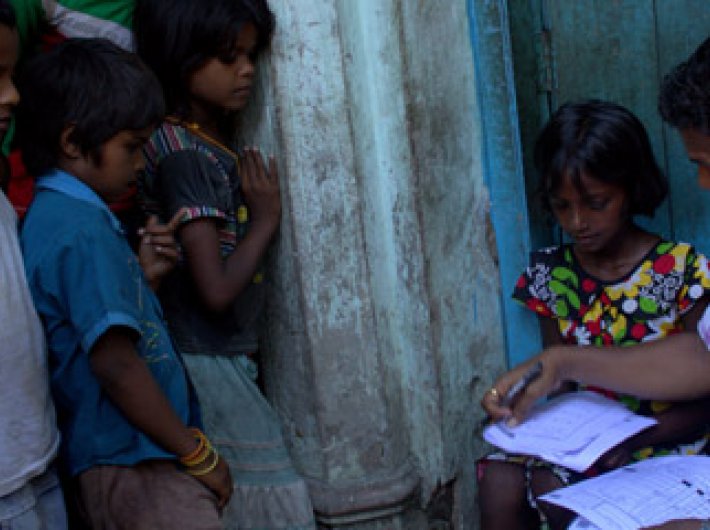


Even as the Right to Education Act is close to completing five years, the quality of learning has declined and remains neglected in rural India, says a report by Pratham, a non-profit organisation.

The tenth annual status of education report (ASER), 2014, says while the elementary education has grown over the last few years, the learning is still in crisis. Only a small improvement is seen in reading and the overall situation with basic reading continues to be disheartening.

The report was released on Tuesday (January 13). The Pratham team covered over 5.6 lakh children from 16,497 villages of 577 rural districts across the country.

In 2014, 48.1% of class 5 children can read class 2 level text. The proportion was 46.8% in 2012 and 47% in 2013.

While Tamil Nadu has shown major gains in reading over last year for class 5; in states like Bihar, Assam, Jharkhand, Chhattisgarh, Madhya Pradesh and Maharashtra, there is visible decline in reading levels over the last 5-6 years.

The ASER report also shows a continuous decline in enrolment of children in government schools while the number is continuously increasing in private schools.

In 2014, 30.8% of all 6-14 year old children in rural India were enrolled in private schools. This was slight improvement from 29% in 2013.

There are five states where private school enrollment rate at the elementary level is more than 50%. These are Manipur (73.3%), Kerala (62.2%), Haryana (54.2%), Uttar Pradesh and Meghalaya (51.7%).

Mathematics learning continues to be a serious problem in rural areas. Except in Tamil Nadu, where an improvement is seen since last year, it is clear that math levels have declined in almost every state over the last 5-8 years. In states of Karnatka and Andhra Pradesh, the situation has been more or less the same.

The ability to read English has also remain unchanged for lower primary grades. Assessment of basic English have been carried out in 2007, 2009, 2012 and 2014. In 2014, only about 25% of children enrolled in class 5 could read simple English sentences, which is virtually unchanged since 2009.

Enrollment

This is the sixth year in a row that enrollment levels are 96% or higher for the 6-14 age group. The proportion of children currently not in school remains at 3.3%.

Enrollment levels are very high for the age group covered by the right to education act (6-14 years) but the proportion of 15-16 year olds not enrolled in school is substantial. Nationally in rural areas 15.9% of boys and 17.3% of girls in this age group are currently out of school. In states like Rajasthan and Uttar Pradesh the proportion of girls who are out of school in the age group 11-14 years is 12.1% and 9.2%.

Other facilities

For the most part, there has been an improvement in other facilities in schools. Since 2010, there has been significant progress in the availability of usable toilets. In 2014, 65.2% of the schools visited had usable toilets whereas the figure was 62.6% in 2013 and 47.2% in 2010.

The percentage of schools equipped with usable separate toilets for girls is 55.7% in 2014. This has gone up from 53.3% in 2010 and 32.9% in 2010. In four states, more than 75% of schools visited had usable girls’ toilets. These states are Gujarat, Kerala, Himachal Pradesh and Haryana.

Comments


Other News

India faces critical shortage of skin donors amid rising burn cases

India reports nearly 70 lakh burn injury cases every year, resulting in approximately 1.4 lakh deaths annually. Experts estimate that up to 50% of these lives could be saved with adequate access to skin donations.   A significant concern is that around 70% of burn victims fall wi

Not just politics, let`s discuss policies too

Why public policy matters Most days, India`s loudest debates stop at the ballot box. We can name every major leader and recall every campaign slogan. Still, far fewer of us can explain why a widow`s pension is delayed or how a government school`s budget is actually approved. That

When algorithms decide and children die

The images have not left me, of dead and wounded children being carried in the arms of the medics and relatives to the ambulances and hospitals. On February 28, at the start of Operation Epic Fury, cruise missiles struck the Shajareh Tayyebeh school – officially named a girls’ school, in Minab,

The economics of representation: Why women in power matter

India’s democracy has grown in scale, but not quite in balance. Women today are active participants in elections, influencing outcomes in ways that were not as visible earlier. Yet their presence in legislative institutions continues to lag behind. The Nari Shakti Vandan Adhiniyam was meant to addres

India will be powerful, not aggressive: Bhaiyyaji

India is poised to emerge as a global power but will remain rooted in its civilisational ethos of non-aggression and harmony, former RSS General Secretary Suresh `Bhaiyyaji` Joshi has said.   He was speaking at the launch of “Rashtrabhav,” a book by Ravindra Sathe

AI: Code, Control, Conquer

India today stands at a critical juncture in the area of artificial intelligence. While the country is among the fastest adopters of AI in the world, it remains heavily reliant on technologies developed elsewhere. This paradox, experts warn, cannot persist if India seeks technological sovereignty.


Archives

Current Issue

Opinion

Facebook Twitter Google Plus Linkedin Subscribe Newsletter

Twitter






