India’s sanitation landscape has undergone a remarkable transformation over the past decade under the Swachh Bharat Mission (SBM). From historically high rates of open defecation to near-universal household toilet access, the country has achieved a public health turnaround of unprecedented scale.
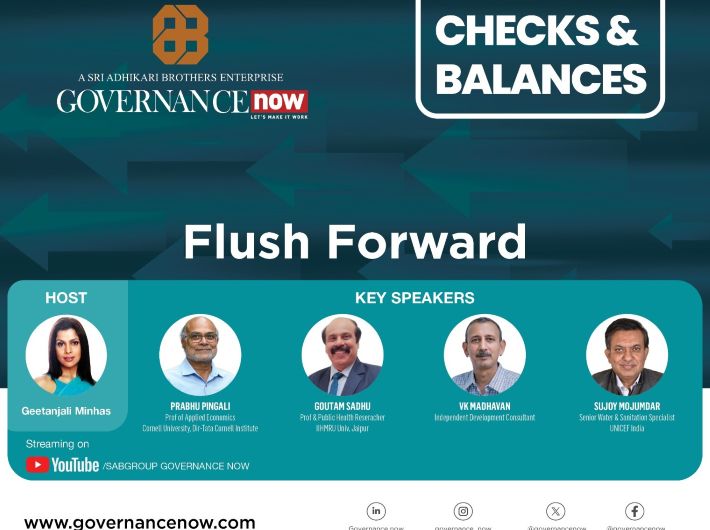
Yet, as experts – VK Madhavan, an independent development consultant, Professor Goutam Sadhu of IIHMR University, Jaipur, Sujoy Mojumdar, Senior Water and Sanitation Expert with UNICEF India, and Professor Prabhu Pingali, Professor of Applied Economics, Cornell University and Director, TCI – note, the journey is far from complete. Sustaining progress requires combining infrastructure, behaviour change, water access, waste management, and governance in a coordinated effort.
Professor Prabhu Pingali emphasises: “For a country the size of India, sanitation cannot be treated as a completed mission; it requires continuous effort, coordination, and reinforcement to secure enduring public health gains.”
In the latest – 25th – episode of ‘Checks and Balances’, Geetanjali Minhas of Governance Now talks with these experts to take stock of the progress on SBM so far and the roadmap ahead.
Rapid Scale of Progress
Between 2014 and 2019, over 100 million rural household toilets were constructed, expanding coverage from roughly 38 percent to more than 95 percent in rural areas. In urban contexts, access to improved sanitation also rose significantly. Madhavan notes, “During the five-year period between 2014 and 2019, more than 40 percent of Indian households gained access to individual household toilets. Given India’s population size, the number of people who gained access in this short period is comparable to the entire population of Brazil.”
Political leadership was pivotal. Professor Pingali observes: “Having the Prime Minister of India come out and say this is a top priority made a big difference that was unprecedented. Chief Ministers in many states took this seriously, allocated funds, and put in place infrastructure for getting this done.”
Behavioural Change and Sustained Usage
Experts emphasise that toilets alone do not guarantee improved public health. Professor Pingali explains: “Our own work shows that if you don’t manage toilet construction along with behaviour change as an integrated part of the intervention, then success is much lower. Behaviour change interventions by NGOs participating in this process have shown big improvements.”
Field evidence from districts like Maharajganj (UP) highlights that when civil society partners with government systems, adoption rates are higher and more durable. Professor Pingali adds: “Where governments have just run this as a standard operational programme without involving civil society groups, success rates have been very isolated.”
Remaining Gaps and Exclusion
Despite dramatic gains, roughly 15–20 percent of households continue to face sanitation challenges. Madhavan states: “The final segment is historically the hardest to reach. Those left behind are likely to be lower-income and socially disadvantaged families who also carry a greater public health burden.”
Self-declared Open Defecation Free status in 2019 highlighted progress but did not guarantee universal coverage. Professor Goutam Sadhu underscores: “Having a toilet does not ensure its use. Sustained adoption depends on water availability, privacy, maintenance, and social acceptance. Deep-rooted cultural norms in some regions still associate toilets near homes with impurity.”
Financial Incentives and Sustainability
Initial SBM incentives enabled mass toilet construction, but these financial supports have not kept pace with inflation. Professor Sadhu highlights: “Microfinance mechanisms, such as low-interest sanitation loans through women’s Self-Help Groups, have helped families repair, upgrade, or construct toilets. The key barrier is often mindset rather than affordability.”
Professor Pingali echoes the need for ongoing support: “Funds were given for construction, but there was very little for maintenance. Many toilets were designed with small pits, so waste management became a big problem. Without proper follow-up, households reverted to open defecation or used toilets for storage.”
Waste Management and Environmental Considerations
While household toilets address open defecation, solid and liquid waste management remains complex. Sujoy Mojumdar notes: “Safe disposal of faecal sludge is critical to avoid environmental contamination. Twin-pit systems allow long-term decomposition, but single pits require proper emptying. Scaling decentralised treatment systems will demand long-term, systematic investment.”
Urban sanitation introduces additional constraints. Professor Pingali adds: “We need a much more comprehensive look at waste management across villages and regions. Providing support for maintenance, recurring visits, and constant monitoring is essential.”
Water Access as a Critical Enabler
Reliable household water supply is essential for toilet usage and maintenance. Professor Sadhu says: “Access to household water significantly influences sanitation outcomes. Women and adolescent girls bear the burden of water collection, and distance to water can discourage consistent use.”
The Jal Jeevan Mission complements sanitation by delivering water directly to households, strengthening toilet usage and hygiene practices.
Monitoring, Technology, and Governance
Robust monitoring systems ensure sustained sanitation outcomes. Professor Pingali notes: “Monitoring should go beyond one-off surveys and include continuous tracking of usage patterns, slippage rates, and behavioural reinforcement through ongoing engagement.”
Emerging technologies, including AI and geo-tagging, offer potential for predictive maintenance, real-time monitoring, and grievance redressal. Yet, experts caution that technology cannot replace community engagement.
Convergence across government programmes remains critical. Professor Pingali states: “Sanitation cannot operate in isolation. Improving child nutrition and health requires integration between sanitation, clean water, maternal health services, immunisation, and child development services.”
Health and Societal Impacts
When adoption is widespread, sanitation improvements translate into measurable public health benefits. Madhavan notes: “If consistent toilet usage continues in villages where infrastructure and behaviour change interventions were integrated, long-term improvements in child health are likely. Sanitation benefits emerge at the community level, not just individual households.”
Children in schools and anganwadis play a key role in reinforcing sanitation habits, cultivating lifelong behavioural change.
India’s sanitation revolution is a historic achievement. Professor Pingali sums it up: “Swachh Bharat Mission was transformative, but toilet construction alone does not guarantee sustained sanitation outcomes. Behaviour change, proper maintenance, waste management, monitoring, and programme convergence are essential.”
Moving forward, experts agree on key priorities: integrating behavioural campaigns with infrastructure, strengthening faecal sludge management, ensuring water access, empowering local institutions, leveraging technology, and maintaining political commitment for securing lasting public health gains for India’s future generations.